
How long does it take to charge an electric car? Most EVs need about 4 to 10 hours for a full charge on a Level 2 home charger, 20 to 40 hours on a standard 120-volt outlet, or roughly 20 to 45 minutes to reach 80% at a compatible DC fast charger. The actual time depends on battery size, starting charge, temperature, charger power and the car’s maximum charging rate.
Those ranges are broad because an electric car does not fill at one constant speed. A powerful station cannot force a vehicle to accept more electricity than its battery system allows, and charging normally slows as the battery approaches full. This guide explains the numbers in practical terms so you can estimate an overnight charge, plan a road-trip stop and choose the right charger.
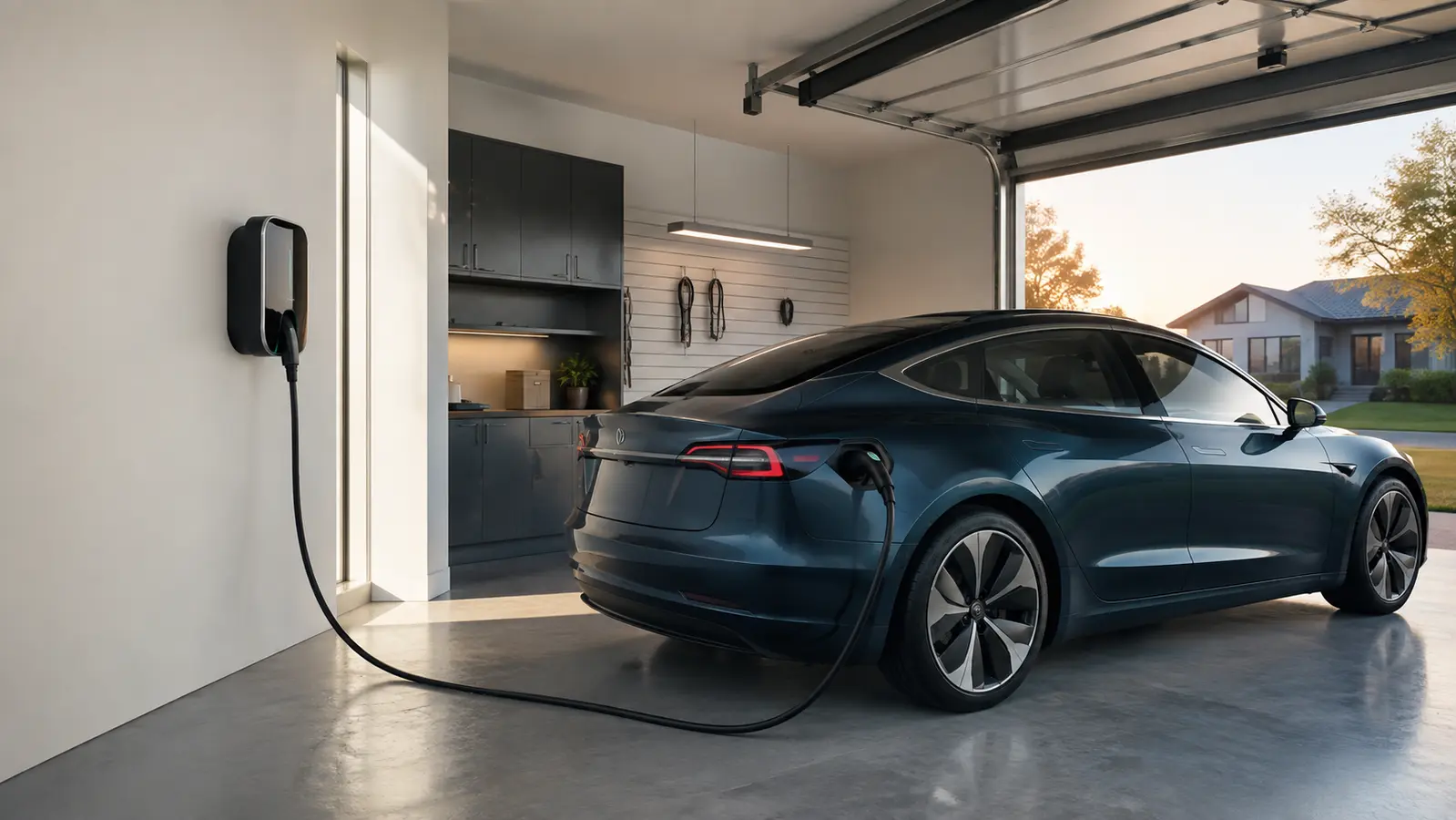
Electric car charging times at a glance
If you are asking how long does it take to charge an electric car, begin with the charging level. Power source is usually the biggest difference between an overnight session and a short travel stop.
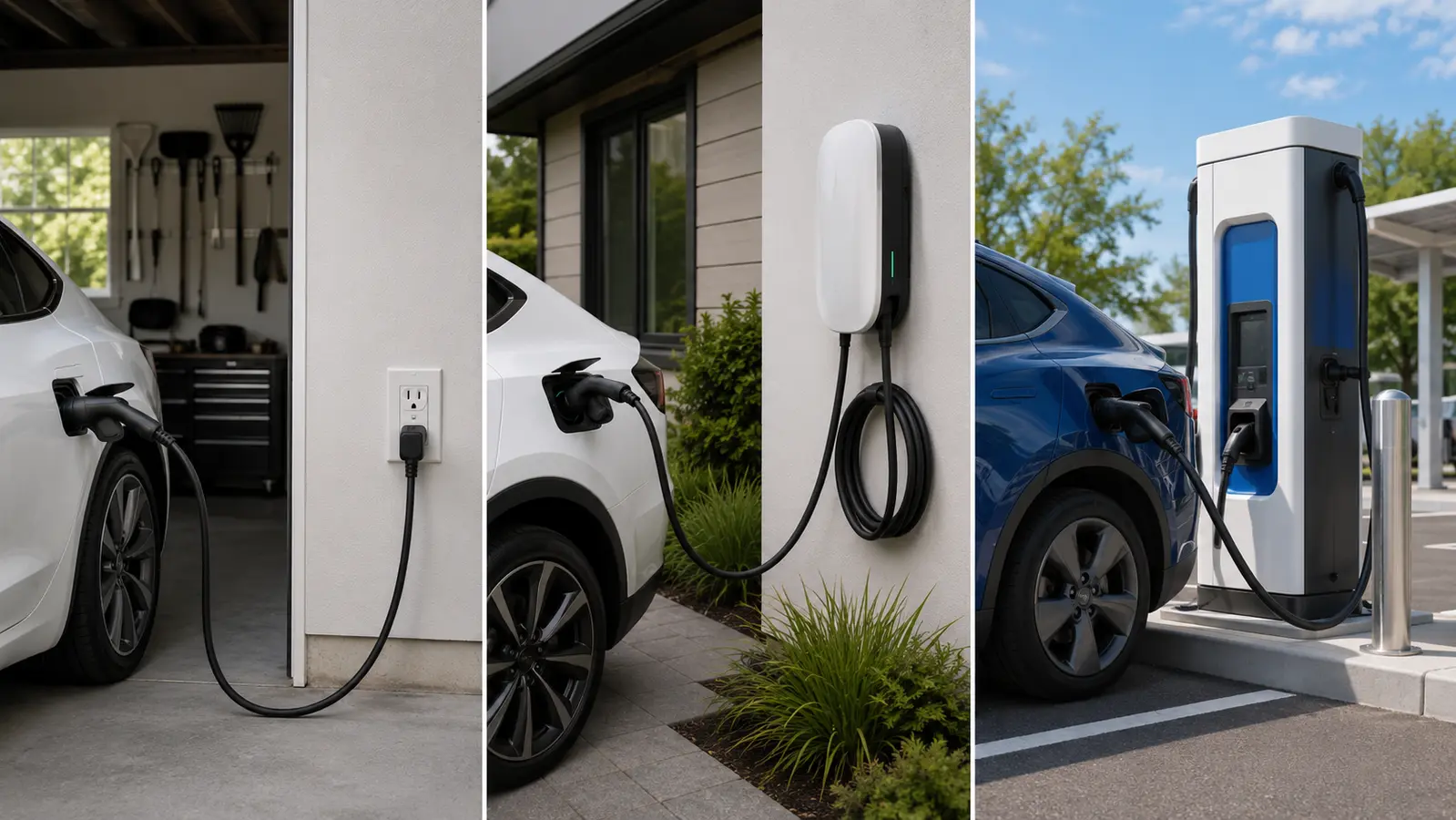
| Charging method | Typical power | Approximate range added | Typical charging time | Best use |
|---|---|---|---|---|
| Level 1 household outlet | 1.3 to 1.9 kW | 2 to 5 miles per hour | 20 to 40+ hours for 0–100% | Low daily mileage and emergency top-ups |
| Level 2 home or public charger | 3.3 to 19.2 kW | 10 to 45 miles per hour | 4 to 10 hours for most EVs | Routine overnight charging |
| DC fast charger | 50 to 350+ kW | About 100 to 250 miles in 20–40 minutes | 20 to 45 minutes for 10–80% | Road trips and quick public charging |
For most owners, Level 2 charging is the practical answer. You plug in after the day’s driving and recover the energy overnight. A DC fast charger is valuable during a long journey, but it is usually unnecessary to wait for 100%. The fastest road-trip strategy is often to arrive with a relatively low state of charge, charge to around 80%, and continue.
How to calculate your electric car charging time
A useful first estimate is:
Charging time = energy needed ÷ effective charging power
Energy needed is not always the vehicle’s full battery capacity. If a 75-kWh battery rises from 20% to 80%, it receives 60% of its capacity:
75 kWh × 0.60 = 45 kWh needed
If the car receives 9.6 kW from a Level 2 charger, the theoretical time is:
45 kWh ÷ 9.6 kW = 4.69 hours
Charging loses some energy as heat and through power conversion. Adding roughly 10% gives a more realistic planning estimate:
4.69 hours × 1.10 = 5.16 hours
This formula works well for AC home charging when the car can accept the charger’s full output. It is less precise for DC fast charging because the rate changes continuously along the charging curve.
Level 1 charging: how long does a standard outlet take?
Level 1 charging uses a normal 120-volt household outlet in the United States. It commonly delivers around 1.3 to 1.9 kW, adding approximately 2 to 5 miles of driving range per hour. A large battery may need more than a full day to move from nearly empty to full.
With Level 1, the answer to how long does it take to charge an electric car is commonly 20 to 40 hours for a near-empty battery, although daily top-ups take much less time.
It can still be sufficient if you drive modest distances. A car connected for 12 hours might recover roughly 24 to 60 miles of range. That can replace an ordinary commute without buying a dedicated charger. Level 1 also gives owners a backup when traveling somewhere without EV equipment.
Use a properly grounded outlet in good condition and follow the vehicle manufacturer’s instructions. Extension cords, damaged receptacles and circuits shared with heavy appliances can create heat or reliability problems. Have an electrician assess an outlet if it becomes warm, trips the breaker or shows wear.
Level 2 charging: the best option for most homes
A Level 2 electric car charger uses 240-volt power and typically supplies between 3.3 and 19.2 kW. Many home installations operate around 7.2, 9.6 or 11.5 kW. Most electric cars can therefore complete a substantial overnight charge in about 4 to 10 hours.
At home, how long does it take to charge an electric car is therefore often answered as one night, but the calculation should use the energy actually consumed rather than the entire battery.
Two limits matter. First, the electrical circuit determines what the charging equipment can deliver. Second, the vehicle’s onboard charger determines what it can receive as AC power. Connecting a car that accepts 7.2 kW to an 11.5-kW wall unit will not make it charge at 11.5 kW.
A Level 2 installation is particularly useful when two drivers share an EV, daily mileage is high, winter reduces efficiency or the vehicle has a large battery. Smart scheduling can also move charging to lower-cost utility hours where time-of-use pricing is available.
DC fast charging: why 10–80% matters
DC fast charging bypasses the car’s onboard AC charger and supplies direct current to the battery. Compatible vehicles may briefly accept 50, 150, 250 or more than 300 kW. Under favorable conditions, many recent EVs can move from 10% to 80% in roughly 20 to 45 minutes.
On a highway trip, how long does it take to charge an electric car usually refers to this 10–80% window rather than a complete 0–100% session.
The advertised peak is not the session average. A battery management system changes the rate to protect the cells. Charging can be strong at a low to moderate state of charge and then taper significantly, especially above 80%. A station marked 350 kW also does not guarantee that rate; the car may accept less, the charger may share power, or temperature may restrict the session.
This is why manufacturers usually publish a 10–80% time instead of a 0–100% time. The last 20% can take disproportionately long. On a road trip, two shorter stops can sometimes be faster than one session that continues to 100%.
What determines how long an electric car takes to charge?
The most accurate response to how long does it take to charge an electric car depends on the following interacting factors.
Battery capacity
A larger battery stores more energy. If two cars receive the same 7.2-kW power, a 100-kWh pack generally takes longer to fill than a 50-kWh pack. Usable capacity can differ from the headline or gross capacity because manufacturers reserve a protective buffer.
Starting and target charge
A daily 40–80% top-up needs far less energy than a 5–100% session. Compare estimates using the same starting and ending percentages. Mixing a full-charge time with a 10–80% fast-charge claim creates a misleading comparison.
The vehicle’s maximum AC and DC rates
Every EV has charging limits. AC charging depends on its onboard charger, while DC charging depends on the battery, voltage architecture, thermal system and software. A higher-powered station helps only when the vehicle can use the additional power.
Battery temperature and preconditioning
Lithium-ion batteries charge best within a suitable temperature range. Cold batteries may accept power slowly, while extreme heat can also cause the system to reduce the rate. Many EVs can precondition the battery while navigating to a fast charger. Using the car’s built-in route planner may activate this automatically.
The charging curve
DC charging is a curve, not a fixed number. Peak power may appear for only part of a session. A vehicle with a lower peak but a stable curve can sometimes finish 10–80% sooner than one that briefly displays a larger peak.
Weather, accessories and battery age
Heating or cooling the cabin while connected can use some incoming power. Battery condition, charger congestion, cable temperature and software limits can also affect the result. These differences explain why a real session may not match a simple calculation exactly.
Realistic charging examples
These examples show why how long does it take to charge an electric car has no single number for every battery and charging source.
| Situation | Energy needed | Charging source | Planning estimate |
|---|---|---|---|
| Small EV, 20–80% | 30 kWh | 7.2-kW Level 2 | About 4.6 hours including losses |
| Midsize EV, 20–80% | 45 kWh | 9.6-kW Level 2 | About 5.2 hours including losses |
| Large EV, 10–90% | 80 kWh | 11.5-kW Level 2 | About 7.7 hours including losses |
| Typical road-trip stop | 10–80% | Compatible DC fast charger | Approximately 20–45 minutes |
These examples are planning tools, not guarantees. Check the vehicle manual or manufacturer charging specifications for its usable battery capacity, onboard charger rating and tested DC charging time.
How long should you charge an EV at home?
You rarely need to calculate a complete 0–100% session. Suppose an EV averages 3.5 miles per kWh and you drive 35 miles. The drive consumes approximately:
35 miles ÷ 3.5 miles per kWh = 10 kWh
Replacing 10 kWh with a 7.2-kW charger theoretically requires:
10 kWh ÷ 7.2 kW = 1.39 hours
After allowing for losses, roughly 1.5 hours may replace that day’s energy. The car can remain connected longer because it stops or manages power when it reaches the selected limit. Many owners set a routine target recommended by their manufacturer and reserve 100% for trips that require the extra range.
How to reduce electric car charging time
- Use a properly installed Level 2 charger for routine home charging.
- Match the circuit and equipment to the vehicle’s maximum AC capability.
- Navigate to a DC fast charger using the car’s route planner when battery preconditioning is supported.
- Arrive at a fast charger with a relatively low state of charge when practical.
- Plan road-trip sessions around 10–80% instead of waiting for 100%.
- Select a station the vehicle can use; an unnecessarily powerful unit will not overcome the car’s limit.
- Keep the charging port and connector clean and report damaged equipment.
- Charge during moderate conditions or while the battery is already warm from driving.
Home charging versus public charging
Home charging is normally slower but more convenient. The vehicle can recover energy during hours when it would otherwise be parked. Public Level 2 charging works well at offices, hotels and destinations where you will stay for several hours. DC fast charging is designed for time-sensitive travel.
The fastest option is not automatically the best for every session. Home charging can be less expensive and places less demand on your schedule. Frequent fast charging is supported by modern EVs, but owners should follow manufacturer guidance concerning charge limits and battery care.
Common charging-time mistakes to avoid
The most common mistake is comparing unlike measurements. One manufacturer may publish a 10–80% DC time while another page describes a 0–100% Level 2 session. The smaller percentage window and faster power source naturally produce a much shorter number. Always check the starting percentage, target percentage, charger power and test conditions before comparing two vehicles.
Another mistake is treating the station’s advertised power as the power the battery receives. If a station offers 350 kW but the car can accept a maximum of 170 kW, the vehicle remains the limiting factor. Even that 170-kW peak may last for only part of the session. Average power across the full charging window gives a more useful picture than peak power alone.
Drivers also overestimate how often they will need a complete charge. An EV that begins the evening at 55% does not require the time quoted for an empty battery. Calculate only the energy needed to reach your target. Finally, avoid planning a time-sensitive trip around a single charger. Availability, queues or reduced station output can extend the stop, so identify a backup location when the route has limited infrastructure.
How to choose the right charging setup
Start with daily mileage, parking time and the vehicle’s AC charging limit. Level 1 may cover a short commute when the car remains connected overnight. Level 2 is a better long-term choice for most battery-electric vehicles because it can restore more range within off-peak hours. Ask a qualified electrician to evaluate service capacity, circuit size, local code requirements and the installation location.
For public charging, choose a network and station that supports the vehicle’s connector and useful charging rate. A reliable 150-kW charger may be a better choice than a distant 350-kW unit when the car cannot exploit the extra output. Good charging decisions balance speed, convenience, cost and the range needed to reach the next destination.
Frequently asked questions
The questions below address the most common variations of how long does it take to charge an electric car for home and public charging.
Can an electric car charge in 20 minutes?
Some compatible EVs can gain a substantial charge in about 20 minutes at a powerful DC fast charger, usually measured from approximately 10% to 80%. It does not mean every car can charge from empty to full in 20 minutes.
How long does it take to charge an electric car at home?
A Level 2 home charger commonly takes 4 to 10 hours for a large charge. A normal 120-volt outlet may take 20 to 40 hours or longer for a full battery, although it can replace a short daily commute overnight.
How long does it take to charge an electric car at a charging station?
A public Level 2 station may add 10 to 45 miles of range per hour. A compatible DC fast charger can often provide a 10–80% charge in around 20 to 45 minutes.
Does a 350-kW charger always charge faster?
No. Charging power is limited by the vehicle, battery temperature, state of charge and station conditions. A car with a 150-kW maximum will not accept 350 kW simply because the station can deliver it.
Why does EV charging slow down after 80%?
The battery management system reduces power at a high state of charge to control heat and protect the cells. This taper makes the final portion slower than the middle of the session.
Is Level 1 charging enough for daily driving?
It can be enough when daily mileage is low and the car remains connected for many hours. Drivers with longer commutes, large batteries or limited charging time will usually benefit from Level 2 equipment.
Should I charge my electric car to 100% every night?
Follow the vehicle manufacturer’s recommendation. Many owners use a lower routine limit and charge to 100% shortly before a long trip. Battery chemistry and manufacturer guidance differ, so one rule does not fit every model.
How long does it take to charge an electric car from empty?
From nearly empty, a typical EV may need 20 to 40+ hours on Level 1 or approximately 4 to 10 hours on Level 2. A DC fast charger is normally measured to 80% rather than completely full.
How long does it take to charge an electric car with Level 1?
A full Level 1 session commonly takes 20 to 40 hours, while an overnight connection may add enough energy for a short commute.
How long does it take to charge an electric car with Level 2?
Most electric cars need about 4 to 10 hours for a large Level 2 charge. The precise result depends on battery capacity and the lower of the station’s output and the car’s AC limit.
How long does it take to charge an electric car with DC fast charging?
A compatible EV commonly needs around 20 to 45 minutes to move from 10% to 80%. Cold weather, a warm battery, station power and the charging curve can change the time.
How long does it take to charge an electric car to 80%?
At a suitable DC station, many modern EVs can reach 80% from a low starting charge in 20 to 45 minutes. Level 2 charging to the same target usually takes several hours.
How long does it take to charge an electric car overnight?
An overnight period of eight to twelve hours is sufficient for most Level 2 sessions and can recover a useful amount of range even with Level 1 charging.
How long does it take to charge an electric car in cold weather?
Cold conditions can extend the session because the battery may initially limit power. Preconditioning before DC charging can reduce the delay when the vehicle supports it.
How long does it take to charge an electric car for 100 miles?
An efficient EV may need roughly 25 to 35 kWh for 100 miles. That can equal about 3 to 5 hours on a 7.2-kW Level 2 charger after allowing for losses, or a much shorter compatible DC session.
How long does it take to charge an electric car at a hotel?
Hotels commonly provide Level 2 charging. Several hours or an overnight stay can therefore restore a substantial portion of the battery, depending on station and vehicle limits.
How long does it take to charge an electric car on a road trip?
Plan approximately 20 to 45 minutes for a typical 10–80% fast-charge stop, plus possible time for locating, accessing or waiting for a charger.
The bottom line
How long it takes to charge an electric car depends mainly on the energy required and the lowest power limit among the charger, circuit and vehicle. Expect roughly 20 to 40+ hours on Level 1, 4 to 10 hours on Level 2, or 20 to 45 minutes for a typical 10–80% DC fast-charge session.
For everyday ownership, think about energy replacement rather than repeatedly charging an empty battery. A Level 2 charger can normally restore a day’s driving well before morning, while fast charging supports longer journeys. Tesla owners can also read our detailed guide to how long it takes to charge a Tesla. If you are comparing long-term ownership expenses, see our guide to electric car battery replacement cost.
For additional charging fundamentals and connector guidance, consult the U.S. Department of Energy Alternative Fuels Data Center.
Charging specifications vary by model, software version and conditions. Confirm electrical work with a qualified electrician and consult your vehicle manufacturer for model-specific limits.