
Owning an electric car without a private garage is possible, but it requires a charging plan that works with your parking arrangement, commute and landlord. This guide explains the realistic options for apartment EV charging, how to ask for permission, who usually pays and how to avoid relying on an unreliable public charger.
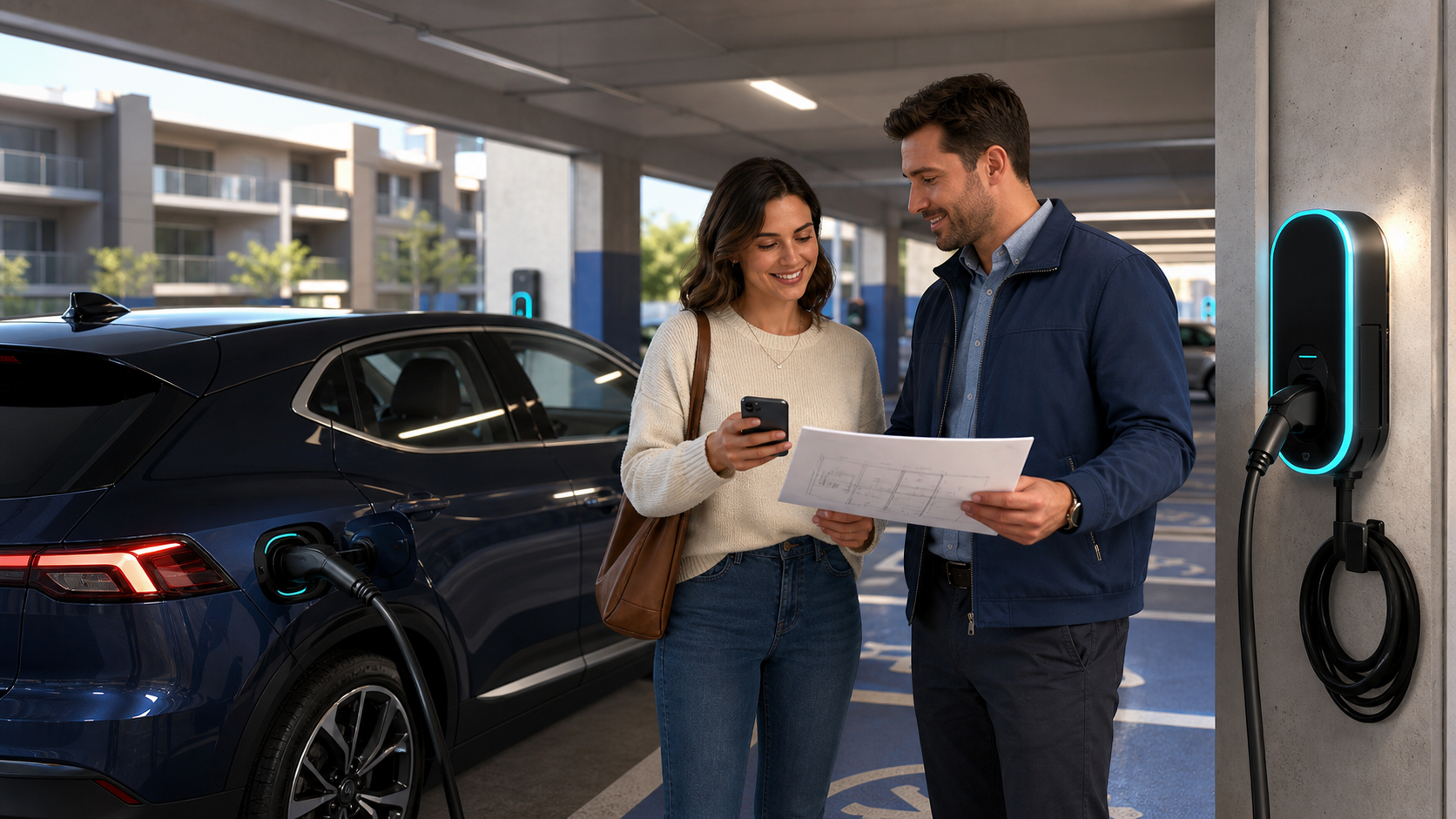
Quick answer
The best solution is usually a dedicated Level 2 charger or smart outlet tied to the resident’s meter. When that is not available, workplace charging, dependable public stations and occasional DC fast charging can form a workable backup plan. Renters should get written approval before installing or regularly using any outlet.
Apartment EV charging options compared
| Option | Typical use | Main advantage | Main drawback |
|---|---|---|---|
| Existing 120-volt outlet | Light daily driving | Low setup cost | Slow and must be inspected |
| Dedicated Level 2 charger | Regular commuters | Convenient overnight charging | Electrical work and approval |
| Shared smart chargers | Multi-unit parking | Billing and access control | Management must participate |
| Workplace charging | Cars parked at work | Replaces home charging | Depends on employer access |
| Public Level 2 or DC charging | Backup or occasional use | No property installation | Higher cost and less convenience |
Start with your real weekly energy need
Do not assume you need a high-power charger. Divide weekly miles by the vehicle’s efficiency in miles per kilowatt-hour. A driver covering 175 miles in a 3.5 mi/kWh EV needs roughly 50 kWh per week before charging losses. That demand might be covered by several overnight Level 1 sessions, two workplace sessions or one or two Level 2 sessions.
Ask the landlord with a complete proposal
A vague request is easy to reject. Send a short written proposal that identifies the parking space, desired equipment, licensed electrician, billing method, insurance responsibility and what happens when the lease ends. Offer two choices: a dedicated circuit for your space or a shared networked charger that can serve future residents.
Sample landlord request
I would like permission to obtain a licensed electrical assessment for EV charging at my assigned parking space. I will not install or use equipment without written approval. The proposal will explain permits, metering, equipment ownership, insurance and restoration at move-out. A networked charger could also provide a billable amenity for future tenants.
Never assume an outlet is safe
A receptacle that powers a light tool may not be suitable for hours of continuous EV charging. An electrician should inspect the circuit, breaker, wiring, grounding and receptacle condition. Avoid extension cords, household adapters and improvised cable routes across sidewalks. The U.S. Department of Energy’s Alternative Fuels Data Center recommends qualified electrical installation and code compliance.
How apartment billing can work
- Resident meter: the cleanest option when a dedicated circuit can connect to your unit.
- Networked charger: identifies users and bills energy or session fees through an app.
- Flat monthly fee: simple, but it can overcharge light users and undercharge heavy users.
- Submeter: records charger consumption separately for reimbursement.
If installation is denied
Build a charging map before deciding the EV will work. Check stations near home, work, groceries and regular destinations at the times you would actually use them. Read recent reliability notes, identify a backup station and compare per-kWh, per-minute, parking and idle fees. A charger that is technically nearby but routinely blocked or broken is not a dependable plan.
Some jurisdictions have “right to charge” rules for tenants or condominium residents, but requirements and cost responsibilities vary. Check current state and local rules rather than relying on a national summary.
Choosing an EV for apartment living
Prioritize efficiency, dependable nearby fast charging and enough real-world range to cover several normal days. Faster AC charging is useful when destination chargers have time limits. A large battery is not automatically better: it costs more and takes longer to refill, while an efficient EV can add more miles from the same outlet.
Apartment EV charging checklist
- Calculate weekly miles and energy use.
- Confirm whether parking is assigned.
- Identify the electrical panel and billing path.
- Request written permission before using an outlet.
- Use a licensed electrician and permitted equipment.
- Price installation, network and parking fees.
- Keep two reliable public backup locations.
- Put equipment ownership and move-out terms in writing.
Frequently asked questions
Can I charge an EV from an apartment outlet?
Only with property approval and after the circuit and receptacle are confirmed suitable for continuous charging.
Who pays for an apartment EV charger?
It depends on the lease and project. A resident may fund a dedicated installation, while an owner may invest in shared chargers as a property amenity.
Can you own an EV with no home charging?
Yes, when workplace or nearby public charging is reliable, affordable and convenient enough for your driving pattern. Test that routine before buying.
For charger speeds and installation choices, compare our Level 1 vs Level 2 charger guide. Apartment EV charging becomes easier when the property plans for safe access, fair billing and future demand.
Bottom line
Apartment EV charging works best when it is treated as a small infrastructure project rather than an informal extension-cord solution. Calculate demand, present a safe billing plan and maintain a public backup. That approach gives the landlord fewer reasons to object and gives you a charging routine you can actually live with.
Apartment EV Charging Approval Checklist
Successful apartment EV charging starts with written approval. A renter should not buy equipment, alter wiring or reserve an electrician until the property owner or manager confirms what is allowed. Begin with a short proposal that identifies the parking space, vehicle, expected annual mileage, preferred charging level and a licensed electrician. Ask whether the building already has an electrical plan, approved contractor, utility program or resident charging policy.
Photograph the parking position and the nearest electrical room without opening panels. Measure the walking route a cable would take and note fire doors, accessible routes, drainage areas and spaces used by other residents. A charging cable must never cross a public walkway or run through a window. The safest design uses permanently installed equipment and cable management approved for the location.
- Get the owner or association’s permission in writing.
- Confirm who pays for design, permits, equipment, installation, electricity and future removal.
- Require a load calculation by a qualified electrician.
- Use listed equipment that matches the voltage, current and outdoor rating.
- Define access control, billing and responsibility for damage.
- Record what happens when the renter moves or changes parking spaces.
Level 1 or Level 2 for an Apartment?
Level 1 can be practical when daily driving is modest and a dedicated receptacle is already available. It adds range slowly, but overnight charging may replace an ordinary commute. The receptacle and circuit still need professional evaluation because continuous EV charging places a long-duration load on the wiring. A general-purpose outlet shared with lighting, tools or garage equipment may trip or overheat.
Level 2 is faster and often easier to manage among several residents. It normally requires a dedicated circuit, suitable panel capacity and permitted installation. Networked Level 2 stations can authenticate users, measure energy and set power limits. For a building planning multiple ports, managed apartment EV charging can distribute available capacity rather than sizing the electrical service for every car to charge at maximum power simultaneously.
| Option | Best fit | Main limitation |
|---|---|---|
| Existing Level 1 outlet | Low daily mileage and assigned parking | Slow charging and circuit must be verified |
| Dedicated Level 2 station | One renter with long-term assigned space | Higher installation cost |
| Shared networked stations | Several residents or rotating spaces | Requires access and billing rules |
| Nearby public charging | Building cannot install equipment yet | More time, variability and usually higher energy cost |
How Apartment Charging Costs Are Divided
The charger price is only one part of the project. The long conduit route, trenching, panel upgrade, transformer work, engineering and permits can cost more than the equipment. Ask for an itemized estimate separating design, hardware, labor, networking, recurring software fees and restoration of walls or pavement. A quote should state the maximum circuit size and the charging power the vehicle can actually receive.
Common payment arrangements include resident-funded installation, owner-funded infrastructure with resident electricity fees, or a shared network operated by a charging provider. Whatever model is chosen, the lease addendum should explain electricity pricing, idle fees, guest use, repairs and refunds. If the renter pays for permanent electrical improvements, clarify whether any cost is reimbursed when the tenancy ends.
Utility Capacity and Load Management
An electrician evaluates the existing service, panels, feeder routes and measured or calculated building demand. A spare breaker position does not prove that capacity is available. Where full-power charging would exceed the service, an energy-management system may reduce charging current during building peaks. This approach can make apartment EV charging possible without an immediate major service upgrade, subject to local codes and utility approval.
Ask the utility about rebates, time-of-use rates and make-ready programs before construction. Some incentives require preapproval, specific equipment or installation by an approved contractor. Never purchase a charger solely because it appears on a rebate list; the electrician must still confirm compatibility with the building and vehicle.
Shared Charging Rules That Prevent Conflict
A shared station works best with transparent rules. Residents need to know how long a vehicle may remain after charging, whether reservations are supported and how faults are reported. Post a contact number and station identifier. Use app notifications and idle fees carefully: they can improve turnover, but residents with mobility limitations or overnight charging may need reasonable accommodations.
- Reserve charging spaces for vehicles that are actively charging.
- Set a reasonable grace period after completion.
- Publish the energy price and every additional fee.
- Provide a process for reporting blocked or damaged equipment.
- Keep accessible spaces and routes compliant with applicable requirements.
- Review utilization before purchasing more stations.
What Renters Should Never Do
Do not use an extension cord, household splitter, travel adapter or unapproved cable across a sidewalk. Do not increase a breaker size to stop nuisance trips. Never install equipment in a common area without permission, and do not assume a dryer outlet is suitable merely because the plug fits an adapter. Heat damage, loose contacts and incorrect grounding can create serious hazards.
If the vehicle or charger repeatedly reports a fault, stop and ask the equipment provider or electrician to diagnose it. Apartment EV charging should be treated as permanent electrical infrastructure, not an improvised appliance connection.
Backup Plan When Installation Is Delayed
Map reliable charging near work, shopping and regular destinations. Compare price, parking limits, connector compatibility and overnight access. A weekly fast-charge session may work for a low-mileage driver, but frequent public charging requires more planning than plugging in at home. Keep at least two networks available and avoid routinely arriving with an extremely low battery.
Before signing a lease, ask whether EV charging is operational today rather than merely “planned.” Visit the parking area, confirm the number of working ports and check whether gasoline vehicles commonly block them. A realistic backup makes the transition manageable while the building studies a permanent solution.
Apartment EV Charging FAQs
Can a landlord charge separately for electricity?
Rules differ by location and billing arrangement. The lease or charging agreement should explain whether the fee is based on measured energy, time, a flat monthly amount or a network tariff. Review local utility and tenancy requirements before accepting the plan.
Can several chargers share one electrical limit?
Yes, compatible networked or energy-managed equipment can allocate current among multiple vehicles. The design must be approved for the site and installed by qualified professionals.
Is a portable charger enough for apartment EV charging?
Only when it is connected to a properly evaluated outlet in an approved location and used according to the vehicle and equipment instructions. Portable does not mean that any receptacle or extension cord is safe.
What should happen to the charger when a renter moves?
The written agreement should decide whether equipment stays, is removed by a licensed electrician or transfers to another resident. It should also assign the cost of restoring surfaces and updating network access.
For charging-speed differences, compare Level 1 and Level 2 charging. Renters can also estimate ongoing energy expense with the guide to the cost of charging an electric car at home.
Final Apartment EV Charging Decision
Choose apartment EV charging only after the owner, electrician and utility requirements align. A safe apartment EV charging plan identifies the circuit, equipment, payment method and removal responsibility in writing. If permanent apartment EV charging is not yet feasible, combine workplace and public stations while the property evaluates managed infrastructure. The best apartment EV charging arrangement is convenient for the renter without creating electrical, accessibility or billing problems for the wider building.