
Electric car charging etiquette works best when public charging is shared fairly. Public charging works best when every driver treats the charger as shared infrastructure. Good EV charging etiquette is not complicated: use the right charger, take only the energy you need, and move your car promptly.
12 rules for courteous public charging
- Use DC fast charging only when it saves meaningful time. If you are staying for hours, a Level 2 charger leaves the faster equipment available for travelers.
- Move your car when charging ends. Turn on app notifications and return before the session finishes.
- Do not charge to 100% at a busy fast charger. Charging normally slows sharply above about 80%, so continuing can hold up the queue.
- Respect the queue. Ask who is waiting and note arrival order. Some networks also show a virtual queue.
- Never unplug a car that is actively charging. Only disconnect another vehicle if the station explicitly permits it and the session is clearly complete.
- Leave accessible bays for drivers who need them. An accessible charging bay is not simply an empty EV space.
- Park within the lines. Position the charge port close enough that the cable does not cross a walkway.
- Return the connector neatly. Seat it in the holster and keep the cable off the ground.
- Report broken equipment. Use the network app or the number on the charger and include the station ID.
- Do not block a charger without charging. EV-designated spaces are fueling spaces, not preferred parking.
- Keep noise and headlights considerate. This matters at chargers near homes and hotels.
- Help without lecturing. New drivers may need a quick explanation of the connector or app.
How long should you stay?
| Situation | Good practice |
|---|---|
| Road-trip DC fast charge | Leave when you have enough range for the next stop plus a safety buffer |
| Busy urban fast charger | Aim for about 80% unless the next leg requires more |
| Workplace Level 2 | Move at the time set by workplace policy |
| Hotel or overnight Level 2 | Follow posted overnight rules and move early if requested |
What if another driver is charging badly?
Start with a polite conversation. If a vehicle is blocking a charger, contact the site host or charging network instead of touching the vehicle. For damaged hardware, stop the session and report it; never use a connector with exposed wiring or obvious heat damage.
Before leaving home
- Install the network app and add a payment method.
- Check live availability and recent driver reports.
- Know your connector type.
- Plan a backup station.
- Set a charge-complete alert.
Charging etiquette reduces queues and makes every station more reliable. For charging-time estimates, see how long it takes to charge an electric car.
Frequently asked questions
Is it rude to charge beyond 80%?
At a busy fast charger, it can be. If you need more energy to reach the next reliable stop, continuing is reasonable; otherwise, moving frees the charger sooner.
Can I leave my EV parked after charging?
Only when the site rules allow it. Many networks charge idle fees, and another driver may need the space.
Why Electric Car Charging Etiquette Matters
Electric car charging etiquette protects access to equipment that many drivers must share. A gasoline pump normally serves a vehicle for only a few minutes, while an EV can occupy a charging space for much longer. Clear behavior reduces queues, prevents cable damage and helps new drivers understand what other people reasonably expect.
Courtesy does not mean every driver must leave at exactly 80 percent. A person crossing a remote area may need more energy, and a driver with limited mobility may require additional time. Good etiquette combines efficient use with awareness of the location, posted rules and the needs of other users.
Choose the Right Charger for the Job
Use the slowest practical option that still meets your trip. A car parked for an eight-hour workday usually does not need a scarce high-power DC charger. Conversely, a traveler who must continue a highway journey benefits from equipment designed for short stops. Matching the charging level to the purpose improves availability for everyone.
- Level 1: useful for long parking periods and low daily mileage where approved outlets exist.
- Level 2: appropriate for workplaces, hotels, shopping areas and overnight charging.
- DC fast charging: best for road trips, urgent range recovery and drivers without dependable home charging.
A vehicle may also charge more slowly than the station’s advertised maximum. Do not occupy a premium high-power stall when an adjacent lower-power connector can deliver the same speed to your car, especially when faster vehicles are waiting.
Understand the Charging Curve
Fast-charging power usually falls as the battery fills. Temperature, battery preconditioning and vehicle design also affect the rate. A session that climbs quickly from 15 to 60 percent may slow dramatically above 80 percent. Watch the car’s estimated completion time and the station’s power display rather than assuming the advertised peak will continue.
Good electric car charging etiquette means leaving when you have enough energy for the next safe stop plus a sensible reserve. If the next reliable charger is far away, continuing beyond 80 percent can be justified. If several alternatives are close and drivers are waiting, ending earlier is considerate and often faster for your own trip.
Queueing at a Busy Charging Site
Charging sites do not always have a formal line. When you arrive, look for cars parked nearby with drivers inside, ask who is waiting and note the order. Some networks use app-based queues; follow the system shown at the station. Do not claim two possible stalls by blocking the aisle or parking across spaces.
- Identify working connectors compatible with your car.
- Ask waiting drivers which stall they expect to use.
- Remain close enough to respond when your turn arrives.
- Move into the space only after the previous car has cleared it.
- Confirm the session starts before leaving the vehicle.
If a charger fails, rejoin the queue fairly rather than assuming priority over everyone. Calm communication normally solves the problem faster than confrontation.
When Is It Acceptable to Unplug Another Vehicle?
Never disconnect a vehicle that is actively charging. Some cars lock the connector, and pulling or forcing it can damage equipment. Even after a session ends, unplugging another vehicle is appropriate only when the site rules permit it and the driver has clearly indicated consent, such as through a dashboard note or a shared-charging policy.
For a blocked or abandoned station, contact the network or property host. Do not touch another vehicle, open its charge door or attempt to move it. Document the charger number and report the situation through the official channel.
Idle Fees, Grace Periods and Moving Promptly
Turn on charging notifications before walking away. Return a few minutes before the expected finish so you can move when charging stops. An idle fee is a financial signal, but avoiding the fee is not the only reason to move; another driver may need the charger even when the network does not impose a charge.
At hotels and overnight locations, posted rules may allow a vehicle to remain connected until morning. Follow those rules rather than applying highway-station expectations. If overnight demand is high, ask the front desk whether vehicles should rotate and leave contact information when appropriate.
Accessible Charging Spaces
An accessible charging bay is not simply an extra EV parking space. Preserve the access aisle and charging route for people who need them. Never stretch a cable across the marked aisle, curb ramp or walkway. If all other stalls are unavailable, local rules and site signage determine whether temporary use is allowed; do not assume.
Drivers should also recognize that a person may need more time to handle a heavy cable, operate an app or move the vehicle. Respectful electric car charging etiquette allows reasonable time and avoids confrontational assumptions about disabilities that may not be visible.
Cable and Connector Care
- Inspect the connector for cracks, exposed conductors, contamination or excessive heat.
- Keep the cable out of traffic lanes and pedestrian routes.
- Do not twist, drop or drive over the cable.
- Return the connector completely to its holster.
- Report damaged hardware with the station identification number.
- Stop using equipment that smells burned, sparks or shows exposed wiring.
In rain or snow, follow the vehicle and charger instructions. Proper charging equipment is designed for outdoor operation, but standing water, collision damage and visibly compromised cables require caution. Do not improvise repairs.
Charging Etiquette at Apartments and Workplaces
Shared residential and workplace chargers need written rules because the same drivers use them repeatedly. Follow reservation times, access controls and any requirement to move after a set number of hours. Do not leave a car in the space for the entire day after the battery finishes.
If charging is included as an employee or tenant benefit, that does not create unlimited personal ownership of a stall. Report recurring congestion to the administrator so the organization can adjust time limits, install load-managed ports or create a rotation system.
Road-Trip Electric Car Charging Etiquette
Prepare before arriving. Install required network apps, add a payment method and know the connector location on the car. Back into or approach the space in the intended direction so the cable reaches without tension. If payment or authentication fails, contact support or move aside when possible while troubleshooting.
When towing or traveling in severe weather, you may need a larger reserve. Explain briefly to waiting drivers if a longer session is necessary. Planning an alternative station prevents one fault from becoming an emergency and reduces pressure to remain at a crowded charger until 100 percent.
How to Handle a Broken or Blocked Charger
First confirm the stall number and read the screen. Try only the normal restart steps provided by the network. If the unit remains unavailable, report it in the app or call the number on the station. Include the error message, connector type and time. Accurate reports help the network repair equipment and warn other drivers.
For a gasoline vehicle or non-charging EV blocking the stall, contact site staff. Avoid arguments and never retaliate by blocking the vehicle. Photos should be used only for a legitimate report and handled according to local privacy rules.
Charging Etiquette Checklist
| Before charging | During charging | Before leaving |
|---|---|---|
| Check connector and live status | Monitor progress and notifications | End the session properly |
| Join the queue fairly | Take only the energy reasonably needed | Return the connector to its holster |
| Park within the marked bay | Keep accessible routes clear | Move the vehicle promptly |
| Confirm charging started | Stay reachable at shared sites | Report damage or faults |
Electric Car Charging Etiquette FAQs
Must I stop charging at 80 percent?
No universal rule requires it. At a crowded fast charger, leaving near 80 percent is often efficient because charging slows. Continue when the next safe leg genuinely requires more energy.
Can I park in an EV space without plugging in?
Usually no. Charging spaces are intended for active charging, subject to posted parking rules. An EV that is not charging can block access just like a gasoline vehicle.
Should I leave a note with my phone number?
Only if you are comfortable and the site culture supports it. Network notifications or a dashboard charging disk can communicate availability without publicly displaying personal information.
What if someone is rude at a charging station?
Stay calm, avoid touching either vehicle and involve the property host or charging network when necessary. Safety matters more than winning an argument about queue position.
Does electric car charging etiquette differ by country?
Local parking laws, connector standards, payment systems and accessibility rules vary. Posted site rules always take priority over informal customs.
Learn why charging speed changes in the guide to why EV fast charging slows after 80 percent, and prepare longer journeys with the EV road-trip planning checklist.
Put Electric Car Charging Etiquette Into Practice
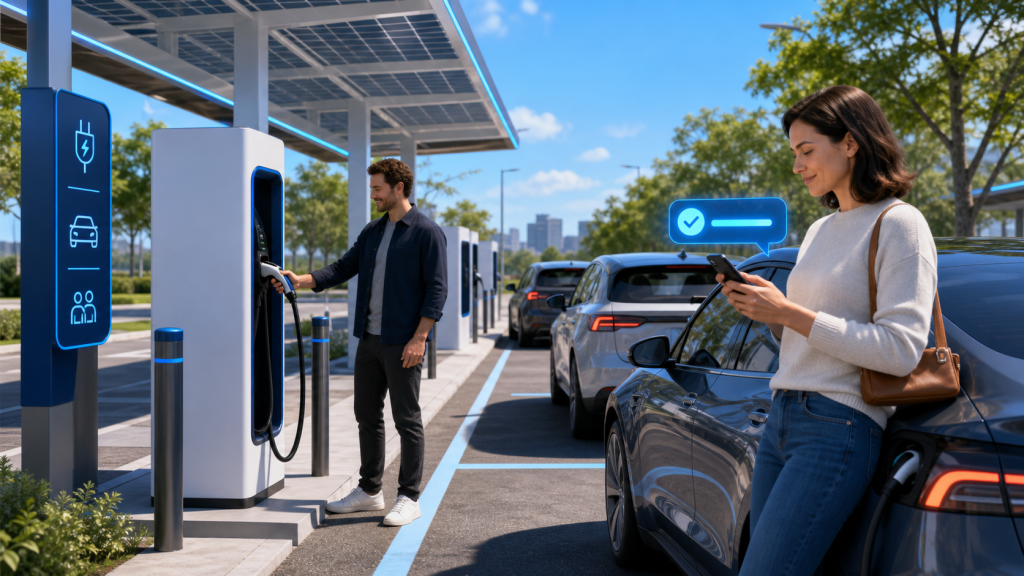
Electric car charging etiquette works when drivers prepare before arriving, monitor the session and leave promptly. The U.S. Department of Energy’s Alternative Fuels Data Center charging overview explains the main charging levels and infrastructure used by drivers. Understanding that equipment makes electric car charging etiquette easier because drivers can select an appropriate station instead of occupying scarce fast-charging capacity unnecessarily.
At every location, apply electric car charging etiquette together with posted parking rules and network instructions. A courteous driver protects accessible routes, handles the connector carefully and communicates calmly. Consistent electric car charging etiquette helps both experienced EV owners and first-time users complete reliable charging sessions.
Electric car charging etiquette is ultimately a simple habit: use the correct equipment, take the energy the journey requires and make the space available again. Practicing electric car charging etiquette at fast chargers, workplaces and apartments reduces conflict. When local rules differ, responsible electric car charging etiquette always begins with the posted instructions.