
EV winter range loss is normal. Cold batteries deliver energy less efficiently, the cabin needs heat, and snow or dense winter air increases resistance. The size of the loss varies by temperature, trip length, speed, tires, and whether the battery was preconditioned.
Why cold weather reduces EV range
- Battery chemistry slows: a cold pack cannot accept or release energy as efficiently.
- Cabin heating uses energy: unlike a combustion car, an EV may not have abundant waste heat.
- Short trips are demanding: the cabin and battery warm repeatedly, so many short journeys can be less efficient than one long trip.
- Winter roads add drag: cold tire pressure, slush, snow, wind and roof accessories all matter.
A practical planning table
| Conditions | Planning buffer | What to do |
|---|---|---|
| Cool, dry day | Small | Check tire pressure and drive normally |
| Below freezing | Moderate | Precondition while plugged in and plan an earlier stop |
| Severe cold, snow or headwind | Large | Add a backup charger and arrive with a generous reserve |
This is a planning framework, not a universal percentage. Your car’s recent-energy graph is a better guide than a generic number.
Seven ways to preserve winter range
- Precondition while connected. Warm the cabin and, when supported, the battery using grid power.
- Use seat and steering-wheel heaters. They warm occupants directly and may let you lower the cabin setting.
- Keep tires correctly inflated. Pressure falls as temperature drops. Use the pressure on the door-jamb label, not the tire sidewall.
- Remove unnecessary roof racks. Aerodynamic drag becomes costly at highway speed.
- Drive smoothly and slightly slower. Speed is one of the strongest controllable range factors.
- Navigate to a fast charger. Many EVs automatically warm the battery when a charger is set as the destination.
- Protect your arrival buffer. Do not plan to reach an unfamiliar winter charger with only a few percent remaining.
Charging in cold weather
A cold battery may fast-charge slowly until it warms. If possible, charge after driving or use battery preconditioning. At home, remaining plugged in helps the car manage battery temperature. The U.S. Department of Energy also recommends preheating while connected and keeping the battery charged for winter travel: DOE winter EV guidance.
Winter trip checklist
- Inspect tire pressure and tread.
- Clear snow from lights, sensors and charge port.
- Carry the charging cable, gloves and an ice scraper.
- Check two charging options near each planned stop.
- Tell someone your route in severe weather.
For the bigger picture, compare this guide with how far an electric car can go on one charge.
FAQ
Does cold weather permanently damage an EV battery?
Normal winter use generally causes a temporary efficiency and charging-speed reduction, not sudden permanent damage. Follow the maker’s storage and charging guidance in extreme conditions.
Should I charge to 100% in winter?
Use the daily limit recommended by your manufacturer. A higher trip charge can be sensible before a long journey, but do not treat 100% as the default without checking the manual.
What Causes EV Winter Range Loss?
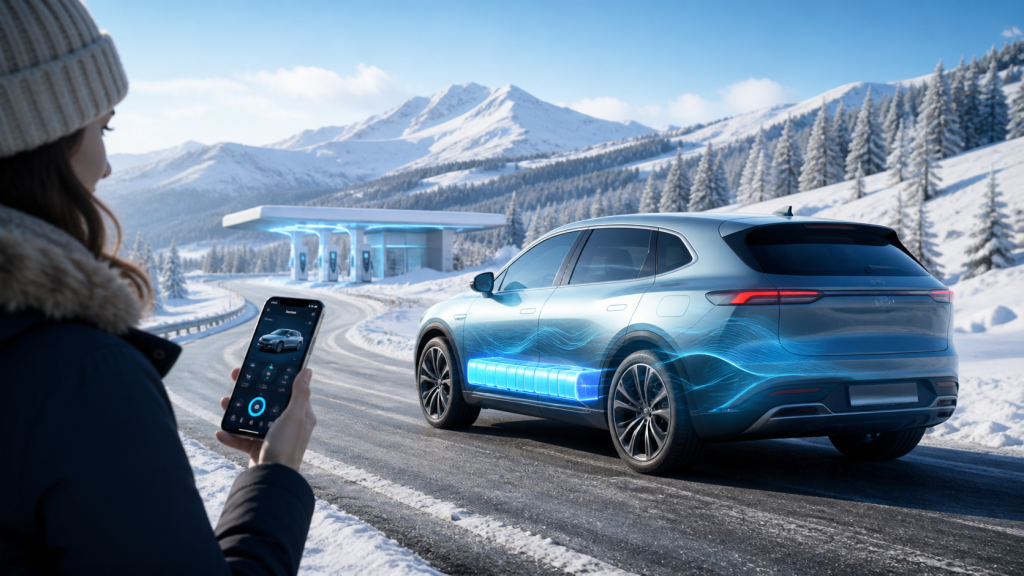
EV winter range loss comes from two demands happening at the same time. A cold lithium-ion battery cannot deliver and accept energy as efficiently as a warm battery, while the cabin heater, window defroster, heated mirrors and other accessories consume electricity that would otherwise move the car. Cold air is denser, tire pressure falls with temperature and snow or slush increases rolling resistance.
The dashboard estimate may drop before the car travels anywhere because the vehicle predicts the energy needed for heating. That change is not necessarily permanent battery degradation. Range normally improves as temperature rises, although an older battery with less usable capacity will still begin with a smaller energy reserve.
How Much Winter Range Should You Plan to Lose?
There is no single percentage for every vehicle. Temperature, trip length, heat-pump design, speed, wind, snow, battery chemistry and whether the car was plugged in before departure all matter. Short trips can show a large proportional loss because the cabin and battery must warm repeatedly. On a longer trip, the initial heating demand is spread across more miles.
Use your own cold-weather history as the best planning reference. Compare similar routes at similar speeds and temperatures. For an unfamiliar winter trip, build a generous arrival reserve and identify an earlier backup charger. Do not plan around the official warm-weather range rating alone.
| Winter factor | Why it affects range | Practical response |
|---|---|---|
| Very cold battery | Reduced power and charge acceptance | Precondition while plugged in |
| Cabin resistance heater | Uses substantial electrical energy | Use seat heat and moderate cabin settings |
| Short repeated trips | Cabin warms from cold each time | Combine errands when practical |
| Low tire pressure | Raises rolling resistance | Check cold pressure regularly |
| Snow, rain and headwinds | Increase road and aerodynamic load | Reduce speed safely and add reserve |
Precondition While the EV Is Plugged In
Preconditioning warms the cabin and, in many vehicles, the high-voltage battery before departure. When the car remains connected, part of that energy can come from the grid instead of the battery. Use the manufacturer’s departure schedule or mobile app and consult the manual for the exact behavior.
Preconditioning is especially useful before DC fast charging. Many EVs automatically warm the battery when a fast charger is selected in the built-in navigation system. Manually entering only the street address may not trigger it. Battery preparation can improve charging speed and reduce time spent at the station.
Heating the Cabin Efficiently
Safety and clear visibility come first. Use enough heat and defrosting to keep the driver comfortable and every window clear. After the cabin warms, reducing the temperature slightly can save energy. Heated seats and a heated steering wheel warm occupants directly and often use less energy than maintaining a very hot cabin.
Heat pumps can be more efficient than resistance heaters in many conditions, but performance varies at very low temperatures and by vehicle design. Do not assume a heat pump eliminates EV winter range loss. It reduces part of the heating penalty; it cannot remove the effects of cold batteries, dense air or snowy roads.
Tire Pressure, Winter Tires and Alignment
Tire pressure falls as ambient temperature drops. Check it when the tires are cold and use the door-jamb specification, not the maximum printed on the tire sidewall. An underinflated tire wastes energy and can wear unevenly. Recheck after major temperature changes.
Winter tires improve traction in suitable conditions but may have higher rolling resistance than efficiency-focused summer tires. The safety benefit outweighs a small range penalty when severe winter conditions require them. Use the correct size, load rating and pressure, and keep alignment within specification.
Driving Techniques That Preserve Cold-Weather Range
- Accelerate smoothly and look far ahead.
- Reduce highway speed when conditions permit; aerodynamic demand rises rapidly with speed.
- Remove roof boxes and racks when they are not needed.
- Clear heavy snow and ice from the vehicle before driving.
- Combine errands so the battery and cabin do not cool completely between stops.
- Use an efficiency or eco mode when it remains safe for road conditions.
- Expect regenerative braking to be limited when the battery is cold or nearly full.
Regeneration limits are normal protective behavior. The friction brakes remain available, but pedal feel can differ as the system blends braking. Leave additional following distance on slippery roads and follow the owner’s manual for snow or ice settings.
Winter Fast-Charging Strategy
A cold battery may charge far below the station’s advertised output. Navigate to the charger early enough for automatic preconditioning and arrive with a reasonably low state of charge when the route is safe. A warm battery at 15 percent often accepts power faster than a cold battery at 65 percent.
Check recent station reports and choose locations with several working stalls. Keep a backup that is reachable before the planned stop. Do not rely on a connector at the edge of the car’s predicted winter range, particularly in rural areas or during a storm.
Parking and Charging During Extreme Cold
Plug in when practical and follow the manufacturer’s recommended charge limit. The vehicle may use grid power to protect or condition the battery. Do not cover charging equipment, use improvised heaters or connect through an unapproved extension cord. Keep the connector free of packed snow and inspect it for damage before use.
If the charge door or connector freezes, use the manufacturer’s approved release or defrost procedure. Do not pour boiling water on electrical equipment or force the latch. Report damaged cables and move to another station.
Winter Emergency Planning
Carry warm clothing, gloves, water, a phone cable, flashlight and roadside-assistance details. Keep more range than usual when traveling through remote areas. If traffic stops, cabin heat uses energy over time, but repeatedly driving in search of an uncertain charger can use more. Contact emergency services when safety is at risk.
Share the route and expected arrival time, monitor weather alerts and avoid travel when authorities advise against it. EV winter range loss is manageable with planning, but it should not encourage risky travel in severe conditions.
EV Winter Range Loss FAQs
Does cold weather permanently damage an EV battery?
Normal temporary range reduction is not the same as permanent damage. Battery-management systems limit charging or power when necessary. Long-term health depends on many factors, so follow manufacturer storage and charging guidance.
Should I charge to 100 percent in winter?
Only when the trip requires it and the manufacturer permits it. For everyday use, follow the recommended charge limit. Schedule a high charge to finish close to departure rather than leaving the battery full for an unnecessary period.
Why does charging slow in winter?
A cold battery cannot safely accept energy as quickly. Preconditioning and arriving after sustained driving can help, but the vehicle controls the final rate.
Can a garage reduce EV winter range loss?
Yes. Even an unheated garage may keep the battery and cabin warmer than exposed outdoor parking, reducing initial heating demand.
Is the dashboard winter estimate accurate?
It is a prediction based on recent driving and current conditions. Treat it as guidance, watch energy consumption during the trip and maintain a reserve.
Compare battery longevity in how long electric-car batteries last and prepare charging stops using the EV road-trip planning guide. The U.S. Department of Energy also explains electric-vehicle operating basics.
Final EV Winter Range Loss Checklist
Reduce EV winter range loss by preconditioning while plugged in, checking cold tire pressure and planning a larger arrival reserve. On highway trips, EV winter range loss is easier to manage when the battery is warm and backup chargers are identified before departure.
- Expect EV winter range loss to vary with temperature, speed, wind and trip length.
- Use enough cabin heat for comfort and clear windows.
- Navigate to fast chargers through the vehicle system when battery preparation depends on it.
- Track your own consumption instead of relying on one universal percentage.
Careful preparation turns EV winter range loss into a predictable planning factor. A final check of weather, charging availability and tire condition helps drivers manage EV winter range loss without sacrificing safety.
EV winter range loss should be included in every cold-weather route estimate. Drivers who measure EV winter range loss on familiar journeys can build more accurate reserves. With preconditioning and sensible charging stops, EV winter range loss becomes manageable rather than surprising.
The practical answer to EV winter range loss is preparation: warm the vehicle, protect a reserve and adjust early. Reviewing EV winter range loss before departure supports safer charging decisions.
Managing EV Winter Range Loss Day to Day
Daily EV winter range loss varies, so record temperature and consumption on a familiar route. This personal EV winter range loss history is more useful than one universal percentage. Drivers can limit EV winter range loss through plugged-in preconditioning and correct tire pressure, but safety and visibility remain the priority. Plan each trip with EV winter range loss included in the reserve, and reassess EV winter range loss whenever weather or speed changes.