
EV tire wear depends on tire choice, vehicle setup and driving. EV tire wear can be faster than drivers expect, but electric cars do not automatically destroy tires. Vehicle weight, instant torque, alignment, tire pressure, road surface and driving style determine how long a set lasts.
Why EV tires can wear faster
- More weight: a large traction battery adds mass, increasing the load carried by each tire.
- Immediate torque: hard launches apply strong force at the contact patch.
- Quiet cabins: manufacturers may use softer, low-noise compounds that balance comfort, grip and longevity.
- Efficiency targets: low rolling resistance helps range, but every design involves tradeoffs.
- Alignment sensitivity: a small toe or camber problem can rapidly wear the inner or outer shoulder.
How to spot the wear pattern
| Pattern | Possible cause | Next step |
|---|---|---|
| Both shoulders | Underinflation | Check cold pressure and inspect for leaks |
| Center tread | Overinflation | Set pressure to the vehicle label |
| One edge | Alignment or suspension | Request an alignment inspection |
| Cupping or scallops | Balance, damper or suspension issue | Have the vehicle inspected |
| Rear tires much faster | Torque, rotation pattern or alignment | Review rotation interval and driving style |
A simple tire-care schedule
- Monthly: check pressure when tires are cold and inspect for cuts or bulges.
- Every few thousand miles: measure tread across the inner, center and outer sections.
- At the maker’s interval: rotate tires if the wheel-and-tire setup permits it.
- After a pothole or curb strike: watch for vibration, steering pull and uneven wear.
- When replacing: match load rating, size and speed rating; confirm the tire is suitable for the vehicle.
Do you need EV-specific tires?
Not every replacement must carry an EV label, but it must meet the vehicle maker’s specifications. EV-focused tires may offer reinforced construction, low rolling resistance and noise-reducing foam. Compare wet braking, comfort, efficiency, warranty and price—not the label alone. Michelin explains that correct load capacity and vehicle fitment remain essential in its EV tire FAQ.
How to make EV tires last longer
- Accelerate progressively instead of using full torque at every start.
- Maintain cold pressure using the door-jamb specification.
- Rotate on schedule where permitted.
- Get alignment checked if wear becomes uneven.
- Avoid carrying unnecessary weight.
- Use a dedicated winter tire where climate and law require it.
Tires are a major part of electric-car maintenance cost, so early inspection can prevent replacing a full set prematurely.
FAQ
How long do EV tires last?
There is no reliable universal mileage. Record tread depth and mileage at each rotation; your own wear rate gives the best forecast.
Will stronger regenerative braking wear tires?
Regeneration reduces friction-brake use, but tire wear still depends on the total force at the road. Smooth one-pedal driving is gentler than abrupt acceleration and deceleration.
Why EV Tire Wear Can Be Faster
EV tire wear is influenced by vehicle weight, immediate motor torque, tire design, alignment and driving style. A battery pack can make an electric vehicle heavier than a similarly sized gasoline model, increasing the load each tire must carry. That does not mean every EV destroys tires quickly; a gently driven, properly aligned EV can achieve strong tire life.
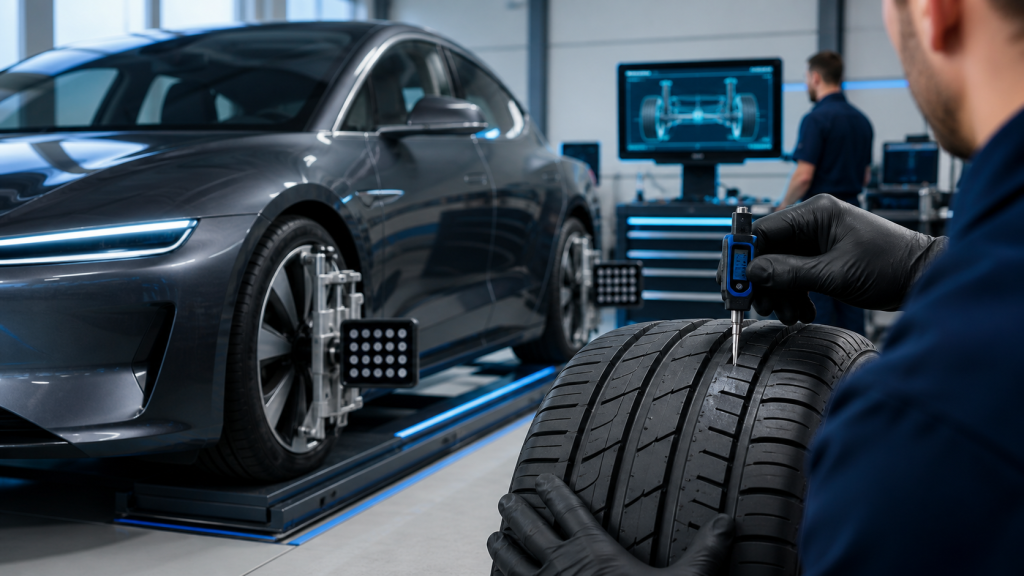
Instant torque matters when the driver repeatedly accelerates hard. The tires must transfer that force to the road, which can remove tread faster. Regenerative braking also places deceleration force through the driven tires, although smooth regeneration is not automatically harmful. Abrupt inputs and aggressive cornering are more important than the presence of an electric motor alone.
EV-Specific Tires Explained
Some tires are engineered for higher loads, low rolling resistance and reduced cabin noise. Reinforced construction can support vehicle weight, while tread compounds balance grip with efficiency. Acoustic foam may reduce road noise that becomes more noticeable without an engine.
An “EV” label is not the only sign of suitability. The replacement must meet the manufacturer’s size, load index, speed rating and other specifications. A tire professional should also consider climate, expected mileage, towing, snow and the driver’s priority between performance, comfort, efficiency and longevity.
How Tire Pressure Affects Range and Wear
Underinflation flexes the sidewall more, generates heat and commonly wears the tread shoulders. Overinflation can reduce the contact patch and contribute to center wear or reduced ride quality. Check pressure when the tires are cold and use the door-jamb label. The number molded on the tire sidewall is not the normal vehicle setting.
Temperature changes pressure. Recheck after a major seasonal shift and before long trips. Do not bleed air from a warm tire merely because its pressure rose during driving. If one tire repeatedly loses pressure, have it inspected rather than topping it up indefinitely.
Measure EV Tire Wear Correctly
Inspect more than one position. Measure inner, center and outer tread on every tire because alignment problems may hide wear on the inside edge. A tread-depth gauge is inexpensive and more precise than a visual estimate. Record measurements during rotations to identify trends.
- Look for uneven shoulders, center wear and cupping.
- Check cuts, bulges, exposed cords and embedded objects.
- Inspect the date code and signs of age-related cracking.
- Compare left and right tires on the same axle.
- Investigate vibration, pulling or a newly off-center steering wheel.
Replace a damaged tire immediately when required by a qualified professional. Legal minimum tread depth differs by location, while wet or snow performance can deteriorate before the legal limit.
Rotation Intervals for Electric Cars
Follow the vehicle manual and tire warranty. Many owners rotate based on mileage, but tread-depth difference can justify earlier service. Front-, rear- and all-wheel-drive layouts wear tires differently. Staggered sizes or directional tires may restrict the rotation pattern.
A rotation redistributes wear; it cannot correct bad alignment, worn suspension or chronic underinflation. Ask the technician to record tread depth and pressure before the service. If one tire is significantly different, diagnose the cause.
Alignment and Suspension Checks
Potholes, curb impacts and rough roads can change alignment. Toe errors can scrub tread surprisingly quickly while the car still feels nearly normal. Camber may concentrate wear on an inner or outer edge. Have alignment checked when wear is uneven, the car pulls, the steering wheel is not centered or suspension work has been performed.
Control-arm bushings, bearings and dampers also affect the tire’s contact with the road. A new alignment will not remain correct if a component is loose or damaged. Battery weight does not excuse abnormal wear; the chassis should still operate within specification.
Driving Habits That Extend Tire Life
- Accelerate progressively instead of using maximum torque at every start.
- Look ahead and use smooth regenerative braking.
- Slow before corners rather than loading the outside tires abruptly.
- Avoid striking curbs and deep potholes.
- Remove unnecessary cargo and roof equipment.
- Use the correct drive mode for the conditions.
- Do not disable traction or stability systems for public-road driving.
Performance EVs can legitimately use tires quickly when driven hard. Owners should treat that as a cost of the chosen performance, not as evidence that all EV tire wear is unavoidable.
Do Low-Rolling-Resistance Tires Last Longer?
Not necessarily. Low rolling resistance primarily reduces energy lost as the tire deforms. Tread life depends on compound, design, load, pressure and use. Compare warranty terms and independent testing for the exact tire rather than assuming an efficiency label guarantees long mileage.
Switching to a tire with different rolling resistance can change range and noise. Maintain the required load rating and avoid choosing solely by price. A tire that saves energy but performs poorly in the local climate is not a responsible tradeoff.
Repairing or Replacing an EV Tire
EV tires are repaired according to the same fundamental safety standards as other passenger tires, but acoustic foam, run-flat construction and damage location can affect repairability. A puncture in the tread may be repairable after internal inspection. Sidewall damage, large punctures or driving while flat often requires replacement.
Do not use a plug-only roadside repair as a permanent solution unless the tire manufacturer and applicable standard allow it. Sealant can help in an emergency but may complicate pressure-sensor service. Tell the technician what product was used.
Replacement Cost Planning
Budget using the installed price: tire, mounting, balancing, valve or sensor service, disposal and alignment if needed. Replacing all four may be required for some all-wheel-drive systems when tread depths differ beyond the manufacturer limit. Confirm the requirement for the exact vehicle rather than relying on a universal rule.
| Wear pattern | Likely factor | Next step |
|---|---|---|
| Both shoulders | Possible underinflation | Verify cold pressure and leaks |
| Center tread | Possible overinflation | Compare with door-jamb setting |
| One edge | Alignment or suspension | Professional inspection |
| Cupping | Damping, balance or suspension | Diagnose before replacing |
| Even rapid wear | Torque, weight, compound or driving | Review tire choice and habits |
EV Tire Wear FAQs
How long should EV tires last?
There is no universal mileage. Tire model, vehicle, alignment, climate and driving behavior create wide variation. Use tread measurements and warranty terms rather than a generic promise.
Do electric cars need special tires?
They need tires meeting the manufacturer’s specifications. EV-marketed designs may improve load capacity, efficiency or noise, but another approved tire can also be suitable.
Does regenerative braking cause tire wear?
It transfers braking force through the driven tires, but smooth use is normal. Abrupt acceleration, hard cornering, incorrect pressure and alignment often matter more.
Can I replace only one tire?
Sometimes, if size, model and tread-depth requirements remain satisfied. All-wheel-drive systems may impose stricter limits. Consult the manual and tire professional.
How can I reduce EV tire wear?
Maintain cold pressure, rotate as permitted, measure tread, correct alignment problems and accelerate smoothly. These steps also support range and predictable handling.
Review the broader electric-car maintenance cost guide and learn about cold-weather pressure changes in EV winter range loss. NHTSA provides official tire safety guidance.
Final EV Tire Wear Prevention Plan
Track EV tire wear with monthly pressure and tread measurements. Uneven EV tire wear should trigger an alignment and suspension inspection instead of another rotation alone. Rapid but even EV tire wear may reflect soft performance tires, frequent hard acceleration or heavy loads.
- Reduce EV tire wear by using the cold pressure on the door label.
- Record EV tire wear before and after each rotation.
- Compare EV tire wear across both axles and all tread positions.
- Investigate EV tire wear after a pothole impact or steering change.
Responsible EV tire wear management improves safety, range and replacement planning. No single tire will eliminate EV tire wear, but correct specification and smooth driving can make it predictable.