
EV towing range changes with trailer shape, speed, load and weather. Towing can reduce an electric vehicle’s range substantially because a trailer adds aerodynamic drag, weight and rolling resistance. The exact EV towing range depends more on trailer shape, speed and weather than on one headline percentage.
What reduces range while towing?
- Aerodynamic area: a tall, square travel trailer pushes far more air than a low utility trailer.
- Highway speed: aerodynamic power demand rises rapidly with speed.
- Mass and hills: extra weight matters most during acceleration and climbing.
- Temperature and wind: cold, rain and a headwind can compound the loss.
- Tires and bearings: low pressure or dragging trailer brakes waste energy.
Use your first leg as a range test
Start with a conservative plan, then calculate the real consumption once the trailer is attached:
Estimated usable towing distance = usable battery energy ÷ observed energy use per mile.
Example: if you plan to use 60 kWh between stops and the combination consumes 0.60 kWh per mile, the mathematical distance is 100 miles. Apply an arrival reserve rather than planning to reach zero.
Pre-trip calculation worksheet
| Input | Where to find it |
|---|---|
| Usable energy for the leg | Departure charge minus planned arrival reserve |
| Observed towing efficiency | Vehicle trip computer after 20–40 representative miles |
| Elevation and weather | Route planner and forecast |
| Charger accessibility | Recent photos, reviews and satellite view |
| Backup stop | A second compatible charger before the primary |
Charging with a trailer
Many charging sites require the trailer to be disconnected because stalls are designed for nose-in parking. Before arrival, inspect satellite imagery and user photos for pull-through spaces. Carry the hitch key and gloves where they are easy to reach, and never block traffic while unhitching.
Eight towing-range tips
- Confirm the vehicle’s tow rating, tongue-weight limit and trailer brake requirements.
- Weigh the loaded trailer; brochure dry weight is not the trip weight.
- Set tire pressures according to vehicle and trailer specifications.
- Use a moderate steady speed.
- Plan shorter first legs until you know actual consumption.
- Favor charging sites with room to maneuver.
- Keep a larger reserve in rain, cold or headwinds.
- Recheck hitch, lights, chains and brake controller at every stop.
Safety comes before range
Never exceed manufacturer limits to gain range or convenience. Regenerative braking can help on descents, but it does not replace properly configured trailer brakes. Long descents can also limit regeneration when the battery is nearly full.
For untowed range fundamentals, see how far an EV goes on one charge.
FAQ
Does trailer weight or shape matter more?
Both matter, but at highway speed a tall trailer’s aerodynamic drag can dominate. A heavier low trailer may perform better than a lighter box-shaped camper.
Can I trust the dashboard range estimate?
After the vehicle learns the new consumption it becomes more useful, but wind, climbs and temperature can still change the result. Track state of charge and distance to a backup charger.
Why EV Towing Range Falls
EV towing range depends heavily on aerodynamic drag. A tall, wide travel trailer pushes a large area through the air and can require far more energy than a compact utility trailer of the same weight. Speed makes the effect stronger, which is why a small reduction in highway speed can materially improve efficiency.
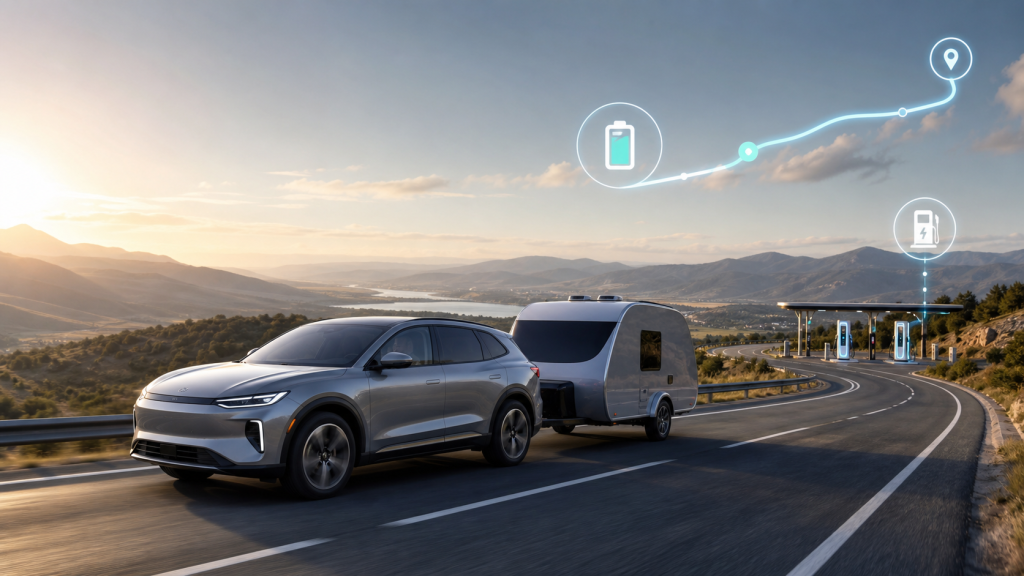
Weight matters most during acceleration and climbing. Regenerative braking can recover part of the energy on descent, but never all of it. Rolling resistance from additional tires, bearings and road surface also increases consumption. Cold weather, rain, snow and headwinds can compound the penalty.
Start With Vehicle and Hitch Limits
Range planning comes after safety and legality. Confirm the vehicle’s maximum trailer weight, tongue-weight limit, gross vehicle weight rating, gross combined rating and axle ratings. Use the owner’s manual and certification labels for the exact configuration. A model name alone is not enough because wheel size, drivetrain and optional towing packages can change limits.
Use a properly rated hitch, ball, wiring harness and brake controller where required. Never exceed a limit to reach a charger or avoid a second trip. Distribute cargo according to the trailer manufacturer’s guidance and weigh the loaded combination when possible.
Calculate a First EV Towing Range Estimate
Use recent solo-driving efficiency as a baseline, then apply a conservative towing multiplier. A simple planning equation is:
Estimated towing range = usable battery energy ÷ expected towing consumption
If a vehicle has 100 kWh of usable energy and the towing estimate is 0.60 kWh per mile, the theoretical range is about 167 miles. A responsible route does not use all of that energy. Holding a 15 percent arrival reserve leaves roughly 85 kWh for the leg, or about 142 miles in this simplified example.
The estimate is not a guarantee. Test the actual trailer on a familiar route, record consumption at several speeds and use the worse result for planning. A headwind on the return journey can reverse an apparently comfortable margin.
Trailer Shape Versus Trailer Weight
| Trailer factor | Range effect | Planning response |
|---|---|---|
| Large frontal area | High aerodynamic drag | Reduce speed and shorten legs |
| Boxy shape | Turbulent airflow | Expect a larger highway penalty |
| Heavy payload | More energy climbing and accelerating | Remove unnecessary cargo |
| Low compact trailer | Usually less drag | Still verify weight and consumption |
| Roof cargo on tow vehicle | Additional drag | Move cargo inside when safe |
A light but tall camper can reduce range more than a heavier low trailer. When comparing equipment, look beyond empty weight and consider frontal area, height and how closely the trailer follows the tow vehicle.
Run a Real-World Test Before a Long Trip
- Load the trailer as it will be used.
- Verify tire pressures on the vehicle and trailer.
- Drive a representative highway loop in safe weather.
- Record distance, energy used, speed, temperature and wind.
- Repeat in the opposite direction to reduce wind and elevation bias.
- Calculate energy per mile or kilometer.
- Add a reserve for worse conditions.
A short test at city speed will not predict highway EV towing range. Aerodynamic demand rises rapidly, so include sustained travel near the intended cruising speed without exceeding legal or equipment limits.
Plan Charging Stops That Fit a Trailer
Connector availability is only part of the problem. Many charging sites require backing into a stall designed for a single car. A connected trailer may block traffic or several chargers. Look for pull-through stations, perimeter stalls or nearby safe trailer parking.
Use satellite imagery and recent driver photos, but confirm conditions can change. Identify where the trailer can be disconnected legally if necessary. Practice coupling, wheel chocking and breakaway connections before the trip. Never unhitch in an active travel lane.
Call rural or destination locations when access is uncertain. A charger that is technically compatible may be behind a height restriction, locked gate or tight turn. Build at least one backup into every long leg.
Charging Strategy While Towing
Arrive with enough reserve to handle a broken or blocked charger. Precondition the battery through the vehicle navigation system when supported. Charge only as high as the next leg requires plus reserve because DC charging often slows at high states of charge.
Two shorter stops can be faster than one session to nearly 100 percent. However, sparse routes may force a high charge. Let route safety and charger spacing determine the target rather than applying an inflexible 80-percent rule.
Speed, Wind and Elevation
Slow down within safe traffic conditions when consumption is higher than planned. Reducing speed is usually the quickest way to protect EV towing range because it cuts aerodynamic demand. Never drive so slowly that the combination creates a hazard; use appropriate lanes and obey minimum-speed rules.
A strong headwind can act like higher road speed. Mountains require energy during the climb, and regeneration on descent will return only part. Plan a larger reserve when the charger sits beyond a major pass, especially in cold weather.
Cold Weather and Cabin Energy
Cold batteries accept and deliver energy less efficiently, while cabin heating draws power. Precondition while connected and keep enough heat for comfort and clear windows. Check both vehicle and trailer tire pressure because temperature changes can reduce it.
Snow and ice can make towing unsafe regardless of available range. Follow weather warnings and delay travel when conditions exceed the driver’s experience or the equipment’s capability.
Payload, Tongue Weight and Tire Safety
Weigh passengers, cargo, hitch equipment and trailer supplies. Tongue weight becomes part of the tow vehicle’s payload and may reach the payload limit before the maximum trailer rating. Water is heavy; consider filling tanks closer to the destination when safe and permitted.
Inspect every tire for pressure, load rating, tread, age and damage. Trailer tires may age before tread wears out. Carry the correct spare and tools, but never work in an unsafe roadside location. Roadside assistance that understands both EVs and trailers can be valuable.
EV Towing Range Emergency Plan
- Save chargers from at least two networks.
- Carry network support numbers and a physical payment card.
- Know where the trailer can be parked or disconnected safely.
- Share the route and arrival time.
- Carry water, weather gear and warning equipment.
- Divert early when energy use exceeds the plan.
Do not continue past a working charger with an inadequate reserve merely because the next station is faster. Early decisions preserve more options.
EV Towing Range FAQs
How much range does towing reduce?
There is no universal percentage. Trailer frontal area, speed, weight, weather and terrain can produce very different results. Test the actual combination.
Can an EV charge with a trailer attached?
Yes at a suitably designed site, but many stalls cannot accommodate the length. Pull-through charging is easiest; otherwise safe uncoupling may be necessary.
Does regenerative braking recover downhill energy?
It recovers part of it, subject to battery state, temperature and traction. It cannot return all energy used climbing and does not replace trailer brakes.
Should I tow at 100 percent charge?
A high departure charge can be useful for a long first leg if permitted by the manufacturer. Plan completion close to departure and retain a destination reserve.
What is the best way to improve EV towing range?
Reduce safe cruising speed, remove unnecessary cargo, maintain tires and plan shorter legs with reliable chargers. Aerodynamics often dominate highway use.
Prepare charging stops with the EV road-trip planning guide and compare cold-weather effects in EV winter range loss. The U.S. Department of Energy provides additional electric-vehicle basics.
Final EV Towing Range Checklist
Calculate EV towing range from measured energy use, not the solo dashboard estimate. Protect EV towing range with a safe speed, correct tire pressure and a realistic reserve. Recheck EV towing range when wind, temperature or elevation changes.
- Test EV towing range with the loaded trailer.
- Plan EV towing range around pull-through or accessible chargers.
- Never extend EV towing range by exceeding weight or speed limits.
Reliable EV towing range planning begins with legal ratings and ends with a backup charger that remains reachable.
EV towing range should be recalculated for every trailer and route. Measuring EV towing range in both directions exposes wind and elevation effects. A larger EV towing range reserve is sensible in cold or remote conditions. Good EV towing range decisions protect passengers, equipment and access to charging.