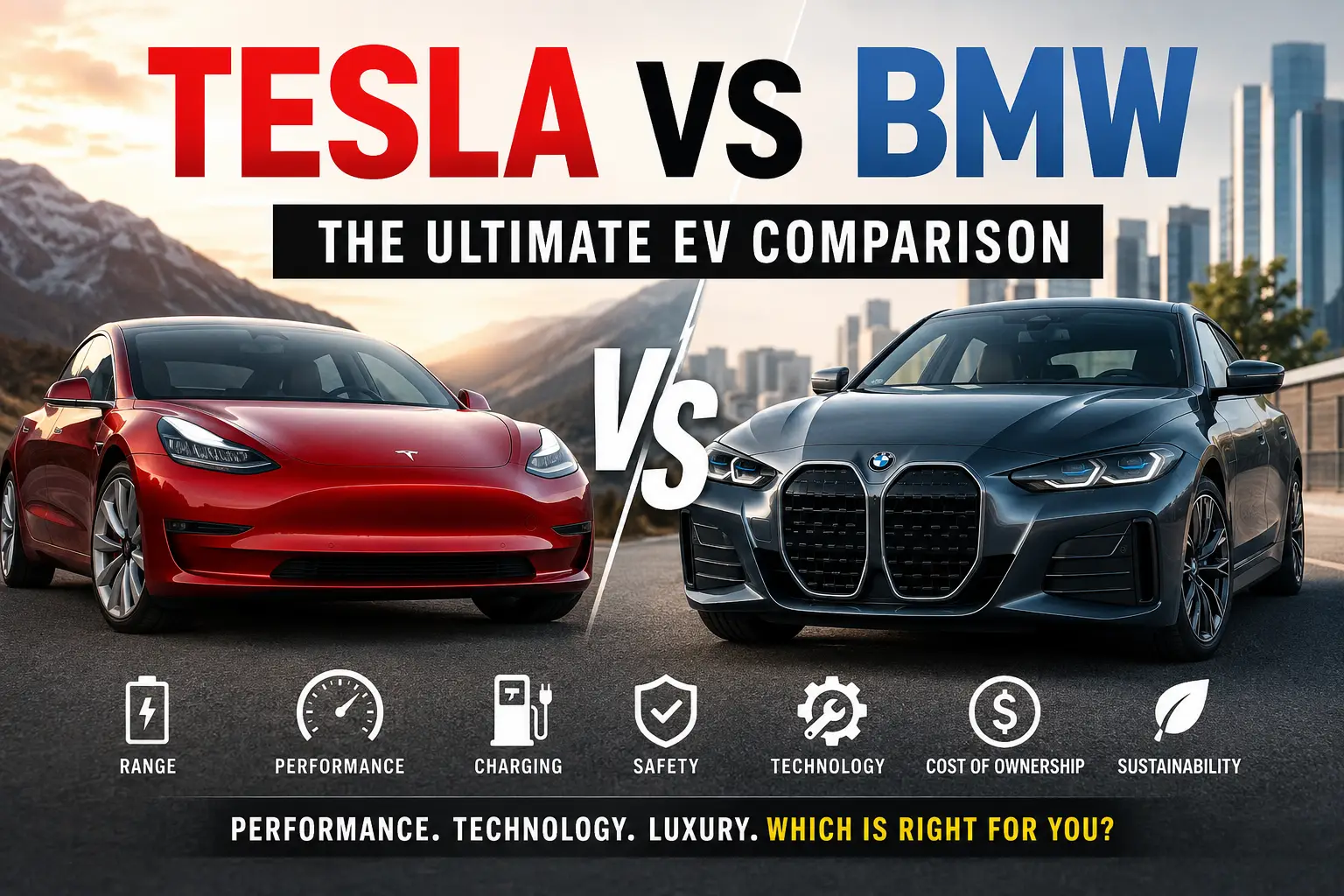
Introduction
The global automotive industry is undergoing one of the most significant transformations in history as electric vehicles (EVs) rapidly replace traditional gasoline and diesel-powered cars. Governments worldwide are encouraging zero-emission transportation through incentives, stricter environmental regulations, and investments in charging infrastructure, while consumers are increasingly choosing electric vehicles for their lower operating costs, advanced technology, and improved driving experience. Among the many EV manufacturers competing in this growing market, Tesla and BMW have established themselves as two of the most influential brands, each offering a unique approach to electric mobility.
For many prospective buyers, deciding between Tesla vs BMW has become one of the most challenging purchasing decisions in today’s automotive market. Tesla has built its reputation around innovation, software integration, long driving range, industry-leading battery technology, and the world’s largest dedicated fast-charging network. BMW, on the other hand, combines more than a century of automotive engineering experience with luxury, refined driving dynamics, premium craftsmanship, and a rapidly expanding portfolio of electric vehicles designed for both performance and everyday practicality.
Although both companies manufacture premium electric vehicles, they target customers with different priorities. Tesla focuses on minimalistic interiors, continuous over-the-air software updates, autonomous driving technologies, and a digital-first ownership experience. BMW emphasizes comfort, traditional luxury, precision engineering, superior build quality, and a driving experience that remains faithful to the brand’s long-established heritage. As a result, many buyers frequently search for terms such as BMW vs Tesla, Tesla or BMW, and BMW or Tesla before investing in an electric vehicle.
The competition between these two manufacturers has intensified significantly over recent years. Tesla continues expanding its lineup with improvements in battery efficiency, charging technology, artificial intelligence, and Full Self-Driving capabilities. Meanwhile, BMW has accelerated its electrification strategy by introducing advanced electric models such as the BMW i4, BMW i5, BMW i7, and BMW iX while also enhancing battery technology, charging compatibility, and intelligent driver assistance systems.
Another important factor influencing purchasing decisions is charging convenience. As Tesla gradually opens its Supercharger network to other manufacturers in several regions, questions like Can BMW use Tesla Superchargers?, BMW Tesla Supercharger compatibility, Tesla Supercharger for BMW, and BMW Tesla charging have become increasingly popular among EV owners. Buyers are no longer comparing only acceleration or horsepower; they are evaluating charging infrastructure, charging speed, battery longevity, ownership costs, software capabilities, safety features, and long-term reliability before making a final decision.
Choosing the right electric vehicle also depends on personal lifestyle, driving habits, and financial considerations. Some drivers prioritize maximum driving range for long-distance travel, while others value luxury interiors, ride comfort, advanced driver assistance systems, or lower maintenance costs. Families may prefer spacious SUVs like the Tesla Model Y or BMW iX, whereas commuters often compare compact premium sedans such as the Tesla Model 3 vs BMW i4. Performance enthusiasts may focus on acceleration, handling, regenerative braking, and battery efficiency, while technology-oriented buyers often compare infotainment systems, smartphone integration, software updates, and autonomous driving capabilities.
This comprehensive guide has been developed to answer every important question surrounding the Tesla vs BMW debate. Rather than focusing on only one aspect, this article provides a complete comparison covering performance, acceleration, driving range, battery technology, charging infrastructure, Tesla Supercharger compatibility, BMW charging solutions, interior quality, comfort, infotainment systems, driver assistance technologies, safety ratings, maintenance costs, reliability, insurance, resale value, environmental impact, and total cost of ownership.
Whether you are purchasing your very first electric vehicle or upgrading from a conventional gasoline-powered car, this detailed comparison will help you understand the strengths, weaknesses, and real-world ownership experience of both manufacturers. By the end of this guide, you will have the knowledge needed to confidently determine whether Tesla or BMW is the better electric vehicle brand for your budget, driving requirements, and long-term expectations.
Table of Contents
- Tesla vs BMW at a Glance
- Tesla and BMW Brand Overview
- Tesla vs BMW Electric Vehicle Lineup
- Tesla Model 3 vs BMW i4
- Tesla Model Y vs BMW iX
- Performance Comparison
- Battery Technology
- Driving Range Comparison
- Charging Speed Comparison
- Can BMW Use Tesla Superchargers?
- Tesla Supercharger vs BMW Charging Network
- Interior and Cabin Experience
- Infotainment and Software
- Driver Assistance and Autonomous Driving
- Safety Ratings
- Reliability Comparison
- Maintenance Costs
- Insurance Costs
- Warranty Comparison
- Resale Value
- Cost of Ownership
- Sustainability and Environmental Impact
- Advantages and Disadvantages
- Frequently Asked Questions
- Final Verdict
This introduction is designed to establish topical authority while naturally incorporating your primary and secondary keywords. The next section should be “Tesla vs BMW at a Glance”, featuring a detailed comparison table that serves as a quick reference for readers and search engines alike.
Tesla vs BMW at a Glance
If you’re comparing premium electric vehicles, both Tesla and BMW offer impressive performance, advanced technology, and long driving ranges. However, they excel in different areas. Tesla leads in battery efficiency, software integration, charging infrastructure, and acceleration, while BMW focuses on luxury, interior craftsmanship, driving comfort, and traditional automotive engineering. The table below provides a quick overview of the most important differences before exploring each category in greater detail.
| Feature | Tesla | BMW |
|---|---|---|
| Company Founded | 2003 | 1916 |
| Headquarters | Austin, Texas, USA | Munich, Germany |
| Primary Focus | Electric Vehicles | Luxury Vehicles & Electric Vehicles |
| Popular EV Models | Model 3, Model Y, Model S, Model X, Cybertruck | i4, i5, i7, iX, iX1 |
| Battery Technology | Lithium-ion with advanced battery management | Lithium-ion with fifth-generation BMW eDrive technology |
| Driving Range | Excellent | Very Good |
| Acceleration | Industry-leading | Sporty and Balanced |
| Charging Network | Tesla Supercharger Network | BMW Charging / Public Charging Networks |
| Supercharger Access | Native | Available in selected regions using compatible standards |
| Interior Design | Minimalist | Premium Luxury |
| Infotainment | Tesla OS | BMW Operating System 9 |
| Software Updates | Frequent Over-the-Air Updates | Over-the-Air Updates Available |
| Driver Assistance | Autopilot & Full Self-Driving (where available) | Driving Assistant Professional |
| Ride Comfort | Firm and Sporty | Smooth and Luxury Focused |
| Performance | Exceptional Straight-line Speed | Excellent Handling and Driving Feel |
| Build Quality | Good | Excellent |
| Maintenance Cost | Generally Lower | Moderate |
| Warranty | Competitive | Competitive |
| Charging Speed | Excellent | Excellent |
| Resale Value | Strong | Strong |
| Best For | Technology Enthusiasts | Luxury Vehicle Buyers |
Quick Comparison Summary
Tesla is the preferred choice for buyers who prioritize cutting-edge technology, long driving range, rapid acceleration, and access to one of the world’s largest fast-charging networks. Features such as over-the-air software updates, advanced battery management, and a highly integrated digital ecosystem make Tesla particularly attractive to technology-focused drivers.
BMW, on the other hand, appeals to buyers seeking premium craftsmanship, refined driving dynamics, luxurious interiors, and the confidence of a well-established automotive manufacturer. The company’s electric vehicle lineup combines modern electrification with the comfort and driving experience for which BMW has long been recognized.
While both brands produce excellent electric vehicles, the ideal choice depends on individual priorities. Drivers focused on innovation and software may lean toward Tesla, whereas those who value traditional luxury and balanced driving characteristics may find BMW to be the better option.
Tesla and BMW Brand Overview
Electric vehicles have evolved from niche alternatives to mainstream transportation, and Tesla and BMW have played major roles in shaping this transformation. Although both companies compete in the premium EV market, their backgrounds, philosophies, and approaches to electric mobility differ significantly. Understanding these differences provides valuable context before comparing their vehicles in detail.
Tesla: The Electric Vehicle Pioneer
Founded in 2003, Tesla was created with a clear mission: to accelerate the world’s transition to sustainable energy. Unlike traditional automakers that gradually expanded into electric vehicles, Tesla was built entirely around EV technology. Its first production vehicle, the Tesla Roadster, demonstrated that electric cars could deliver impressive performance and practical driving range, challenging the perception that EVs were slow or limited.
Today, Tesla has become one of the world’s largest electric vehicle manufacturers. Its lineup includes the Model 3, Model Y, Model S, Model X, and Cybertruck, each designed around software integration, battery efficiency, and continuous innovation. Rather than relying solely on traditional dealership networks, Tesla sells directly to customers through its website and company-owned stores, creating a unique purchasing experience.
One of Tesla’s biggest competitive advantages is its software-first philosophy. Features such as over-the-air (OTA) software updates, advanced navigation, intelligent battery management, and driver assistance technologies continue to improve throughout a vehicle’s lifespan. This allows Tesla owners to receive new features, bug fixes, and performance improvements without visiting a service center.
Tesla also developed the Tesla Supercharger network, one of the largest and most reliable fast-charging infrastructures worldwide. This extensive charging ecosystem has significantly reduced range anxiety and has become a major selling point for Tesla owners. In recent years, Tesla has also begun opening parts of its Supercharger network to compatible vehicles from other manufacturers, including certain BMW electric models in supported markets.
BMW: A Legacy of Engineering Excellence
Founded in 1916, BMW (Bayerische Motoren Werke) is one of the world’s most respected luxury automobile manufacturers. Over more than a century, the company has earned a reputation for precision engineering, premium craftsmanship, and engaging driving dynamics. While BMW initially became famous for gasoline-powered sports sedans and luxury vehicles, it has invested heavily in electrification over the past decade.
BMW entered the modern electric vehicle market with innovative models such as the BMW i3 and BMW i8, demonstrating an early commitment to sustainable mobility. Building on this foundation, the company expanded its electric lineup with vehicles such as the BMW i4, BMW i5, BMW i7, BMW iX, and iX1, offering customers electric alternatives across multiple vehicle segments.
Unlike Tesla’s technology-first approach, BMW integrates electric powertrains while maintaining the premium driving experience that has long defined the brand. BMW places strong emphasis on ride comfort, interior quality, driving balance, refined handling, and luxury materials. Its vehicles combine modern digital technologies with traditional automotive craftsmanship, appealing to buyers who value both innovation and comfort.
BMW has also invested significantly in battery research, sustainable manufacturing, and recycling initiatives. Its latest generation of electric vehicles uses advanced eDrive technology designed to improve efficiency, performance, and charging capabilities while reducing environmental impact throughout the vehicle’s lifecycle.
Different Philosophies, Same Destination
Although Tesla and BMW compete in the same premium electric vehicle market, their strategies reflect different philosophies.
Tesla approaches vehicle development much like a technology company. Software, artificial intelligence, battery innovation, and digital integration are central to its identity. Many Tesla owners appreciate the seamless ecosystem, regular software updates, and minimalist interior design that emphasizes touchscreen controls and automation.
BMW, by contrast, approaches electric mobility as an extension of its long-standing automotive expertise. Its focus remains on delivering a refined driving experience, luxurious interiors, excellent build quality, and balanced vehicle dynamics while incorporating modern electric technologies. BMW continues to blend innovation with the comfort and craftsmanship expected from a premium luxury manufacturer.
These contrasting philosophies influence nearly every aspect of ownership—from driving feel and cabin design to charging experience, maintenance, and overall user satisfaction.
Tesla vs BMW: Brand Comparison
| Category | Tesla | BMW |
|---|---|---|
| Founded | 2003 | 1916 |
| Headquarters | Austin, Texas, USA | Munich, Germany |
| Core Identity | Electric Vehicle & Energy Company | Luxury Automobile Manufacturer |
| EV Experience | Dedicated EV Manufacturer | Premium Automaker Transitioning to EVs |
| Sales Model | Direct-to-Consumer | Global Dealer Network |
| Software Updates | Frequent Over-the-Air Updates | Over-the-Air Updates Available |
| Charging Ecosystem | Tesla Supercharger Network | BMW Charging & Public Networks |
| Brand Focus | Innovation, Technology, Sustainability | Luxury, Engineering, Driving Experience |
Key Takeaway
Tesla and BMW represent two different visions of the future of electric mobility. Tesla prioritizes innovation, software integration, and charging infrastructure, making it an excellent choice for buyers seeking cutting-edge technology. BMW focuses on premium engineering, refined driving dynamics, and luxury craftsmanship, appealing to drivers who want an electric vehicle without sacrificing the comfort and quality associated with traditional luxury cars.
Understanding these philosophies provides the foundation for the detailed comparisons that follow. In the next section, we’ll compare the complete electric vehicle lineups from both manufacturers, helping you identify which models compete directly with one another and which best suit different types of drivers.
Tesla vs BMW Electric Vehicle Lineup
As electric vehicle adoption continues to grow worldwide, both Tesla and BMW have expanded their EV portfolios to serve different types of drivers. From compact executive sedans to luxury SUVs and flagship performance vehicles, each manufacturer now offers multiple electric models designed for various lifestyles and budgets.
Although Tesla currently has a smaller lineup, each model is purpose-built as a fully electric vehicle. BMW, on the other hand, offers a broader selection by combining dedicated EVs with electric versions of its traditional vehicle lineup. Understanding which models compete directly with one another is the first step in choosing between Tesla or BMW.
Tesla Electric Vehicle Lineup
Tesla has focused on building a streamlined portfolio of fully electric vehicles that cover the most popular market segments. Every Tesla is designed around a dedicated EV platform, allowing the company to maximize battery efficiency, interior space, and software integration.
Tesla Model 3
The Tesla Model 3 is the company’s entry-level electric sedan and remains one of the world’s best-selling EVs. It is known for its impressive driving range, rapid acceleration, minimalist interior, and advanced software ecosystem. The Model 3 is aimed at buyers seeking an affordable premium electric vehicle without sacrificing performance or technology.
Best for:
- Daily commuting
- Long-distance travel
- First-time EV buyers
- Technology enthusiasts
Tesla Model Y
The Tesla Model Y is a compact electric SUV that combines the practicality of an SUV with the efficiency and performance of the Model 3. It offers increased cargo space, optional third-row seating in certain markets, and excellent real-world driving range, making it particularly popular among families.
Best for:
- Families
- Road trips
- Everyday practicality
- Buyers needing additional cargo space
Tesla Model S
The Model S is Tesla’s flagship luxury sedan, offering exceptional performance, long driving range, and cutting-edge technology. High-performance variants deliver supercar-level acceleration while maintaining everyday usability.
Best for:
- Luxury buyers
- High-performance enthusiasts
- Executive transportation
Tesla Model X
The Model X is Tesla’s premium electric SUV featuring spacious seating, impressive acceleration, and distinctive Falcon Wing rear doors. It combines luxury, advanced technology, and family-friendly practicality.
Best for:
- Large families
- Luxury SUV buyers
- Drivers seeking maximum interior space
Tesla Cybertruck
The Cybertruck is Tesla’s all-electric pickup truck, designed with a stainless-steel exoskeleton, high towing capacity, and off-road capability. It targets customers looking for utility, durability, and advanced EV technology.
Best for:
- Pickup truck owners
- Commercial users
- Outdoor enthusiasts
BMW Electric Vehicle Lineup
BMW’s electric vehicle portfolio has expanded rapidly over the past few years. Unlike Tesla’s dedicated lineup, BMW offers electric versions across several vehicle categories, allowing customers to choose an EV that closely resembles its gasoline-powered counterparts.
BMW i4
The BMW i4 is a premium electric Gran Coupé that competes directly with the Tesla Model 3. It combines sporty handling, luxurious interior materials, and advanced driver assistance systems while maintaining BMW’s traditional driving character.
Best for:
- Business professionals
- Luxury sedan buyers
- Drivers who enjoy engaging handling
BMW i5
The BMW i5 is the electric version of the popular 5 Series executive sedan. It provides additional interior space, advanced technology, and premium comfort, making it ideal for long-distance travel and executive use.
Best for:
- Executive buyers
- Long-distance commuters
- Luxury-focused drivers
BMW i7
As BMW’s flagship luxury electric sedan, the i7 offers premium materials, rear-seat comfort, advanced infotainment, and sophisticated driving assistance technologies.
Best for:
- Chauffeur services
- Luxury buyers
- Executive transportation
BMW iX
The BMW iX is BMW’s flagship electric SUV, competing directly with the Tesla Model Y and, in some configurations, the Model X. It emphasizes comfort, luxury, spaciousness, and advanced technology.
Best for:
- Families
- Luxury SUV buyers
- Long-distance travel
BMW iX1
The BMW iX1 is a compact electric SUV designed for urban drivers and smaller families. It offers practical dimensions while maintaining premium features and efficient electric performance.
Best for:
- City driving
- Young professionals
- Small families
Tesla vs BMW: Which Models Compete?
| Tesla Model | Closest BMW Competitor | Vehicle Type |
|---|---|---|
| Tesla Model 3 | BMW i4 | Premium Electric Sedan |
| Tesla Model Y | BMW iX | Premium Electric SUV |
| Tesla Model S | BMW i5 / BMW i7 | Luxury Electric Sedan |
| Tesla Model X | BMW iX | Luxury Electric SUV |
| Tesla Cybertruck | No direct BMW competitor | Electric Pickup Truck |
Which Brand Offers More Choice?
BMW currently offers a wider variety of electric vehicles across multiple segments, making it easier for buyers to find a model that fits their preferred size, body style, and level of luxury. Tesla, while offering fewer models, focuses on refining each vehicle through software updates, battery improvements, and continuous innovation.
If your priority is technology, charging infrastructure, and software integration, Tesla’s lineup remains highly competitive. If you prefer greater model diversity, premium interiors, and traditional luxury, BMW provides a broader selection of electric vehicles to choose from.
Tesla Model 3 vs BMW i4
The Tesla Model 3 and the BMW i4 are two of the most popular premium electric sedans available today. Both deliver impressive performance, zero-emission driving, advanced technology, and practical everyday usability, yet they cater to different types of drivers. While Tesla emphasizes efficiency, software, and charging convenience, BMW focuses on luxury, craftsmanship, and a more traditional driving experience.
If you’re deciding between these two electric sedans, it’s important to compare them across all the factors that matter, including performance, driving range, charging, interior comfort, technology, safety, ownership costs, and long-term value.
Quick Comparison
| Feature | Tesla Model 3 | BMW i4 |
|---|---|---|
| Vehicle Type | Electric Sedan | Electric Gran Coupé |
| Seating Capacity | 5 | 5 |
| Drive Options | RWD or AWD | RWD or AWD |
| EPA Driving Range* | Up to ~360 miles (variant-dependent) | Up to ~318 miles (variant-dependent) |
| 0–60 mph | As quick as ~2.9 seconds (Performance) | As quick as ~3.7 seconds (M50) |
| Fast Charging | Tesla Supercharger | CCS / NACS support in selected markets |
| Software Updates | Frequent OTA updates | OTA updates available |
| Interior Style | Minimalist | Premium Luxury |
| Infotainment | 15.4-inch central touchscreen | Curved digital display with iDrive |
| Cargo Space | Excellent | Very Good |
*Actual range varies by trim, driving conditions, temperature, wheel size, speed, and other factors.
Exterior Design
The Tesla Model 3 follows a clean and minimalist design philosophy. Smooth body lines, flush door handles, and a low aerodynamic profile help improve efficiency while giving the vehicle a modern appearance. Tesla has refined the Model 3 over several years, resulting in improved aerodynamics and reduced wind noise.
The BMW i4 adopts a more traditional luxury sedan design while incorporating distinctive electric vehicle styling cues. It retains BMW’s recognizable kidney grille design (adapted for EVs), sculpted bodywork, and sporty proportions. Drivers who appreciate conventional automotive styling often find the i4 more visually familiar than the minimalist Tesla.
Winner
- Tesla: Better aerodynamic efficiency.
- BMW: More premium and traditional luxury styling.
Interior and Cabin Quality
One of the biggest differences between these vehicles is their interior philosophy.
Tesla removes almost every physical button from the cabin. Nearly all controls—including climate settings, navigation, media, and many vehicle functions—are operated through the large central touchscreen. This creates a clean, uncluttered interior with a distinctly futuristic feel.
BMW takes a different approach by blending modern digital displays with premium materials, supportive seating, and carefully placed physical controls. While the i4 includes large digital screens, it also retains BMW’s familiar iDrive controller and tactile buttons for frequently used functions, making many operations easier while driving.
Tesla Model 3 Interior Highlights
- Minimalist dashboard
- Large central touchscreen
- Spacious cabin
- Excellent visibility
- Wireless software updates
BMW i4 Interior Highlights
- Premium leather and trim options
- Curved digital display
- Ambient lighting
- Comfortable long-distance seating
- Higher-quality materials throughout the cabin
Winner: BMW i4 for luxury and material quality.
Performance and Driving Experience
Tesla is widely recognized for its instant electric acceleration. Even the standard Model 3 delivers rapid acceleration, while the Performance version rivals many high-performance sports cars.
BMW approaches performance differently. The i4 emphasizes balanced handling, steering precision, ride comfort, and driver engagement. Instead of focusing solely on straight-line acceleration, BMW delivers a refined driving experience that feels confident on highways and winding roads alike.
If acceleration is your top priority, Tesla generally has the advantage. If you enjoy responsive steering and a more traditional luxury sports sedan feel, the BMW i4 is an excellent choice.
Driving Range
Driving range remains one of the most important considerations when purchasing an electric vehicle.
Tesla has consistently been among the industry leaders in battery efficiency, allowing the Model 3 to achieve impressive real-world driving distances depending on the selected trim.
The BMW i4 also offers competitive range figures that are more than sufficient for most daily commuting and long-distance travel. Although some Model 3 variants provide a longer maximum range, many drivers may not notice a significant difference during everyday use.
For buyers who frequently take long road trips, Tesla’s combination of strong efficiency and the extensive Supercharger network provides additional convenience.
Winner: Tesla Model 3
Charging Comparison
Charging infrastructure can significantly influence the ownership experience.
Tesla owners benefit from seamless integration with the Tesla Supercharger network, where navigation automatically plans charging stops and battery preconditioning helps optimize charging performance.
BMW i4 owners can access a wide range of public charging providers, and in some regions compatible BMW models can also use Tesla Superchargers that support non-Tesla vehicles. Charging availability and compatibility depend on local infrastructure and connector standards.
Both vehicles support convenient home charging, making overnight charging practical for most owners.
Winner: Tesla, thanks to its highly integrated charging ecosystem.
Technology and Infotainment
Tesla is often viewed as a technology company that builds cars. Its software interface is intuitive, regularly updated, and packed with features such as navigation, entertainment apps, voice commands, and vehicle controls.
BMW’s iDrive system is among the most advanced infotainment platforms in the automotive industry. It offers crisp graphics, wireless smartphone integration, voice assistance, navigation, and multiple control methods, including touchscreen, rotary controller, and voice commands.
Tesla provides a simpler, software-focused experience, while BMW offers greater flexibility for users who prefer multiple ways to interact with the vehicle.
Safety
Both vehicles perform well in independent crash testing and include a comprehensive suite of active safety technologies.
Common features include:
- Automatic Emergency Braking
- Lane Keeping Assistance
- Blind Spot Monitoring
- Adaptive Cruise Control
- Forward Collision Warning
- Multiple Airbags
- Stability and Traction Control
Tesla additionally emphasizes camera-based driver assistance, while BMW combines cameras with other sensor technologies in many of its advanced safety systems.
Maintenance and Ownership Costs
Electric vehicles generally require less maintenance than gasoline-powered cars because they have fewer moving parts.
Tesla typically has lower routine maintenance requirements, as there are no engine oil changes, spark plugs, or exhaust system components to service. Software diagnostics and remote updates can also reduce some service visits.
BMW electric vehicles also benefit from reduced maintenance compared to combustion-engine models, but service costs may be somewhat higher due to premium parts, labor rates, and luxury vehicle ownership expenses.
Tesla Model 3 vs BMW i4: Pros and Cons
Tesla Model 3
Pros
- Excellent driving range
- Outstanding acceleration
- Industry-leading charging network
- Frequent software updates
- Lower operating costs
- Strong battery efficiency
Cons
- Minimalist interior may not appeal to everyone
- Most vehicle controls rely on the touchscreen
- Firmer ride than some luxury competitors
BMW i4
Pros
- Premium cabin materials
- Comfortable ride quality
- Excellent handling
- Traditional luxury experience
- High-quality build and refinement
Cons
- Higher purchase price for some trims
- Public charging experience varies by region
- Maximum range is generally lower than comparable Tesla variants
Which Should You Buy?
The Tesla Model 3 is the better choice if your priorities include maximum driving range, rapid acceleration, software innovation, and convenient long-distance travel supported by the Tesla Supercharger network. It delivers a technology-focused ownership experience and remains one of the benchmarks in the electric sedan market.
The BMW i4 is ideal for drivers who value premium craftsmanship, refined ride comfort, engaging handling, and a luxury interior. It successfully combines BMW’s traditional driving character with modern electric performance, making it an excellent alternative for buyers transitioning from conventional luxury vehicles.
Ultimately, both vehicles are outstanding electric sedans, and the right choice depends on whether you place greater value on cutting-edge technology and efficiency or on luxury, comfort, and driving refinement.
Tesla Model Y vs BMW iX
The Tesla Model Y and the BMW iX are among the most sought-after premium electric SUVs on the market. While both offer impressive performance, advanced safety features, and zero-emission driving, they are designed with different priorities in mind.
The Tesla Model Y emphasizes efficiency, software innovation, practicality, and access to the Tesla Supercharger network. In contrast, the BMW iX focuses on luxury, comfort, premium craftsmanship, and refined driving dynamics. Choosing between these two SUVs depends on whether you value cutting-edge technology or a more traditional luxury experience.
Quick Comparison
| Feature | Tesla Model Y | BMW iX |
|---|---|---|
| Vehicle Type | Compact Electric SUV | Luxury Electric SUV |
| Seating Capacity | 5 (7-seat option in some markets) | 5 |
| Drive Options | RWD / AWD | AWD |
| EPA Driving Range* | Up to ~337 miles (variant-dependent) | Up to ~324 miles (variant-dependent) |
| Fast Charging | Tesla Supercharger | CCS / NACS support in selected markets |
| Cargo Space | Excellent | Very Good |
| Interior Style | Minimalist | Luxury Premium |
| OTA Updates | Yes | Yes |
| Driver Assistance | Autopilot | Driving Assistant Professional |
| Best For | Families, commuters, road trips | Luxury buyers, executive travel |
*Actual range depends on trim, driving style, weather, and other conditions.
Exterior Design
The Tesla Model Y shares much of its styling with the Model 3, featuring smooth aerodynamic lines, flush door handles, and a clean, minimalist appearance. Its compact dimensions make it easy to maneuver in urban environments while still providing generous interior space.
The BMW iX adopts a bold and distinctive design with large proportions, sculpted body panels, and a commanding road presence. BMW designed the iX to stand out as a flagship electric SUV, combining modern styling with luxury cues that distinguish it from traditional SUVs.
Drivers looking for a sleek and understated design may prefer the Model Y, while those wanting a more premium and eye-catching appearance may be drawn to the BMW iX.
Interior Comfort and Cabin Experience
The interior experience is one of the biggest differences between these two vehicles.
Tesla’s cabin is intentionally minimalist. Nearly every vehicle function is controlled through the large central touchscreen, resulting in a clean and uncluttered dashboard. The panoramic glass roof enhances the feeling of openness, and the rear seats offer ample legroom for passengers.
BMW takes a more luxurious approach. The iX features premium materials, high-quality leather options, ambient lighting, acoustic insulation, and ergonomically designed seats intended for maximum comfort on long journeys. Physical controls are thoughtfully combined with digital interfaces, providing a balance between technology and usability.
Tesla Model Y Interior Highlights
- Minimalist dashboard
- Panoramic glass roof
- Large touchscreen interface
- Spacious rear seating
- Excellent cargo flexibility
BMW iX Interior Highlights
- Premium leather and sustainable material options
- Curved dual-display cockpit
- Heated and ventilated seating options
- Ambient lighting
- Superior cabin insulation
Winner: BMW iX for luxury and cabin refinement.
Performance and Driving Experience
Both SUVs deliver instant electric torque, making acceleration smooth and responsive.
The Tesla Model Y is known for its quick acceleration and agile handling. Its low center of gravity, created by the floor-mounted battery pack, provides confident cornering and stable highway performance.
The BMW iX offers strong acceleration as well, but its primary focus is refinement. Suspension tuning prioritizes ride comfort while maintaining BMW’s signature handling characteristics. Long-distance driving feels relaxed, quiet, and composed.
Drivers seeking sporty acceleration may favor the Model Y, whereas those prioritizing comfort and refinement will likely appreciate the BMW iX.
Driving Range
Range is often one of the most important considerations when buying an electric SUV.
Tesla has consistently demonstrated excellent battery efficiency, allowing the Model Y to deliver competitive real-world range while maintaining strong performance.
The BMW iX also provides impressive driving range suitable for everyday commuting and long-distance travel. Although some versions of the Model Y may travel farther on a full charge, the difference is relatively small for many drivers.
Both vehicles comfortably exceed the daily driving requirements of most owners.
Winner: Tesla Model Y
Charging Comparison
Charging convenience plays a major role in EV ownership.
Tesla owners benefit from seamless access to the company’s extensive Supercharger network. The vehicle automatically plans charging stops during navigation and prepares the battery for faster charging before arrival.
BMW iX owners can charge at home using Level 2 chargers or use numerous public DC fast chargers. In several regions, compatible BMW models can also access selected Tesla Supercharger locations, although availability depends on local infrastructure and connector standards.
For drivers who frequently travel long distances, Tesla’s integrated charging ecosystem remains one of its strongest advantages.
Winner: Tesla Model Y
Technology and Infotainment
Tesla continues to lead in software integration. The Model Y includes regular over-the-air updates that improve navigation, entertainment, vehicle performance, and system functionality throughout the vehicle’s lifetime.
BMW’s latest Operating System provides an intuitive infotainment experience with wireless Apple CarPlay, Android Auto, voice recognition, navigation, and customizable digital displays. Unlike Tesla, BMW retains physical controls for frequently used functions, which many drivers find easier to use while driving.
Both systems are highly capable, but they cater to different preferences.
- Choose Tesla if you value software innovation and a fully digital experience.
- Choose BMW if you prefer a balance between touchscreen technology and physical controls.
Safety Features
Safety is a major strength for both manufacturers.
Common safety features include:
- Automatic Emergency Braking
- Adaptive Cruise Control
- Blind Spot Monitoring
- Lane Keeping Assistance
- Forward Collision Warning
- Multiple Airbags
- Electronic Stability Control
Tesla’s safety systems rely heavily on cameras and software, while BMW combines cameras with additional sensor technologies to support its advanced driver assistance systems.
Both SUVs have earned strong safety reputations and are equipped with comprehensive active and passive safety technologies.
Ownership Costs
Electric SUVs generally require less maintenance than gasoline-powered vehicles.
The Tesla Model Y typically offers lower routine maintenance costs due to fewer service requirements and extensive software diagnostics.
The BMW iX also benefits from reduced maintenance compared with conventional luxury SUVs, though service costs may be higher because of premium components and labor associated with luxury vehicles.
Insurance premiums vary by market, driver profile, and vehicle specification, so prospective buyers should compare quotes before purchasing.
Tesla Model Y vs BMW iX: Pros and Cons
Tesla Model Y
Pros
- Excellent driving range
- Outstanding charging network
- Strong resale value
- Spacious cargo area
- Frequent software updates
- Lower operating costs
Cons
- Minimalist interior may not suit everyone
- Ride quality can feel firmer than some luxury SUVs
- Most controls are touchscreen-based
BMW iX
Pros
- Luxurious cabin
- Exceptional ride comfort
- Premium build quality
- Quiet interior
- Advanced driver assistance features
- Strong overall refinement
Cons
- Higher purchase price
- Public charging experience depends on region
- Higher maintenance and repair costs than many mainstream EVs
Which SUV Should You Choose?
The Tesla Model Y is an excellent choice for buyers who prioritize efficiency, charging convenience, software innovation, and long-term ownership costs. It offers one of the most complete electric SUV experiences available and remains a benchmark in its class.
The BMW iX is better suited to drivers seeking a luxurious, comfortable, and refined SUV with premium craftsmanship and an engaging driving experience. It successfully combines BMW’s traditional strengths with modern electric technology.
If your priority is technology, efficiency, and charging infrastructure, the Tesla Model Y stands out. If you value luxury, comfort, and premium craftsmanship, the BMW iX is likely the better fit.
Tesla Model Y vs BMW iX
The Tesla Model Y and the BMW iX are among the most sought-after premium electric SUVs on the market. While both offer impressive performance, advanced safety features, and zero-emission driving, they are designed with different priorities in mind.
The Tesla Model Y emphasizes efficiency, software innovation, practicality, and access to the Tesla Supercharger network. In contrast, the BMW iX focuses on luxury, comfort, premium craftsmanship, and refined driving dynamics. Choosing between these two SUVs depends on whether you value cutting-edge technology or a more traditional luxury experience.
Quick Comparison
| Feature | Tesla Model Y | BMW iX |
|---|---|---|
| Vehicle Type | Compact Electric SUV | Luxury Electric SUV |
| Seating Capacity | 5 (7-seat option in some markets) | 5 |
| Drive Options | RWD / AWD | AWD |
| EPA Driving Range* | Up to ~337 miles (variant-dependent) | Up to ~324 miles (variant-dependent) |
| Fast Charging | Tesla Supercharger | CCS / NACS support in selected markets |
| Cargo Space | Excellent | Very Good |
| Interior Style | Minimalist | Luxury Premium |
| OTA Updates | Yes | Yes |
| Driver Assistance | Autopilot | Driving Assistant Professional |
| Best For | Families, commuters, road trips | Luxury buyers, executive travel |
*Actual range depends on trim, driving style, weather, and other conditions.
Exterior Design
The Tesla Model Y shares much of its styling with the Model 3, featuring smooth aerodynamic lines, flush door handles, and a clean, minimalist appearance. Its compact dimensions make it easy to maneuver in urban environments while still providing generous interior space.
The BMW iX adopts a bold and distinctive design with large proportions, sculpted body panels, and a commanding road presence. BMW designed the iX to stand out as a flagship electric SUV, combining modern styling with luxury cues that distinguish it from traditional SUVs.
Drivers looking for a sleek and understated design may prefer the Model Y, while those wanting a more premium and eye-catching appearance may be drawn to the BMW iX.
Interior Comfort and Cabin Experience
The interior experience is one of the biggest differences between these two vehicles.
Tesla’s cabin is intentionally minimalist. Nearly every vehicle function is controlled through the large central touchscreen, resulting in a clean and uncluttered dashboard. The panoramic glass roof enhances the feeling of openness, and the rear seats offer ample legroom for passengers.
BMW takes a more luxurious approach. The iX features premium materials, high-quality leather options, ambient lighting, acoustic insulation, and ergonomically designed seats intended for maximum comfort on long journeys. Physical controls are thoughtfully combined with digital interfaces, providing a balance between technology and usability.
Tesla Model Y Interior Highlights
- Minimalist dashboard
- Panoramic glass roof
- Large touchscreen interface
- Spacious rear seating
- Excellent cargo flexibility
BMW iX Interior Highlights
- Premium leather and sustainable material options
- Curved dual-display cockpit
- Heated and ventilated seating options
- Ambient lighting
- Superior cabin insulation
Winner: BMW iX for luxury and cabin refinement.
Performance and Driving Experience
Both SUVs deliver instant electric torque, making acceleration smooth and responsive.
The Tesla Model Y is known for its quick acceleration and agile handling. Its low center of gravity, created by the floor-mounted battery pack, provides confident cornering and stable highway performance.
The BMW iX offers strong acceleration as well, but its primary focus is refinement. Suspension tuning prioritizes ride comfort while maintaining BMW’s signature handling characteristics. Long-distance driving feels relaxed, quiet, and composed.
Drivers seeking sporty acceleration may favor the Model Y, whereas those prioritizing comfort and refinement will likely appreciate the BMW iX.
Driving Range
Range is often one of the most important considerations when buying an electric SUV.
Tesla has consistently demonstrated excellent battery efficiency, allowing the Model Y to deliver competitive real-world range while maintaining strong performance.
The BMW iX also provides impressive driving range suitable for everyday commuting and long-distance travel. Although some versions of the Model Y may travel farther on a full charge, the difference is relatively small for many drivers.
Both vehicles comfortably exceed the daily driving requirements of most owners.
Winner: Tesla Model Y
Charging Comparison
Charging convenience plays a major role in EV ownership.
Tesla owners benefit from seamless access to the company’s extensive Supercharger network. The vehicle automatically plans charging stops during navigation and prepares the battery for faster charging before arrival.
BMW iX owners can charge at home using Level 2 chargers or use numerous public DC fast chargers. In several regions, compatible BMW models can also access selected Tesla Supercharger locations, although availability depends on local infrastructure and connector standards.
For drivers who frequently travel long distances, Tesla’s integrated charging ecosystem remains one of its strongest advantages.
Winner: Tesla Model Y
Technology and Infotainment
Tesla continues to lead in software integration. The Model Y includes regular over-the-air updates that improve navigation, entertainment, vehicle performance, and system functionality throughout the vehicle’s lifetime.
BMW’s latest Operating System provides an intuitive infotainment experience with wireless Apple CarPlay, Android Auto, voice recognition, navigation, and customizable digital displays. Unlike Tesla, BMW retains physical controls for frequently used functions, which many drivers find easier to use while driving.
Both systems are highly capable, but they cater to different preferences.
- Choose Tesla if you value software innovation and a fully digital experience.
- Choose BMW if you prefer a balance between touchscreen technology and physical controls.
Safety Features
Safety is a major strength for both manufacturers.
Common safety features include:
- Automatic Emergency Braking
- Adaptive Cruise Control
- Blind Spot Monitoring
- Lane Keeping Assistance
- Forward Collision Warning
- Multiple Airbags
- Electronic Stability Control
Tesla’s safety systems rely heavily on cameras and software, while BMW combines cameras with additional sensor technologies to support its advanced driver assistance systems.
Both SUVs have earned strong safety reputations and are equipped with comprehensive active and passive safety technologies.
Ownership Costs
Electric SUVs generally require less maintenance than gasoline-powered vehicles.
The Tesla Model Y typically offers lower routine maintenance costs due to fewer service requirements and extensive software diagnostics.
The BMW iX also benefits from reduced maintenance compared with conventional luxury SUVs, though service costs may be higher because of premium components and labor associated with luxury vehicles.
Insurance premiums vary by market, driver profile, and vehicle specification, so prospective buyers should compare quotes before purchasing.
Tesla Model Y vs BMW iX: Pros and Cons
Tesla Model Y
Pros
- Excellent driving range
- Outstanding charging network
- Strong resale value
- Spacious cargo area
- Frequent software updates
- Lower operating costs
Cons
- Minimalist interior may not suit everyone
- Ride quality can feel firmer than some luxury SUVs
- Most controls are touchscreen-based
BMW iX
Pros
- Luxurious cabin
- Exceptional ride comfort
- Premium build quality
- Quiet interior
- Advanced driver assistance features
- Strong overall refinement
Cons
- Higher purchase price
- Public charging experience depends on region
- Higher maintenance and repair costs than many mainstream EVs
Which SUV Should You Choose?
The Tesla Model Y is an excellent choice for buyers who prioritize efficiency, charging convenience, software innovation, and long-term ownership costs. It offers one of the most complete electric SUV experiences available and remains a benchmark in its class.
The BMW iX is better suited to drivers seeking a luxurious, comfortable, and refined SUV with premium craftsmanship and an engaging driving experience. It successfully combines BMW’s traditional strengths with modern electric technology.
If your priority is technology, efficiency, and charging infrastructure, the Tesla Model Y stands out. If you value luxury, comfort, and premium craftsmanship, the BMW iX is likely the better fit.
Next Section
The next major section should be Performance Comparison. Rather than focusing on individual models, it will compare Tesla and BMW as brands, covering acceleration, electric motors, handling, ride quality, regenerative braking, and real-world driving experience across their EV lineups. This broad comparison also helps target additional keywords like Tesla vs BMW performance, BMW EV performance, and Electric Cars Comparison.
next
Excellent. Now we move into one of the core sections of the pillar page. This section compares Tesla and BMW as brands, not just individual models. It also naturally reinforces your target keywords like Tesla vs BMW, BMW EV, Electric Cars Comparison, and EV Comparison.
Performance Comparison
Performance has become one of the defining characteristics of modern electric vehicles. Unlike traditional internal combustion engine (ICE) cars, electric vehicles deliver instant torque, resulting in rapid acceleration and a smooth driving experience. Both Tesla and BMW have embraced this advantage, but each brand interprets performance differently.
Tesla prioritizes raw acceleration, efficiency, and software optimization, while BMW focuses on balanced handling, driver engagement, ride refinement, and precision engineering. Understanding these differences can help buyers determine which brand aligns better with their driving style and everyday needs.
Acceleration
Tesla has built a strong reputation for producing some of the quickest production vehicles in the world. Even entry-level Tesla models provide impressive acceleration thanks to instant electric torque, while Performance variants can rival or outperform many high-end sports cars.
BMW’s electric vehicles are also quick, but the company places greater emphasis on delivering smooth and controlled acceleration rather than pursuing the fastest possible sprint times. The result is a driving experience that feels refined and predictable while still being highly responsive.
Comparison
| Category | Tesla | BMW |
|---|---|---|
| Instant Torque | Excellent | Excellent |
| Straight-Line Acceleration | Outstanding | Excellent |
| Performance Models | Industry Leading | High Performance |
| Everyday Driving | Very Responsive | Very Responsive |
Winner: Tesla
Driving Dynamics and Handling
Although acceleration often receives the most attention, handling plays an equally important role in overall driving enjoyment.
Tesla vehicles are engineered with a low center of gravity due to their floor-mounted battery packs. This improves stability during cornering and helps the vehicle remain planted at higher speeds. Steering is responsive, and the driving experience feels agile.
BMW has spent decades refining vehicle dynamics, and this expertise is evident in its electric lineup. The company carefully balances steering precision, suspension tuning, weight distribution, and chassis control to create vehicles that feel composed and engaging on both city roads and winding highways.
Drivers who enjoy spirited driving often appreciate BMW’s more natural steering feel and balanced chassis.
Winner: BMW
Ride Comfort
Ride comfort is an area where Tesla and BMW take noticeably different approaches.
Tesla generally uses firmer suspension tuning, which contributes to responsive handling and sporty road manners. While this improves agility, occupants may notice more road imperfections on rough surfaces.
BMW places a greater emphasis on comfort and refinement. Advanced suspension systems, premium seating, superior cabin insulation, and careful chassis tuning provide a smoother and quieter driving experience, especially during long journeys.
For drivers who frequently travel on highways or prioritize passenger comfort, BMW often delivers the more relaxed ride.
Winner: BMW
Electric Motor Performance
Both manufacturers use highly efficient electric motors designed to maximize performance and energy efficiency.
Tesla designs its powertrain around efficiency, delivering strong acceleration while maintaining excellent energy consumption. Continuous software updates also help optimize motor performance over time.
BMW’s latest eDrive technology integrates electric motors, power electronics, and transmission components into a compact system that emphasizes smooth power delivery, efficiency, and long-term reliability.
In real-world driving, both brands provide immediate throttle response and quiet operation, making everyday driving effortless.
Winner: Tie
Regenerative Braking
Regenerative braking allows electric vehicles to recover energy during deceleration and send it back to the battery.
Tesla is known for its strong one-pedal driving capability. Drivers can often accelerate and slow the vehicle using only the accelerator pedal, reducing the need to use the brake pedal in many situations.
BMW offers regenerative braking as well but provides multiple settings that allow drivers to customize the braking feel. This flexibility appeals to drivers who prefer a driving experience closer to that of conventional vehicles.
Winner: Tesla
Noise and Cabin Refinement
Electric vehicles are naturally quieter than gasoline-powered cars because they lack engine noise.
Tesla cabins are generally quiet, especially at lower speeds. However, some models may allow slightly more wind or road noise into the cabin at highway speeds compared to luxury competitors.
BMW invests heavily in acoustic insulation, laminated glass, and premium cabin materials to minimize external noise. The result is an exceptionally quiet and refined environment that enhances long-distance comfort.
Winner: BMW
Driving Modes
Both Tesla and BMW allow drivers to adjust vehicle behavior through selectable driving modes.
Tesla offers modes that influence acceleration, steering response, and energy consumption. Software updates occasionally introduce additional features and refinements.
BMW provides several driving modes—including Eco, Comfort, and Sport—that adjust throttle response, steering weight, regenerative braking, and suspension characteristics (where equipped). These modes enable drivers to tailor the vehicle to different road conditions and personal preferences.
Winner: Tie
Everyday Driving Experience
For daily commuting, both Tesla and BMW perform exceptionally well, but the ownership experience differs.
Tesla emphasizes simplicity. Navigation integrates seamlessly with charging stops, software updates continually improve the vehicle, and the minimalist interior creates a futuristic environment.
BMW offers a more traditional premium experience with luxurious seating, intuitive controls, refined ride quality, and excellent visibility. Drivers transitioning from conventional luxury cars often find BMW’s approach more familiar and comfortable.
Ultimately, the better everyday driving experience depends on personal preference rather than objective performance.
Tesla vs BMW Performance Summary
| Performance Category | Winner |
|---|---|
| Acceleration | Tesla |
| Driving Range Efficiency | Tesla |
| Handling | BMW |
| Ride Comfort | BMW |
| Cabin Quietness | BMW |
| Regenerative Braking | Tesla |
| Driving Engagement | BMW |
| Technology Integration | Tesla |
| Everyday Ease of Use | Tie |
Performance Verdict
Tesla remains the benchmark for buyers seeking rapid acceleration, software-driven innovation, and exceptional electric powertrain efficiency. Its vehicles deliver exhilarating straight-line performance while maintaining impressive energy efficiency and seamless integration with the Tesla Supercharger network.
BMW, however, excels in areas that many luxury vehicle buyers value most: refined handling, premium ride quality, superior cabin comfort, and balanced driving dynamics. Rather than chasing headline acceleration figures, BMW focuses on delivering confidence, comfort, and driver satisfaction in everyday conditions.
If your priority is maximum performance and cutting-edge technology, Tesla has the advantage. If you prefer a more refined and engaging luxury driving experience, BMW is the stronger choice.
Battery Technology
Battery technology is the foundation of every electric vehicle. It determines driving range, charging speed, efficiency, performance, longevity, and overall ownership costs. While Tesla and BMW both use advanced lithium-ion battery systems, their engineering philosophies differ significantly.
Tesla has built its reputation around maximizing battery efficiency, energy density, and software-controlled battery management. BMW focuses on combining efficient battery technology with long-term durability, safety, and sustainable manufacturing practices.
For most buyers comparing Tesla vs BMW, understanding how each company designs and manages its batteries is just as important as comparing acceleration or driving range.
Tesla Battery Technology
Tesla is widely recognized as a leader in electric vehicle battery innovation. Rather than relying solely on larger battery packs, Tesla continuously improves battery chemistry, thermal management, software optimization, and energy efficiency to maximize real-world performance.
Depending on the model and production year, Tesla uses different battery chemistries, including Lithium Iron Phosphate (LFP) and Nickel Cobalt Aluminum (NCA), selected based on the vehicle’s intended purpose. These battery systems are managed by sophisticated Battery Management Systems (BMS) that continuously monitor temperature, charging, power output, and battery health.
Tesla’s thermal management system helps maintain optimal battery temperatures during driving, fast charging, and extreme weather conditions, contributing to consistent performance and long battery life.
Key Advantages of Tesla Batteries
- High energy efficiency
- Advanced Battery Management System (BMS)
- Excellent thermal management
- Long battery lifespan
- Frequent software optimization through OTA updates
- Strong real-world driving efficiency
BMW Battery Technology
BMW has invested heavily in the development of its fifth-generation eDrive technology, integrating advanced battery cells, electric motors, and power electronics into a compact and efficient system.
The company designs its batteries with a strong emphasis on durability, safety, and consistent long-term performance. Sophisticated cooling systems help regulate battery temperatures during charging and operation, while intelligent energy management optimizes power delivery and regenerative braking.
BMW also places significant importance on sustainable sourcing of battery materials, increased recyclability, and reducing the environmental impact of battery production.
Key Advantages of BMW Batteries
- Advanced eDrive technology
- Efficient battery cooling
- Excellent long-term reliability
- Strong safety engineering
- Sustainable manufacturing initiatives
- Smooth power delivery
Battery Capacity
Battery capacity is measured in kilowatt-hours (kWh) and influences how much energy an electric vehicle can store.
Although larger battery packs can increase driving range, overall efficiency depends on several additional factors, including vehicle weight, aerodynamics, powertrain design, software optimization, and driving conditions.
Tesla has become particularly effective at extracting greater driving range from similar battery capacities through continuous improvements in efficiency and software.
BMW also offers competitive battery capacities across its electric vehicle lineup, balancing range with vehicle performance and comfort.
Battery Management System (BMS)
A Battery Management System is one of the most important components of any electric vehicle.
The BMS continuously monitors:
- Battery temperature
- State of charge
- Cell voltage
- Charging speed
- Battery health
- Power distribution
- Safety conditions
Tesla’s software-centric approach allows its Battery Management System to receive regular improvements through over-the-air updates, while BMW integrates its BMS into its broader vehicle control architecture to optimize performance and reliability.
Both manufacturers employ highly advanced battery management systems designed to maximize efficiency and protect battery longevity.
Battery Lifespan
One of the biggest concerns among first-time EV buyers is battery longevity.
Modern electric vehicle batteries are designed to last for many years under normal operating conditions. With proper charging habits and routine maintenance, both Tesla and BMW batteries can retain a substantial portion of their original capacity even after extensive use.
Factors affecting battery lifespan include:
- Charging habits
- Climate
- Fast charging frequency
- Driving style
- Battery temperature
- Vehicle maintenance
Both manufacturers provide battery warranties that offer additional confidence to buyers, although coverage varies by model and market.
Charging Efficiency
Battery technology also affects charging performance.
Tesla batteries are optimized for rapid charging on the Tesla Supercharger network, with software automatically preparing the battery before arriving at a charging station to improve charging speed.
BMW batteries support fast charging on compatible public DC chargers and selected Tesla Superchargers in supported regions. Intelligent charging systems help protect battery health while maintaining efficient charging performance.
Sustainability
As electric vehicle adoption increases, sustainability has become an important consideration beyond tailpipe emissions.
Tesla continues investing in battery recycling technologies, renewable energy integration, and manufacturing improvements aimed at reducing environmental impact.
BMW has placed sustainability at the center of its electrification strategy by increasing the use of recycled materials, responsibly sourced raw materials, and lower-carbon manufacturing processes throughout its supply chain.
Both manufacturers are actively working to reduce the environmental footprint associated with battery production.
Tesla vs BMW Battery Comparison
| Category | Tesla | BMW |
|---|---|---|
| Battery Chemistry | Multiple chemistries depending on model | Advanced lithium-ion |
| Battery Management | Excellent | Excellent |
| Thermal Management | Industry Leading | Excellent |
| Energy Efficiency | Outstanding | Very Good |
| Fast Charging Performance | Excellent | Excellent |
| Software Optimization | Industry Leading | Very Good |
| Sustainability Focus | High | High |
| Long-Term Reliability | Excellent | Excellent |
Which Brand Has Better Battery Technology?
Tesla currently leads in battery efficiency, software optimization, and real-world energy management. Its ability to combine advanced battery chemistry with intelligent software and thermal management contributes to excellent driving range and consistent performance.
BMW, however, has developed highly reliable battery systems that prioritize durability, safety, and premium driving refinement. For many buyers, the difference in everyday battery performance is less noticeable than differences in interior comfort, driving dynamics, or charging convenience.
If your primary goal is maximizing efficiency and extracting the greatest possible range from each charge, Tesla holds a slight advantage. If you prioritize long-term reliability, refined engineering, and sustainable manufacturing, BMW’s battery technology is equally compelling.
Driving Range Comparison
Driving range is one of the most important factors when purchasing an electric vehicle. It determines how far a vehicle can travel on a single charge and directly affects convenience, travel planning, and overall ownership satisfaction. While advances in battery technology and charging infrastructure have reduced range anxiety, buyers still want an EV that provides dependable real-world performance.
Tesla has long been recognized for its exceptional range and energy efficiency, consistently ranking among the industry’s best. BMW has made significant progress with its latest electric vehicles, offering competitive ranges that comfortably meet the needs of most drivers. Although both brands perform well, their engineering priorities result in different strengths.
Tesla Driving Range
Tesla vehicles are engineered to maximize efficiency through advanced battery management, aerodynamic design, lightweight construction, and intelligent software optimization. These factors allow Tesla to extract more distance from each kilowatt-hour of stored energy.
Current Tesla models offer impressive driving ranges depending on the chosen trim level. Even entry-level versions are suitable for daily commuting, while Long Range variants are designed for frequent highway travel and road trips.
Advantages of Tesla’s Range
- Excellent energy efficiency
- Aerodynamic vehicle design
- Intelligent route planning
- Battery preconditioning before charging
- Continuous software improvements through OTA updates
- Extensive Supercharger network supporting long-distance travel
BMW Driving Range
BMW has significantly expanded the capabilities of its electric vehicles through its latest eDrive technology. Models such as the BMW i4, i5, i7, and iX offer competitive driving ranges suitable for urban commuting, business travel, and extended highway journeys.
BMW emphasizes consistency and predictable real-world performance rather than simply achieving the highest laboratory test figures. Efficient battery cooling systems, regenerative braking, and optimized power management contribute to stable range across a variety of driving conditions.
Advantages of BMW’s Range
- Consistent real-world performance
- Efficient energy management
- Advanced regenerative braking
- Excellent highway stability
- Reliable long-distance capability
- Competitive range across multiple vehicle segments
Real-World Driving Range
Official range estimates provide a useful benchmark, but actual driving distance depends on several real-world factors.
These include:
- Driving speed
- Outside temperature
- Road conditions
- Terrain
- Vehicle load
- Tire pressure
- Climate control usage
- Driving style
For example, frequent high-speed motorway driving generally reduces range more than city driving because aerodynamic drag increases rapidly with speed. Likewise, very hot or cold weather can affect battery efficiency as energy is used to heat or cool the battery and cabin.
Tesla’s advanced energy management software often helps optimize efficiency under changing conditions, while BMW’s focus on thermal stability contributes to consistent performance over long journeys.
Highway Performance
Highway driving places greater demands on an electric vehicle’s battery because sustained high speeds increase energy consumption.
Tesla’s streamlined aerodynamics and efficient powertrain allow many of its models to maintain excellent highway efficiency. Integrated navigation also estimates energy consumption in real time and recommends charging stops when necessary.
BMW vehicles perform confidently on highways thanks to refined suspension systems, excellent cabin insulation, and stable high-speed handling. Although energy consumption naturally increases at higher speeds, BMW’s electric SUVs and sedans remain highly capable long-distance vehicles.
City Driving
Electric vehicles generally achieve better efficiency in city traffic than conventional gasoline-powered cars because regenerative braking recovers energy during deceleration.
Tesla’s one-pedal driving system allows many drivers to complete daily journeys with minimal use of the brake pedal, maximizing energy recovery and improving efficiency.
BMW also offers advanced regenerative braking, with selectable regeneration levels in many models. This flexibility allows drivers to choose a driving style that feels most comfortable while still improving overall efficiency.
Weather Impact on Driving Range
Weather has a noticeable effect on every electric vehicle.
Cold Weather
Cold temperatures reduce battery efficiency and increase energy demand for cabin heating. As a result, driving range typically decreases during winter conditions.
Tesla automatically preconditions its battery before charging in cold weather, helping improve charging performance. BMW uses advanced thermal management systems to maintain battery temperature and preserve efficiency in varying climates.
Hot Weather
High temperatures can also influence range because the air conditioning system consumes additional energy. However, both Tesla and BMW employ liquid-cooled battery systems that help maintain safe operating temperatures and protect battery longevity.
Energy Efficiency
While battery capacity is important, efficiency determines how effectively that stored energy is used.
Tesla consistently ranks among the industry’s most efficient electric vehicle manufacturers due to:
- Highly efficient electric motors
- Advanced software optimization
- Aerodynamic body design
- Intelligent regenerative braking
- Continuous over-the-air software improvements
BMW has also achieved excellent efficiency through:
- Fifth-generation eDrive technology
- Optimized power electronics
- Intelligent energy management
- Efficient thermal control systems
- Lightweight engineering techniques
Long-Distance Travel
For drivers who frequently travel between cities, charging convenience becomes almost as important as driving range.
Tesla owners benefit from the company’s integrated Supercharger network, which automatically plans charging stops along a route. This seamless experience reduces travel planning and minimizes charging delays.
BMW owners can access an expanding network of public DC fast chargers. In some markets, compatible BMW electric vehicles can also use Tesla Superchargers, further improving long-distance travel flexibility.
Tesla vs BMW Driving Range Comparison
| Category | Tesla | BMW |
|---|---|---|
| Maximum Driving Range | Excellent | Very Good |
| Real-World Efficiency | Excellent | Very Good |
| Highway Efficiency | Excellent | Very Good |
| City Efficiency | Excellent | Excellent |
| Regenerative Braking | Excellent | Excellent |
| Cold Weather Performance | Very Good | Very Good |
| Hot Weather Performance | Excellent | Excellent |
| Long-Distance Travel | Excellent | Very Good |
Which Brand Offers Better Driving Range?
Tesla continues to lead the industry in overall energy efficiency and driving range. Through advanced battery management, aerodynamic engineering, and continuous software optimization, Tesla vehicles often travel farther on a single charge than many competitors with similar battery capacities. Combined with the extensive Tesla Supercharger network, this makes Tesla particularly attractive for drivers who regularly take long road trips.
BMW has made remarkable progress in recent years, delivering electric vehicles with competitive ranges, reliable battery performance, and excellent real-world usability. While some Tesla models offer a slight advantage in maximum distance, BMW’s latest EVs provide more than enough range for daily commuting, business travel, and family journeys.
For buyers who place the highest priority on maximum driving range and energy efficiency, Tesla remains the stronger choice. However, those seeking a balance of range, luxury, ride comfort, and premium craftsmanship will find BMW’s electric lineup equally capable for most real-world driving scenarios.
Charging Speed Comparison
Charging speed is one of the most important considerations when choosing an electric vehicle. A fast-charging battery and reliable charging network can significantly improve the ownership experience by reducing downtime during road trips and making daily charging more convenient.
Both Tesla and BMW support home charging and public DC fast charging, but their charging ecosystems differ considerably. Tesla has developed one of the world’s largest proprietary fast-charging networks, while BMW relies on a combination of home charging solutions and public charging providers.
For buyers comparing Tesla vs BMW, understanding charging speed, charging infrastructure, and compatibility is just as important as comparing driving range or performance.
Home Charging
Most electric vehicle owners perform the majority of their charging at home.
Home charging allows drivers to plug in their vehicle overnight and begin each day with a fully charged battery. Both Tesla and BMW support Level 1 and Level 2 home charging, although Level 2 charging is generally recommended because it significantly reduces charging time.
Tesla offers its Wall Connector, which integrates seamlessly with Tesla vehicles and provides smart charging features through the Tesla app.
BMW offers the BMW Wallbox and supports various compatible home charging systems, allowing owners to schedule charging sessions and monitor charging status remotely.
For daily commuting, home charging is typically the most convenient and cost-effective option regardless of brand.
AC Charging
Alternating Current (AC) charging is commonly used for residential charging stations, workplaces, hotels, and shopping centers.
Both Tesla and BMW efficiently support AC charging, making it suitable for overnight charging or longer parking periods.
Typical AC charging characteristics include:
- Ideal for overnight charging
- Lower charging costs
- Reduced battery stress compared to repeated DC fast charging
- Widely available in residential settings
Since both manufacturers perform similarly in this category, neither has a significant advantage.
Winner: Tie
DC Fast Charging
DC fast charging delivers electricity directly to the battery at much higher power levels than standard AC charging.
This significantly reduces charging times during long-distance travel.
Both Tesla and BMW support high-power DC charging, although actual charging speed depends on factors such as:
- Battery temperature
- State of charge
- Battery chemistry
- Charger output
- Weather conditions
Modern battery management systems automatically regulate charging speed to protect battery health while maximizing efficiency.
Tesla Supercharger Network
One of Tesla’s biggest competitive advantages is the Tesla Supercharger network.
Tesla has spent more than a decade building a global network of high-speed charging stations strategically located along major highways, cities, and travel corridors. Navigation systems automatically identify nearby Superchargers, estimate battery usage, and prepare the battery before arrival to achieve optimal charging speeds.
Key advantages include:
- Extensive global charging network
- Reliable charging availability
- Automatic charger routing
- Battery preconditioning
- Simple plug-and-charge experience
- Integrated payment system
- Frequent network expansion
For many Tesla owners, the Supercharger network is one of the strongest reasons to choose the brand.
Can BMW Use Tesla Superchargers?
This is one of the most frequently asked questions among prospective EV buyers.
The answer is yes—but not everywhere.
Tesla has begun opening portions of its Supercharger network to non-Tesla electric vehicles in several countries. Whether a BMW can use a Tesla Supercharger depends on several factors, including:
- Country or region
- Charging connector standard (such as NACS or CCS)
- Vehicle compatibility
- Individual Supercharger station availability
In markets where Tesla has enabled access for other manufacturers, compatible BMW electric vehicles can charge at selected Tesla Supercharger locations. However, not every Supercharger currently supports non-Tesla vehicles, so drivers should verify compatibility before planning a trip.
As Tesla continues expanding access, cross-brand charging is expected to become more common.
BMW Charging Network
Rather than operating its own exclusive charging infrastructure, BMW provides access to a broad network of public charging providers through BMW Charging.
Depending on the country, BMW owners may access thousands of charging stations operated by independent networks.
Advantages include:
- Wide public charging availability
- Multiple charging providers
- Flexible payment options
- Navigation integration
- Home and workplace charging compatibility
Although BMW does not own these charging stations, its charging ecosystem continues to expand through partnerships with charging operators worldwide.
Charging Speed in Everyday Use
The actual time required to charge an electric vehicle depends on several factors.
These include:
- Battery size
- Current battery level
- Charger power
- Ambient temperature
- Battery temperature
- Vehicle software
Most drivers rarely charge from 0% to 100%. During road trips, it is often more efficient to charge from approximately 10–20% up to 70–80%, as charging speed typically slows as the battery approaches full capacity.
Both Tesla and BMW automatically adjust charging rates to maximize efficiency while protecting long-term battery health.
Charging Costs
Charging costs vary significantly depending on where the vehicle is charged.
Home Charging
Home charging is generally the least expensive option because electricity rates are typically lower than public charging prices.
Public Charging
Public fast chargers often cost more than residential electricity but offer much faster charging speeds, making them ideal for long-distance travel.
The total cost depends on:
- Local electricity prices
- Charging network pricing
- Time-of-use rates
- Charging speed
- Country or region
Regardless of brand, charging an EV is often less expensive than fueling a comparable gasoline vehicle, though actual savings depend on local energy costs and driving habits.
Tesla vs BMW Charging Comparison
| Category | Tesla | BMW |
|---|---|---|
| Home Charging | Excellent | Excellent |
| AC Charging | Excellent | Excellent |
| DC Fast Charging | Excellent | Excellent |
| Dedicated Charging Network | Tesla Supercharger | Public Charging Networks |
| Route Planning | Fully Integrated | Integrated with Supported Networks |
| Plug-and-Charge Experience | Excellent | Available on Compatible Networks |
| Global Charging Availability | Extensive | Extensive Through Partners |
| Long-Distance Convenience | Outstanding | Very Good |
Which Brand Offers the Better Charging Experience?
Tesla continues to set the benchmark for charging convenience thanks to its integrated Supercharger network, intelligent route planning, battery preconditioning, and seamless plug-and-charge experience. These features make long-distance travel simple and reduce much of the uncertainty that new EV owners may experience.
BMW provides a highly capable charging experience through its compatibility with numerous public charging networks and expanding support for Tesla Superchargers in selected markets. While BMW owners may occasionally rely on multiple charging providers, improvements in charging infrastructure and cross-brand compatibility continue to narrow the gap.
For drivers who prioritize fast, reliable, and seamless charging, Tesla currently holds the advantage. However, BMW’s charging ecosystem has evolved significantly, making it a strong choice for buyers seeking a premium electric vehicle with flexible charging options.
Tesla Supercharger vs BMW Charging Network
One of the biggest advantages of owning an electric vehicle is the growing availability of charging infrastructure. However, not all charging networks provide the same level of convenience, reliability, or user experience. While charging speed is important, the overall charging ecosystem—including station availability, payment methods, route planning, reliability, and ease of use—can significantly influence the ownership experience.
Tesla has built one of the world’s most recognizable fast-charging ecosystems through its proprietary Supercharger network. BMW, meanwhile, partners with multiple public charging providers, giving its customers access to an extensive and continually expanding charging network across many countries.
Understanding the differences between these charging ecosystems is essential for anyone deciding between Tesla or BMW.
Tesla Supercharger Network
Tesla began developing its Supercharger network long before many competitors had entered the electric vehicle market. Today, the network spans thousands of charging locations across North America, Europe, Asia, and other regions, enabling Tesla owners to travel long distances with confidence.
Unlike many public charging providers, Tesla’s network is fully integrated into the vehicle. Drivers simply enter their destination, and the navigation system automatically calculates charging stops, estimates battery usage, and prepares the battery for optimal charging before arrival.
This integration simplifies long-distance travel and minimizes the planning required for road trips.
Key Benefits of Tesla Superchargers
- Extensive global network
- High reliability
- Intelligent route planning
- Automatic battery preconditioning
- Plug-and-charge convenience
- Integrated payment through the Tesla account
- Frequent expansion into new locations
BMW Charging Ecosystem
BMW follows a different strategy. Instead of operating its own exclusive charging network, the company collaborates with public charging providers to give customers access to a broad range of charging stations.
Through BMW Charging, drivers can locate compatible charging stations, monitor charging sessions, and manage payments using supported apps and services. Depending on the country, BMW owners may have access to thousands of AC and DC charging points operated by different providers.
This partnership model offers flexibility because drivers are not limited to a single charging network.
Benefits of BMW Charging
- Access to multiple charging providers
- Broad public charging coverage
- Home charging integration
- Workplace charging compatibility
- Route planning through BMW navigation
- Flexible payment options
Reliability
Charging reliability is just as important as charging speed.
Tesla Superchargers are known for their consistent performance because Tesla controls the hardware, software, and maintenance of the network. This unified approach helps deliver a predictable charging experience.
BMW owners depend on public charging operators, and reliability may vary depending on the provider, maintenance standards, and local infrastructure. While many public charging networks are highly dependable, the overall experience can differ from one location to another.
Advantage: Tesla
Ease of Use
Tesla emphasizes simplicity. Owners typically connect the charging cable, and the charging session begins automatically without requiring additional authentication.
BMW’s charging process is also straightforward, but the experience may vary depending on the charging provider. Some stations require RFID cards, mobile apps, or contactless payment before charging begins, although Plug & Charge technology is becoming more common on compatible networks.
For first-time EV owners, Tesla’s seamless charging process often feels more intuitive.
Advantage: Tesla
Mobile Apps and Navigation
Both manufacturers provide mobile applications that allow drivers to monitor battery status, start or stop charging, locate charging stations, and manage charging schedules remotely.
Tesla’s mobile app integrates tightly with the vehicle and Supercharger network, offering real-time information on charger availability, estimated charging time, and trip planning.
BMW’s My BMW App provides similar vehicle management features while also helping drivers locate compatible charging stations and monitor charging progress.
Both apps continue to improve with regular software updates and offer a high level of functionality.
Advantage: Tie
Can BMW Use Tesla Superchargers?
As electric vehicle charging standards evolve, compatibility between manufacturers has improved significantly.
In several regions, Tesla has opened parts of its Supercharger network to non-Tesla vehicles. This means that many compatible BMW electric vehicles can now charge at selected Tesla Supercharger locations, provided the vehicle and charging station support the same connector standard.
However, availability varies depending on:
- Country or region
- Connector type
- Vehicle compatibility
- Individual charging station policies
Before relying on a Tesla Supercharger during a trip, BMW drivers should confirm compatibility using official charging maps or their vehicle’s navigation system.
Public Charging Availability
Public charging infrastructure continues to expand rapidly worldwide.
Tesla owners can use Superchargers as well as many third-party charging networks using compatible adapters or connectors where supported.
BMW owners benefit from access to numerous public charging providers, offering flexibility across urban areas, highways, shopping centers, hotels, and workplaces.
As governments and private companies invest in charging infrastructure, the difference in network availability between manufacturers is expected to become smaller over time.
Future of EV Charging
The electric vehicle industry is moving toward greater interoperability between manufacturers and charging providers.
Several automakers have announced support for common charging standards, while charging networks are expanding to accommodate a wider range of vehicles. These developments are expected to improve charging convenience for all EV owners, regardless of brand.
Tesla’s decision to open portions of its Supercharger network to other manufacturers represents an important step toward a more unified charging ecosystem, while BMW continues to strengthen partnerships with charging providers and invest in future charging technologies.
Tesla Supercharger vs BMW Charging Network Comparison
| Category | Tesla Supercharger | BMW Charging |
|---|---|---|
| Network Ownership | Tesla | Partner Networks |
| Charging Coverage | Extensive Global Network | Extensive Through Partners |
| Reliability | Excellent | Very Good |
| Plug-and-Charge | Native and Seamless | Available on Compatible Networks |
| Route Planning | Fully Integrated | Integrated with Navigation |
| Mobile App | Tesla App | My BMW App |
| Long-Distance Travel | Outstanding | Very Good |
| Future Expansion | Continuous Global Growth | Expanding Through Partnerships |
Which Charging Ecosystem Is Better?
Tesla currently offers the more integrated charging ecosystem. By controlling both the vehicles and the Supercharger network, Tesla delivers a seamless charging experience with intelligent route planning, battery preconditioning, and reliable fast charging. This level of integration is particularly valuable for drivers who frequently travel long distances.
BMW provides a flexible and increasingly capable charging experience through partnerships with numerous public charging providers. As support for common charging standards grows and Tesla expands access to its Supercharger network, BMW owners are gaining more charging options than ever before.
For drivers seeking the simplest and most integrated charging experience, Tesla remains the industry leader. However, BMW’s charging ecosystem continues to evolve, making it a practical and competitive solution for everyday driving and long-distance travel.
Interior and Cabin Experience
The interior of an electric vehicle is where drivers and passengers spend all of their time, making cabin comfort, technology, space, and material quality just as important as performance or driving range. While Tesla and BMW both offer modern interiors designed around electric mobility, their design philosophies are dramatically different.
Tesla embraces minimalism, removing nearly all physical buttons in favor of a large central touchscreen that controls almost every vehicle function. BMW, meanwhile, combines advanced digital technology with premium materials, ergonomic seating, and traditional luxury design. The result is two very different cabin experiences that appeal to different types of buyers.
If you’re trying to decide between Tesla or BMW, the interior may ultimately be the deciding factor.
Dashboard Design
Tesla’s dashboard is intentionally simple. Most models feature a clean horizontal layout with a single centrally mounted touchscreen replacing the traditional instrument cluster and physical controls. This minimalist approach creates an open, modern feel while reducing visual clutter.
BMW follows a more conventional luxury layout. Its latest electric vehicles feature curved digital displays integrated into an elegant dashboard, complemented by premium trim, ambient lighting, and strategically placed physical controls. Drivers who prefer familiar layouts often find BMW’s cabin easier to adapt to.
Tesla Dashboard Highlights
- Minimalist design
- Large central touchscreen
- Hidden air vents
- Clean dashboard layout
- Few physical buttons
BMW Dashboard Highlights
- Curved digital displays
- Premium dashboard materials
- Physical shortcut buttons
- iDrive rotary controller
- Elegant interior styling
Winner: BMW
Interior Materials
Material quality plays a major role in how luxurious a vehicle feels.
Tesla uses synthetic leather upholstery, soft-touch materials, wood or textile trim (depending on the model), and sustainable interior components. While the materials are durable and modern, Tesla focuses more on simplicity than traditional luxury.
BMW places greater emphasis on premium craftsmanship. Buyers can choose from high-quality leather, sustainable upholstery options, genuine wood trim, aluminum accents, crystal controls on certain models, and carefully stitched interior surfaces.
The difference is immediately noticeable when entering both vehicles.
Winner: BMW
Seating Comfort
Comfort is especially important for drivers who spend long hours behind the wheel.
Tesla seats provide excellent support for everyday driving and long journeys. The front seats are spacious, and rear passengers enjoy generous legroom thanks to the flat floor created by the battery pack.
BMW seats are engineered with luxury in mind. Depending on the model and trim, buyers may find features such as:
- Multi-way power adjustment
- Heated seats
- Ventilated seats
- Massage functions
- Memory settings
- Premium lumbar support
These features contribute to a more refined experience during long-distance travel.
Winner: BMW
Passenger Space
Electric vehicle platforms allow manufacturers to maximize interior space because there is no large engine or transmission tunnel.
Tesla uses this advantage effectively, creating spacious cabins that feel open thanks to panoramic glass roofs and minimalist dashboards.
BMW also provides generous passenger accommodations, particularly in larger models like the iX and i7, where rear-seat comfort rivals many luxury vehicles.
Both brands comfortably seat five adults, although larger BMW models generally provide a more luxurious rear-seat experience.
Winner: Tie
Cargo Capacity
Practicality is one of Tesla’s strongest advantages.
Many Tesla models include:
- Large rear cargo area
- Flat folding rear seats
- Front trunk (frunk)
- Multiple storage compartments
- Deep under-floor storage
These features make Tesla vehicles particularly practical for families, shopping, and road trips.
BMW electric vehicles also provide generous luggage space, although most models do not include a front trunk because of packaging differences.
For buyers who regularly carry luggage, sports equipment, or family gear, Tesla often offers greater storage flexibility.
Winner: Tesla
Technology Integration
Tesla’s interior revolves around software.
Nearly every function—including navigation, climate control, charging information, entertainment, and vehicle settings—is controlled through the central touchscreen.
BMW integrates digital technology while preserving physical controls for frequently used features. Drivers can operate many systems using:
- Touchscreen
- Voice control
- Steering-wheel controls
- iDrive rotary controller
- Physical shortcut buttons
This combination offers flexibility for different user preferences.
Winner: Tie
Ambient Lighting
Ambient lighting contributes significantly to the overall cabin atmosphere.
Tesla uses subtle interior lighting that complements its minimalist design.
BMW offers customizable ambient lighting with multiple color themes that enhance the premium feel of the cabin, particularly during nighttime driving.
Combined with premium materials and illuminated trim pieces, BMW creates a more luxurious environment.
Winner: BMW
Build Quality
Build quality influences both long-term durability and day-to-day satisfaction.
Tesla has made notable improvements in manufacturing quality over the years, with better panel alignment, improved cabin materials, and enhanced overall refinement in newer models.
BMW has decades of experience producing luxury vehicles and is widely recognized for excellent fit and finish. Panel gaps, material consistency, switchgear quality, and assembly precision remain among the company’s strengths.
While Tesla continues to improve, BMW generally maintains an advantage in perceived build quality.
Winner: BMW
Family Practicality
For families, interior practicality extends beyond luxury.
Tesla offers:
- Large cargo area
- Flat floor
- Excellent rear legroom
- Panoramic roof
- Convenient front trunk
- Multiple USB charging ports
BMW provides:
- Premium seating comfort
- Superior cabin refinement
- Excellent sound insulation
- Child-seat compatibility
- Spacious rear seating
- Numerous storage compartments
Families focused on maximum cargo space may lean toward Tesla, while those prioritizing passenger comfort may prefer BMW.
Tesla vs BMW Interior Comparison
| Category | Tesla | BMW |
|---|---|---|
| Dashboard Design | Minimalist | Luxury Digital |
| Material Quality | Very Good | Excellent |
| Seating Comfort | Excellent | Outstanding |
| Passenger Space | Excellent | Excellent |
| Cargo Space | Outstanding | Very Good |
| Ambient Lighting | Good | Excellent |
| Build Quality | Very Good | Excellent |
| Cabin Quietness | Very Good | Outstanding |
| Luxury Feel | Modern | Premium Luxury |
| Practicality | Excellent | Excellent |
Which Interior Is Better?
The answer depends on what you expect from your vehicle.
Tesla’s interior is designed for buyers who appreciate modern technology, simplicity, and a clean, uncluttered cabin. The minimalist design, spacious layout, and software-focused controls create a futuristic driving experience that feels different from traditional automobiles.
BMW’s interior is tailored to drivers seeking premium craftsmanship, superior comfort, and a more conventional luxury experience. High-quality materials, refined ergonomics, customizable ambient lighting, and thoughtfully integrated technology make BMW cabins feel more upscale and welcoming.
If your priority is innovation, simplicity, and practicality, Tesla offers one of the most distinctive interiors in the EV market. If you value luxury, craftsmanship, and long-distance comfort, BMW remains the stronger choice.
Technology and Infotainment
Modern electric vehicles are more than just a means of transportation—they are connected digital platforms. From navigation and entertainment to smartphone integration and over-the-air software updates, technology has become one of the key factors influencing purchasing decisions. Both Tesla and BMW have invested heavily in digital innovation, but their approaches differ significantly.
Tesla designs its vehicles around a software-first philosophy, where nearly every function is controlled through a central touchscreen and improved continuously through over-the-air updates. BMW combines advanced digital technology with traditional automotive ergonomics, offering drivers multiple ways to interact with the vehicle while maintaining the premium experience expected from a luxury brand.
For buyers comparing Tesla vs BMW, technology can often be the deciding factor.
Infotainment System
Tesla uses a single high-resolution central touchscreen as the heart of the vehicle. Almost every function—including navigation, climate control, media, charging settings, and vehicle configuration—is managed through this interface.
The system is designed to be intuitive, responsive, and frequently updated. Tesla’s minimalist approach removes most physical buttons, creating a clean dashboard while placing greater emphasis on software.
BMW uses its latest Operating System with a large curved display that combines the digital instrument cluster and central infotainment screen. Unlike Tesla, BMW also retains physical shortcut buttons and the iDrive rotary controller, giving drivers multiple ways to operate the system.
Tesla Infotainment Highlights
- Large high-resolution touchscreen
- Simple and clean interface
- Fast response time
- Frequent software improvements
- Integrated charging information
- Entertainment applications
BMW Infotainment Highlights
- Curved digital display
- BMW Operating System
- iDrive rotary controller
- Touchscreen functionality
- Physical shortcut buttons
- Premium graphical interface
Winner: Tie
Navigation System
Navigation is one of the most frequently used features in an electric vehicle.
Tesla’s navigation system is fully integrated with the battery management system. It automatically estimates battery consumption, identifies available Superchargers along the route, calculates charging stops, and preconditions the battery before arriving at a charging station to maximize charging speed.
BMW also provides intelligent navigation capable of planning efficient routes while displaying nearby charging stations and estimated arrival battery levels. Depending on the market and charging provider, BMW’s navigation can also recommend charging stops for longer journeys.
Both systems are highly capable, although Tesla’s integration with its own charging network provides an additional advantage during long-distance travel.
Winner: Tesla
Over-the-Air Software Updates
One of Tesla’s defining strengths is its ability to improve vehicles through over-the-air (OTA) software updates.
Instead of visiting a dealership, owners regularly receive new features, performance improvements, navigation enhancements, bug fixes, and security updates directly through their vehicle’s internet connection.
BMW also supports over-the-air updates, allowing certain vehicle systems to receive improvements without requiring a service appointment. While BMW’s update strategy has expanded significantly in recent years, Tesla continues to release software updates more frequently and often introduces entirely new features long after the vehicle has been purchased.
Winner: Tesla
Smartphone Integration
Smartphone connectivity has become an essential part of modern vehicle ownership.
BMW offers full support for:
- Apple CarPlay
- Android Auto
- Wireless smartphone connectivity
- Bluetooth
- USB connectivity
Tesla takes a different approach. Rather than supporting Apple CarPlay or Android Auto, Tesla relies on its own integrated software ecosystem. Drivers interact with Tesla’s native navigation, music streaming, messaging, and entertainment services through the vehicle’s operating system and the Tesla mobile app.
Some buyers appreciate Tesla’s seamless ecosystem, while others prefer the flexibility of using familiar smartphone interfaces.
Winner: BMW
Voice Control
Voice assistants improve convenience by allowing drivers to control various vehicle functions without taking their hands off the steering wheel.
Tesla’s voice command system allows users to perform tasks such as:
- Navigate to destinations
- Adjust climate settings
- Play music
- Make phone calls
- Open the glove compartment
- Control windshield wipers
BMW’s Intelligent Personal Assistant provides natural language interaction for many vehicle functions, including navigation, climate control, media, and certain vehicle settings. It can also learn user preferences over time and personalize responses.
Both systems continue to improve through software updates.
Winner: Tie
Mobile Applications
Both Tesla and BMW provide mobile apps that extend vehicle functionality beyond the driver’s seat.
Tesla App Features
- Remote locking and unlocking
- Climate control
- Battery monitoring
- Charging management
- Vehicle location
- Remote software updates
- Service scheduling
My BMW App Features
- Remote locking and unlocking
- Charging management
- Vehicle location
- Climate control
- Service appointments
- Navigation destination sharing
- Vehicle status monitoring
Both applications are polished and useful for everyday ownership.
Winner: Tie
Entertainment Features
Tesla has transformed its infotainment system into a digital entertainment platform.
Available features may include:
- Music streaming
- Video streaming (when parked)
- Podcasts
- Web browser
- Casual games
- Karaoke
- Bluetooth media
BMW also offers premium entertainment features, including music streaming, connected services, premium audio systems, and smartphone integration. However, Tesla generally provides a broader range of built-in entertainment options.
Winner: Tesla
Connectivity
Reliable connectivity enables software updates, live traffic information, remote vehicle management, and online services.
Tesla vehicles are designed to remain connected through integrated cellular connectivity and Wi-Fi, supporting continuous communication between the vehicle and Tesla’s cloud services.
BMW offers similar connected services through BMW ConnectedDrive, providing navigation updates, vehicle diagnostics, emergency services, and remote vehicle management.
Both manufacturers offer excellent connectivity, though Tesla’s ecosystem feels more tightly integrated.
Winner: Tesla
Artificial Intelligence and Smart Features
Artificial intelligence plays an increasingly important role in electric vehicles.
Tesla uses AI extensively for:
- Driver assistance
- Navigation optimization
- Energy management
- Charging recommendations
- Predictive software improvements
- Voice recognition
BMW also incorporates AI into:
- Intelligent Personal Assistant
- Driver assistance systems
- Predictive navigation
- Personalized driver profiles
- Energy optimization
- Connected services
Both companies continue investing heavily in AI, although Tesla currently places greater emphasis on software-driven innovation.
Winner: Tesla
Tesla vs BMW Technology Comparison
| Technology Category | Tesla | BMW |
|---|---|---|
| Infotainment System | Excellent | Excellent |
| Navigation | Excellent | Very Good |
| OTA Updates | Industry Leading | Very Good |
| Apple CarPlay | No | Yes |
| Android Auto | No | Yes |
| Voice Assistant | Excellent | Excellent |
| Mobile App | Excellent | Excellent |
| Entertainment Features | Outstanding | Very Good |
| AI Integration | Industry Leading | Excellent |
| Connectivity | Excellent | Excellent |
Which Brand Offers Better Technology?
Tesla has redefined what drivers expect from an electric vehicle by treating the car as a continuously evolving software platform. Frequent over-the-air updates, seamless navigation integrated with the Supercharger network, advanced AI capabilities, and a rich entertainment ecosystem make Tesla one of the most technologically advanced automotive brands in the world.
BMW, however, successfully combines digital innovation with traditional automotive usability. Its support for Apple CarPlay and Android Auto, intuitive iDrive controller, premium user interface, and intelligent connected services provide a refined technology experience without requiring drivers to abandon familiar controls.
If your priority is software innovation, artificial intelligence, and continuous feature updates, Tesla remains the industry leader. If you prefer luxury, flexibility, and a balanced blend of digital and physical controls, BMW offers one of the most sophisticated infotainment systems in the premium EV market.
Driver Assistance and Autonomous Driving
Driver assistance technologies have become one of the biggest selling points of modern electric vehicles. Features such as adaptive cruise control, lane centering, automatic emergency braking, and parking assistance improve convenience and safety during everyday driving. Both Tesla and BMW have invested heavily in these technologies, but they have taken different approaches.
Tesla emphasizes a software-driven ecosystem with advanced camera-based driver assistance, while BMW combines cameras, radar (on many models), and other sensors to create a balanced suite of driver assistance features. Although both systems can reduce driver workload, neither Tesla nor BMW vehicles are fully autonomous, and drivers must remain attentive and ready to take control at all times.
Tesla Autopilot
Tesla Autopilot is the company’s standard driver assistance system available on most of its vehicles. It is designed to assist with steering, acceleration, and braking under certain driving conditions.
Key features include:
- Adaptive Cruise Control
- Lane Centering
- Traffic-Aware Cruise Control
- Automatic Steering Assistance
- Collision Avoidance Support
- Driver Monitoring
Autopilot is intended to reduce driver fatigue during highway driving, but it does not replace an attentive driver. Hands should remain on the steering wheel (or drivers should otherwise comply with the vehicle’s driver-monitoring requirements), and the driver is always responsible for operating the vehicle safely.
Tesla Full Self-Driving (FSD)
Tesla also offers Full Self-Driving (FSD) as an optional package in supported markets.
Despite its name, FSD does not make the vehicle fully autonomous. It is an advanced driver assistance system that can perform additional tasks under driver supervision, such as:
- Assisted highway navigation
- Automatic lane changes
- Traffic light and stop sign response
- Automatic parking assistance
- Smart Summon (where available)
Feature availability varies by country because of local regulations and software releases. Drivers must continuously supervise the system and be prepared to intervene immediately when necessary.
BMW Driving Assistant Professional
BMW’s flagship driver assistance package is known as Driving Assistant Professional.
It includes a comprehensive collection of technologies designed to make driving safer and more comfortable without attempting to replace the driver.
Key features include:
- Adaptive Cruise Control
- Lane Keeping Assistance
- Steering Assistance
- Blind Spot Detection
- Front Collision Warning
- Rear Cross Traffic Alert
- Traffic Jam Assistance (on supported models and roads)
- Speed Limit Recognition
BMW’s system focuses on providing smooth assistance while maintaining predictable vehicle behavior and clear communication with the driver.
Highway Driving
Both manufacturers offer excellent highway driver assistance.
Tesla’s Autopilot performs well on highways by maintaining speed, following traffic, and assisting with lane positioning. Navigation can also recommend charging stops during longer journeys.
BMW’s Driving Assistant Professional delivers smooth adaptive cruise control and lane-centering assistance while maintaining a comfortable driving experience. Many drivers appreciate BMW’s natural steering feel and gradual system responses.
For long-distance highway travel, both systems significantly reduce driver fatigue, but active supervision remains essential.
Parking Assistance
Parking technologies have improved dramatically in recent years.
Tesla offers features such as:
- Automatic Parking
- Rear Camera
- Parking Sensors (model-dependent)
- Smart Summon (where available)
BMW provides:
- Parking Assistant
- Surround View Cameras
- Automatic Parking Assistance
- Reverse Assistant (on supported models)
- Parking Sensors
BMW’s parking technologies are especially useful in tight urban environments and parking garages, where precise maneuvering is important.
Safety Technologies
Both manufacturers equip their electric vehicles with a wide range of active safety systems.
Common technologies include:
- Automatic Emergency Braking
- Forward Collision Warning
- Lane Departure Warning
- Blind Spot Monitoring
- Adaptive Cruise Control
- Rear Cross Traffic Alert
- Traffic Sign Recognition
- Electronic Stability Control
These systems are designed to assist the driver and help reduce the likelihood or severity of certain types of collisions. They are not substitutes for safe driving.
Driver Monitoring
Driver monitoring is an important part of modern driver assistance systems.
Tesla uses a combination of steering input and, on many newer models, an interior camera to help verify that the driver remains attentive while assistance features are active.
BMW also incorporates driver monitoring technologies that help detect inattentiveness and remind drivers to stay engaged with the driving task.
Both companies continue refining these systems as regulations and technology evolve.
Software and Continuous Improvements
One advantage of software-based driver assistance is the ability to improve systems over time.
Tesla frequently delivers enhancements through over-the-air updates, introducing refinements to driver assistance features, user interfaces, and vehicle performance.
BMW also provides remote software updates that improve supported systems, although updates are generally less frequent than Tesla’s.
Tesla vs BMW Driver Assistance Comparison
| Feature | Tesla | BMW |
|---|---|---|
| Adaptive Cruise Control | ✔ | ✔ |
| Lane Centering | ✔ | ✔ |
| Automatic Emergency Braking | ✔ | ✔ |
| Blind Spot Monitoring | ✔ | ✔ |
| Parking Assistance | ✔ | ✔ |
| Highway Driving Assistance | Excellent | Excellent |
| Remote Software Updates | Frequent | Regular |
| Advanced Driver Assistance | Autopilot / FSD (where available) | Driving Assistant Professional |
| Driver Monitoring | ✔ | ✔ |
Which Driver Assistance System Is Better?
Tesla is widely recognized for its software-focused approach to driver assistance. Autopilot and the optional Full Self-Driving package receive regular over-the-air improvements and integrate closely with the vehicle’s navigation and computing systems. For buyers who value rapid software innovation and cutting-edge driver assistance features, Tesla offers one of the most advanced ecosystems available today.
BMW takes a different approach by prioritizing refinement, consistency, and ease of use. Driving Assistant Professional delivers smooth, predictable assistance that complements the brand’s focus on comfort and driving confidence. Rather than emphasizing experimental capabilities, BMW concentrates on enhancing everyday driving while keeping the driver fully engaged.
For technology enthusiasts seeking the latest software-driven features, Tesla has the advantage. For drivers who prefer a polished, luxury-focused driver assistance experience with intuitive controls, BMW is an excellent choice.
Safety Ratings and Crash Protection
Safety has always been a major priority for both Tesla and BMW. Modern electric vehicles are designed with advanced structural engineering, intelligent driver assistance systems, and multiple passive safety features that help protect occupants before, during, and after a collision. While both manufacturers consistently develop vehicles with high safety standards, they achieve this through different engineering philosophies.
Tesla focuses on integrating software, structural battery design, and active safety technologies to help prevent accidents before they occur. BMW combines decades of automotive engineering expertise with advanced crash protection, occupant safety systems, and sophisticated driver assistance features to provide a balanced approach to vehicle safety.
For buyers comparing Tesla vs BMW, understanding both active and passive safety systems is essential before making a purchase.
Vehicle Structure
Electric vehicles benefit from unique structural advantages because the heavy battery pack is mounted low in the chassis.
Tesla designs its vehicles around a rigid passenger compartment with reinforced crash structures that help absorb and distribute impact forces. The absence of a traditional engine also creates a larger front crumple zone, improving protection during frontal collisions.
BMW follows a similar philosophy by using high-strength steel, aluminum, and carefully engineered crumple zones to protect occupants while maintaining the structural integrity expected from a premium luxury vehicle.
Both manufacturers engineer their EV platforms specifically for electric powertrains rather than simply adapting gasoline-powered designs.
Active Safety Systems
Active safety systems help reduce the likelihood of collisions by assisting the driver during everyday driving.
Both Tesla and BMW include a comprehensive suite of safety technologies such as:
- Automatic Emergency Braking
- Forward Collision Warning
- Lane Departure Warning
- Lane Keeping Assistance
- Blind Spot Monitoring
- Adaptive Cruise Control
- Rear Cross Traffic Alert
- Traffic Sign Recognition
- Electronic Stability Control
- Traction Control
These systems continuously monitor the vehicle’s surroundings and can warn the driver or intervene under certain circumstances to help avoid or reduce the severity of an accident.
Passive Safety Features
Passive safety systems protect occupants during a collision.
Both Tesla and BMW equip their electric vehicles with multiple passive safety features, including:
- Front airbags
- Side airbags
- Curtain airbags
- Seatbelt pretensioners
- Energy-absorbing crumple zones
- Reinforced passenger safety cell
- Child seat anchor points (ISOFIX/LATCH)
- High-strength body structure
These systems work together to minimize injuries by managing crash forces and protecting occupants throughout the vehicle.
Battery Safety
Battery safety is a major consideration for electric vehicle buyers.
Tesla and BMW use advanced battery management systems that continuously monitor battery temperature, voltage, charging conditions, and overall health. If abnormal conditions are detected, protective systems can limit charging or power output to help safeguard the battery.
Both manufacturers also protect the battery pack with reinforced housings mounted beneath the vehicle floor. These structures are designed to reduce the risk of battery damage during collisions or road impacts.
In addition, sophisticated liquid-cooling systems help maintain optimal battery temperatures during driving, charging, and extreme weather conditions, improving both safety and long-term durability.
Emergency Response Features
Modern electric vehicles include several features designed to improve emergency response after an accident.
Examples include:
- Automatic hazard light activation
- Emergency braking support
- Automatic unlocking of doors in certain collision scenarios
- Emergency call services (market-dependent)
- High-voltage battery isolation after severe impacts
- Occupant protection systems
These technologies are intended to improve occupant safety and assist emergency responders when necessary.
Child Safety
Families purchasing an electric vehicle often prioritize child safety.
Both Tesla and BMW provide:
- ISOFIX/LATCH child seat mounting points
- Rear child safety locks
- Multiple airbags
- Advanced seatbelt systems
- Rear occupant reminders (on supported models)
- Spacious rear seating for child seats
Larger SUVs such as the Tesla Model Y and BMW iX provide additional flexibility for families requiring multiple child seats or extra passenger space.
Driver Visibility
Good visibility contributes to overall road safety.
Tesla offers:
- Large windshield
- Panoramic glass roof
- Rearview cameras
- Multiple exterior cameras
- Parking visualization
BMW provides:
- Large mirrors
- Surround-view camera systems
- Parking sensors
- High-resolution reversing cameras
- Excellent outward visibility
Both manufacturers continue to improve visibility using digital camera systems and advanced parking assistance technologies.
Crash Protection Philosophy
Although both companies prioritize occupant protection, their engineering approaches differ.
Tesla relies heavily on software integration, rigid structural design, and active safety systems that aim to help prevent accidents before they occur. Continuous software updates can further improve certain safety-related features over the life of the vehicle.
BMW combines traditional automotive engineering with advanced electronics, emphasizing structural integrity, predictable vehicle behavior, and occupant protection during every stage of a collision.
These differing philosophies have both contributed to strong safety reputations in the electric vehicle market.
Tesla vs BMW Safety Comparison
| Safety Category | Tesla | BMW |
|---|---|---|
| Vehicle Structure | Excellent | Excellent |
| Active Safety Systems | Excellent | Excellent |
| Passive Safety Systems | Excellent | Excellent |
| Battery Protection | Excellent | Excellent |
| Driver Assistance | Excellent | Excellent |
| Child Safety Features | Excellent | Excellent |
| Emergency Response Features | Excellent | Excellent |
| Crash Engineering | Excellent | Excellent |
| Overall Safety Focus | Software & Prevention | Engineering & Occupant Protection |
Which Brand Is Safer?
Both Tesla and BMW have established strong reputations for producing safe electric vehicles. Tesla emphasizes accident prevention through software, advanced driver assistance systems, and continuous over-the-air improvements, while BMW focuses on robust engineering, premium build quality, and comprehensive occupant protection.
Rather than declaring one manufacturer universally safer than the other, prospective buyers should review the independent crash-test results for the specific model and model year they are considering, as ratings can vary between vehicles and evolve with new designs.
Whether you choose Tesla or BMW, both manufacturers provide modern electric vehicles equipped with advanced safety technologies designed to protect drivers and passengers in a wide range of driving conditions.
Reliability and Long-Term Ownership
Reliability is one of the most important factors when investing in an electric vehicle. While performance, driving range, and technology often attract buyers initially, long-term reliability determines ownership satisfaction over many years. A dependable electric vehicle should offer consistent performance, minimal unexpected repairs, strong battery durability, and access to quality service when required.
Both Tesla and BMW have made significant investments in improving the reliability of their electric vehicles. Tesla focuses on software-driven diagnostics, battery longevity, and continuous vehicle improvements through over-the-air updates. BMW applies decades of automotive engineering experience to produce electric vehicles that emphasize mechanical durability, premium build quality, and long-term refinement.
Although both manufacturers continue to improve with each new generation of vehicles, their ownership experiences differ in several important ways.
Battery Reliability
The battery is the most valuable component in any electric vehicle.
Both Tesla and BMW design their battery systems to maintain a high level of performance over many years of regular driving. Sophisticated Battery Management Systems (BMS) continuously monitor charging, temperature, voltage, and overall battery health to reduce wear and improve longevity.
Under normal operating conditions, owners can generally expect modern EV batteries to retain a substantial portion of their original capacity after years of use. Factors such as driving habits, climate, charging frequency, and maintenance all influence long-term battery health.
Tesla Battery Reliability
Tesla has accumulated millions of miles of real-world driving data, allowing the company to refine battery management through software updates. Intelligent thermal management and optimized charging strategies help reduce battery degradation over time.
BMW Battery Reliability
BMW combines advanced battery cooling systems with conservative energy management to prioritize long-term durability and consistent performance. Its latest eDrive technology has been engineered to deliver reliable performance throughout the vehicle’s service life.
Winner: Tie
Build Quality
Build quality affects both reliability and owner satisfaction.
Tesla has made noticeable improvements in manufacturing quality over the past several years. Newer production models generally exhibit better panel alignment, improved interior materials, and higher assembly consistency than earlier generations.
BMW has long been recognized for its precision manufacturing and premium craftsmanship. Consistent fit and finish, durable materials, and careful quality control remain among the company’s strongest attributes.
Drivers who place a high value on interior refinement and manufacturing precision often find BMW to have a slight advantage.
Winner: BMW
Software Reliability
Software has become an essential part of electric vehicle ownership.
Tesla continuously updates vehicle software through over-the-air updates that introduce new features, improve performance, fix bugs, and enhance vehicle functionality. This allows Tesla owners to benefit from improvements without visiting a service center.
BMW also supports remote software updates, improving navigation, infotainment, and selected vehicle systems. While BMW’s software ecosystem continues to expand, Tesla generally releases updates more frequently.
Both manufacturers continue investing heavily in software stability and cybersecurity.
Winner: Tesla
Maintenance Requirements
One advantage shared by all electric vehicles is reduced routine maintenance compared to gasoline-powered cars.
Neither Tesla nor BMW electric vehicles require:
- Engine oil changes
- Spark plug replacement
- Timing belt replacement
- Fuel filter replacement
- Exhaust system maintenance
However, regular maintenance still includes:
- Tire rotation
- Brake inspections
- Brake fluid replacement (according to manufacturer schedules)
- Cabin air filter replacement
- Windshield wiper maintenance
- Suspension inspections
- Cooling system inspections (where applicable)
Tesla generally recommends maintenance only when required, while BMW follows scheduled service intervals that vary by model and market.
Service Network
Service availability can significantly influence the ownership experience.
Tesla operates dedicated service centers in many regions while also providing mobile service for selected repairs. Depending on where you live, appointment availability may vary.
BMW benefits from its long-established global dealership and service network. In many countries, owners have access to numerous authorized service centers with experienced technicians and readily available parts.
Prospective buyers should consider local service availability before choosing either brand.
Common Ownership Experience
Tesla Owners Often Appreciate
- Frequent software improvements
- Excellent battery efficiency
- Simple maintenance requirements
- Seamless charging experience
- Strong technology ecosystem
Some Tesla Owners Report
- Waiting times for service in certain regions
- Heavy reliance on touchscreen controls
- Variations in build quality between production years
BMW Owners Often Appreciate
- Premium build quality
- Comfortable ride
- Excellent interior durability
- Traditional luxury experience
- Extensive dealer support
Some BMW Owners Report
- Higher servicing costs compared with some mainstream EVs
- More complex option packages
- Dependence on third-party charging providers in many markets
Individual experiences vary based on model, location, driving conditions, and service availability.
Warranty Coverage
Both Tesla and BMW provide warranties covering the vehicle and the high-voltage battery, though coverage periods and conditions vary by model, market, and model year.
Battery warranties are designed to provide confidence against manufacturing defects and certain levels of capacity loss during the warranty period.
Before purchasing an EV, buyers should review the official warranty information for their specific model and country.
Repair Costs
Electric vehicles generally require fewer routine repairs than conventional gasoline-powered vehicles because they contain fewer moving mechanical components.
However, accident repairs involving advanced sensors, aluminum body panels, or battery systems can be expensive regardless of brand.
Repair costs depend on factors such as:
- Vehicle model
- Parts availability
- Labor rates
- Insurance coverage
- Repair complexity
- Country or region
Obtaining comprehensive insurance coverage is often recommended for premium electric vehicles.
Long-Term Ownership Costs
Several factors influence the overall cost of owning an electric vehicle over many years.
These include:
- Electricity costs
- Insurance premiums
- Tire replacement
- Scheduled maintenance
- Unexpected repairs
- Depreciation
- Government incentives
- Home charging installation
Many owners find that lower routine maintenance requirements help offset the higher initial purchase price associated with premium electric vehicles.
Tesla vs BMW Reliability Comparison
| Reliability Category | Tesla | BMW |
|---|---|---|
| Battery Reliability | Excellent | Excellent |
| Build Quality | Very Good | Excellent |
| Software Reliability | Outstanding | Very Good |
| Maintenance Requirements | Low | Low to Moderate |
| Service Network | Good | Excellent |
| Battery Management | Excellent | Excellent |
| Long-Term Durability | Excellent | Excellent |
| Overall Ownership Experience | Technology Focused | Luxury Focused |
Which Brand Is More Reliable?
Both Tesla and BMW produce highly capable electric vehicles designed for long-term ownership, but they excel in different areas.
Tesla’s strengths lie in software innovation, battery efficiency, and continuous over-the-air improvements that keep vehicles current throughout their lifespan. Owners who prioritize technology, charging convenience, and minimal routine maintenance often find Tesla to be an excellent long-term choice.
BMW stands out for its premium manufacturing quality, refined engineering, and extensive dealer support network. Buyers seeking a luxury ownership experience with high-quality materials and predictable servicing often prefer BMW.
Rather than one brand being universally more reliable, the better choice depends on your priorities. If you value software innovation and a technology-driven ownership experience, Tesla has the advantage. If you prioritize build quality, craftsmanship, and an established service network, BMW remains an outstanding option for long-term ownership.
Maintenance Costs
One of the biggest advantages of owning an electric vehicle is lower maintenance compared to traditional gasoline or diesel-powered cars. Because EVs have fewer moving parts, they eliminate many routine services associated with internal combustion engines, such as oil changes, spark plug replacements, fuel filter changes, and exhaust system repairs.
Both Tesla and BMW benefit from these advantages, but their maintenance strategies and ownership costs differ. Tesla emphasizes minimal scheduled servicing and software-based diagnostics, while BMW follows a more traditional maintenance approach supported by its global dealership network.
For buyers comparing Tesla vs BMW, understanding long-term maintenance costs is essential for estimating the true cost of ownership.
Routine Maintenance
Electric vehicles generally require less routine maintenance because they use electric motors instead of internal combustion engines.
Typical maintenance items for both Tesla and BMW include:
- Tire rotation
- Tire replacement
- Brake inspections
- Brake fluid replacement (according to manufacturer recommendations)
- Cabin air filter replacement
- Windshield wiper blade replacement
- Windshield washer fluid
- Suspension inspections
- Cooling system inspections (where applicable)
Since regenerative braking reduces wear on the conventional braking system, brake pads often last significantly longer than those on gasoline-powered vehicles.
Tesla Maintenance
Tesla follows a condition-based maintenance philosophy rather than requiring frequent scheduled servicing.
The vehicle continuously monitors many systems and alerts owners if service is needed. Over-the-air software updates can also resolve certain software-related issues without requiring a visit to a service center.
Typical Tesla maintenance may include:
- Tire rotation
- Tire replacement
- Cabin air filter replacement
- Brake fluid checks
- Air conditioning service when recommended
- Wheel alignment (if required)
- Windshield wiper replacement
This approach helps reduce routine maintenance costs while minimizing downtime.
BMW Maintenance
BMW electric vehicles also benefit from reduced maintenance requirements compared to gasoline-powered BMW models.
However, BMW continues to recommend scheduled inspections and maintenance at specified intervals. Owners also have access to a large network of authorized service centers that perform inspections, software updates, and repairs using manufacturer-approved parts.
Typical BMW EV maintenance includes:
- Scheduled inspections
- Tire maintenance
- Cabin air filter replacement
- Brake fluid replacement
- Suspension inspections
- Cooling system checks
- Software updates
- Battery health diagnostics
BMW’s maintenance schedule may appeal to owners who prefer regular professional inspections.
Tire Wear
Electric vehicles are typically heavier than comparable gasoline vehicles because of their battery packs.
Instant electric torque can also accelerate tire wear, particularly in high-performance models.
Factors influencing tire life include:
- Driving style
- Tire quality
- Vehicle weight
- Road conditions
- Wheel alignment
- Tire pressure
Both Tesla and BMW owners should inspect tire condition regularly and rotate tires according to the manufacturer’s recommendations to maximize lifespan.
Brake Maintenance
Regenerative braking reduces the workload placed on conventional brake components.
As a result:
- Brake pads generally last longer.
- Brake discs experience less wear.
- Routine brake servicing is less frequent than in gasoline vehicles.
However, periodic brake inspections remain important to ensure proper operation, particularly in regions with wet or snowy climates where corrosion can occur.
Battery Maintenance
Unlike gasoline engines, electric vehicle batteries require very little routine maintenance.
Owners can help preserve battery health by:
- Following the manufacturer’s charging recommendations.
- Avoiding unnecessary exposure to extreme temperatures where possible.
- Keeping vehicle software up to date.
- Using DC fast charging when appropriate rather than exclusively.
- Monitoring battery health through the vehicle’s diagnostics.
Both Tesla and BMW include sophisticated Battery Management Systems that automatically manage charging and thermal conditions to help maximize battery longevity.
Service Availability
Access to qualified technicians is an important part of long-term ownership.
Tesla operates dedicated service centers and, in many areas, mobile service units that can perform certain repairs at the owner’s location. Service availability varies depending on the region.
BMW benefits from a long-established global dealership and service network. In many markets, owners can choose from numerous authorized workshops with trained technicians and access to genuine replacement parts.
Drivers should consider local service availability when comparing the two brands.
Maintenance Cost Comparison
Although maintenance costs vary by region, labor rates, driving habits, and vehicle model, general trends are consistent.
Tesla owners often benefit from:
- Fewer scheduled service visits
- Lower routine maintenance
- Software-based diagnostics
- Remote software updates
BMW owners benefit from:
- Comprehensive dealership support
- Predictable scheduled maintenance
- Experienced technicians
- Wide service availability
Repair costs outside warranty can vary significantly for both manufacturers, particularly when advanced electronics or body components are involved.
Tips to Reduce EV Maintenance Costs
Regardless of brand, owners can reduce maintenance expenses by following a few best practices:
- Rotate tires regularly.
- Maintain correct tire pressure.
- Install software updates promptly.
- Follow recommended service schedules.
- Use approved charging equipment.
- Address warning messages early.
- Drive smoothly to reduce tire and brake wear.
- Schedule periodic inspections even if no problems are apparent.
Preventive maintenance helps avoid larger repair costs and supports long-term vehicle reliability.
Tesla vs BMW Maintenance Comparison
| Maintenance Category | Tesla | BMW |
|---|---|---|
| Oil Changes | Not Required | Not Required |
| Scheduled Maintenance | Minimal | Periodic Inspections |
| Brake Wear | Low | Low |
| Tire Maintenance | Regular | Regular |
| Battery Maintenance | Minimal | Minimal |
| Software Updates | Frequent OTA | Remote Software Updates |
| Service Network | Dedicated Service Centers | Global Dealer Network |
| Routine Maintenance Costs | Generally Lower | Low to Moderate |
Which Brand Costs Less to Maintain?
Both Tesla and BMW electric vehicles require significantly less routine maintenance than conventional gasoline-powered vehicles. The absence of engine oil changes, spark plugs, fuel systems, and complex transmissions reduces servicing requirements and lowers long-term ownership costs.
Tesla generally has the advantage when it comes to routine maintenance because of its condition-based servicing model, extensive over-the-air software updates, and reduced need for scheduled service visits. This can translate into lower maintenance expenses and less downtime over the life of the vehicle.
BMW, however, offers the reassurance of a mature global dealership network and structured maintenance programs. Owners who value regular inspections, widespread service availability, and traditional customer support may find BMW’s approach more appealing.
Ultimately, both manufacturers provide relatively low-maintenance ownership experiences compared to internal combustion vehicles. The better choice depends on whether you prioritize minimal scheduled servicing and software-driven maintenance (Tesla) or comprehensive dealership support and structured maintenance (BMW).
Insurance Costs
Insurance is an important part of the total cost of owning an electric vehicle. While EVs typically have lower running and maintenance costs than gasoline-powered vehicles, insurance premiums can be higher due to expensive battery systems, advanced driver assistance technologies, specialized repair procedures, and the cost of replacement parts.
Both Tesla and BMW manufacture premium electric vehicles, but insurance costs vary depending on the model, driver profile, location, repair costs, annual mileage, and insurer. Understanding these factors can help buyers estimate the long-term cost of ownership before purchasing a vehicle.
What Determines EV Insurance Costs?
Insurance companies calculate premiums based on several risk factors. Although each insurer uses its own pricing model, the following variables commonly influence insurance rates:
- Driver age and driving history
- Vehicle value
- Annual mileage
- Geographic location
- Theft risk
- Repair costs
- Availability of replacement parts
- Safety features
- Claim history
- Driver assistance technologies
Premiums can differ significantly even for similar vehicles, making it worthwhile to compare multiple insurance providers before buying an EV.
Tesla Insurance Costs
Tesla vehicles are often associated with higher insurance premiums than many conventional vehicles because of several factors.
These include:
- Higher purchase prices on some models
- Expensive camera and sensor calibration
- Specialized repair procedures
- Aluminum body components on certain models
- Advanced electronics
- Battery replacement costs following severe damage
However, Tesla’s strong safety performance and advanced driver assistance features may help offset some risk factors depending on the insurer and region.
In some markets, Tesla also offers its own insurance program, although availability varies by country.
BMW Electric Vehicle Insurance
BMW electric vehicles generally fall within the premium insurance category as well.
Insurance pricing reflects factors such as:
- Luxury vehicle classification
- Advanced safety systems
- Premium replacement parts
- Repair labor costs
- Vehicle performance
- Market value
BMW’s extensive dealer and repair network may simplify repairs in many regions, which can influence repair logistics, though insurance premiums still vary by insurer and location.
Repair Costs and Insurance Claims
One of the largest contributors to insurance premiums is repair cost.
Electric vehicles contain sophisticated components that may require specialized equipment and trained technicians after a collision.
Repairs commonly involving higher costs include:
- Battery pack damage
- Camera replacement and calibration
- Radar or sensor replacement
- High-voltage electrical components
- Aluminum body repairs (where applicable)
- Structural repairs
- Advanced lighting systems
Since both Tesla and BMW use advanced technology, accident repairs can be expensive regardless of manufacturer.
Safety Features and Their Impact
Modern safety systems can reduce accident frequency and may positively influence insurance assessments.
Both Tesla and BMW offer:
- Automatic Emergency Braking
- Forward Collision Warning
- Blind Spot Monitoring
- Lane Keeping Assistance
- Adaptive Cruise Control
- Collision Avoidance Systems
- Rear Cross Traffic Alert
While these technologies may contribute to lower claim rates, they also include expensive sensors and cameras that can increase repair costs after even minor collisions.
Insurance for Young Drivers
Insurance premiums tend to be higher for younger or less experienced drivers regardless of vehicle brand.
Because Tesla and BMW electric vehicles often have:
- Strong acceleration
- High market values
- Premium repair costs
young drivers may face substantially higher insurance premiums than experienced drivers.
Parents purchasing an EV for younger family members should obtain insurance quotes before finalizing their purchase.
Regional Differences
Insurance costs vary widely around the world.
Factors affecting regional pricing include:
- Local labor costs
- Availability of repair facilities
- Theft rates
- Weather conditions
- Government regulations
- Parts availability
- Accident statistics
- Competition among insurers
For example, insurance premiums for the same Tesla Model Y or BMW i4 may differ considerably between countries—or even between cities within the same country.
How to Reduce Insurance Costs
Owners can often lower insurance premiums by following a few practical strategies.
These include:
- Comparing quotes from multiple insurers
- Maintaining a clean driving record
- Choosing an appropriate deductible
- Parking the vehicle in a secure location
- Installing approved security systems where applicable
- Bundling home and auto insurance policies
- Limiting annual mileage if possible
- Reviewing discounts for advanced safety features
Shopping around regularly can lead to meaningful savings over the lifetime of the vehicle.
Tesla vs BMW Insurance Comparison
| Insurance Category | Tesla | BMW |
|---|---|---|
| Vehicle Class | Premium EV | Premium EV |
| Average Repair Costs | High | High |
| Battery Replacement Cost | High | High |
| Advanced Safety Features | Excellent | Excellent |
| Driver Assistance Systems | Advanced | Advanced |
| Insurance Availability | Varies by Market | Widely Available |
| Typical Premium Level | Moderate to High | Moderate to High |
| Overall Insurance Risk | Premium Vehicle | Premium Vehicle |
Which Brand Is Cheaper to Insure?
There is no universal answer because insurance premiums depend on factors such as the specific model, driver profile, location, annual mileage, and insurer. In many markets, Tesla vehicles can cost more to insure due to specialized repairs and advanced electronic components. However, BMW electric vehicles are also premium vehicles with sophisticated technology and may carry similarly high insurance costs.
Rather than assuming one brand is always cheaper, buyers should request insurance quotes for the exact Tesla or BMW model they plan to purchase. Comparing quotes from multiple insurers can reveal substantial price differences and provide a more accurate estimate of long-term ownership costs.
Ultimately, insurance should be considered alongside purchase price, maintenance, charging expenses, depreciation, and resale value when evaluating the overall cost of owning an electric vehicle.
Warranty and Customer Support
A comprehensive warranty provides peace of mind when purchasing an electric vehicle. Since EVs rely on expensive battery systems, advanced electronics, and sophisticated software, buyers often consider warranty coverage just as important as driving range or performance.
Both Tesla and BMW provide warranties covering manufacturing defects, high-voltage battery systems, and major vehicle components. However, warranty terms, service experiences, and customer support options vary by model, model year, and country. Understanding these differences can help buyers make a more informed purchasing decision.
Basic Vehicle Warranty
The basic (or limited) vehicle warranty protects against defects in materials and workmanship during the warranty period.
Coverage generally includes:
- Electrical components
- Suspension components
- Steering systems
- Climate control systems
- Interior electronics
- Manufacturing defects
- Factory-installed equipment
Wear-and-tear items such as tires, brake pads, windshield damage, and accidental damage are typically not covered under the basic warranty unless specified by the manufacturer.
Since warranty durations differ by market and vehicle model, buyers should always review the official warranty booklet before purchasing.
High-Voltage Battery Warranty
The battery is the most expensive component in an electric vehicle, making battery warranty coverage particularly important.
Both Tesla and BMW provide dedicated warranties for their high-voltage battery systems.
Battery warranties generally protect against:
- Manufacturing defects
- Premature battery failure
- Significant capacity loss beyond the manufacturer’s warranty threshold
- Battery-related component failures covered by the warranty
Coverage terms—including duration and the minimum retained battery capacity guaranteed—vary by manufacturer, model, and region.
Both companies have designed their battery systems to provide reliable long-term performance under normal operating conditions.
Electric Drive Unit Coverage
Electric motors contain far fewer moving parts than internal combustion engines, but they remain essential components of the drivetrain.
Warranty coverage commonly applies to:
- Electric drive units
- Power electronics
- High-voltage control components
- Charging systems (where applicable)
- Related drivetrain components
Specific inclusions depend on the vehicle model and local warranty policy.
Roadside Assistance
Roadside assistance provides additional support if a vehicle becomes disabled during travel.
Services may include:
- Flat tire assistance
- Towing
- Battery-related support
- Lockout assistance
- Emergency transportation (where available)
- Breakdown assistance
Tesla and BMW both offer roadside assistance programs in many markets, although eligibility, duration, and available services vary by country and warranty status.
Tesla Customer Support
Tesla operates a direct-to-customer service model.
Support options include:
- Tesla mobile app
- Online scheduling
- Mobile Service (available in supported regions)
- Dedicated Tesla Service Centers
- Remote vehicle diagnostics
- Over-the-air software troubleshooting
One of Tesla’s advantages is its ability to diagnose and, in some cases, resolve software-related issues remotely without requiring the owner to visit a service center.
However, service availability and appointment wait times vary depending on location.
BMW Customer Support
BMW follows a traditional dealership model supported by one of the world’s largest automotive service networks.
Customers typically receive support through:
- Authorized BMW dealerships
- Certified service technicians
- Telephone support
- Mobile applications
- Online service scheduling
- Warranty repairs
- Genuine BMW parts
For many buyers, BMW’s extensive dealership network provides convenient access to service, especially in regions where Tesla’s service footprint is smaller.
Software Support
Software has become an important part of warranty and customer support.
Tesla frequently delivers:
- Bug fixes
- Security improvements
- Feature enhancements
- Performance optimizations
- Navigation updates
through over-the-air software updates.
BMW also provides Remote Software Upgrades for supported vehicles, improving infotainment, navigation, and selected vehicle functions without requiring a dealership visit.
Both manufacturers continue expanding their software support capabilities.
Extended Warranty Options
Some owners choose additional protection beyond the standard factory warranty.
Depending on the market, extended warranty plans may provide coverage for:
- Electrical systems
- Infotainment systems
- Suspension components
- Air conditioning
- Drive systems
- Selected electronic modules
Availability, pricing, and coverage vary by country and provider. Buyers should carefully review exclusions, deductibles, and claim procedures before purchasing an extended warranty.
Warranty Transferability
A transferable warranty can improve resale value by giving future buyers added confidence.
In many markets, portions of the original factory warranty may transfer to subsequent owners if the vehicle is sold during the warranty period. However, transfer rules, eligibility requirements, and exclusions differ between manufacturers and regions.
Prospective buyers of used EVs should confirm the remaining warranty coverage and transfer conditions with the manufacturer or an authorized dealer.
Tesla vs BMW Warranty Comparison
| Warranty Category | Tesla | BMW |
|---|---|---|
| Basic Vehicle Warranty | Comprehensive | Comprehensive |
| Battery Warranty | Yes | Yes |
| Electric Drive Unit Coverage | Yes | Yes |
| Roadside Assistance | Available | Available |
| Mobile Service | Available in Supported Regions | Limited |
| Dealer Network | Dedicated Service Centers | Extensive Global Network |
| Remote Software Updates | Frequent OTA Updates | Remote Software Upgrades |
| Extended Warranty Options | Market Dependent | Market Dependent |
| Warranty Transferability | Varies by Market | Varies by Market |
Which Brand Offers Better Warranty and Support?
Both Tesla and BMW provide comprehensive warranty protection for their electric vehicles, including dedicated coverage for high-voltage batteries and electric drivetrain components. Buyers should compare the official warranty terms for the specific model and country in which the vehicle will be registered, as coverage can vary.
Tesla distinguishes itself through its software-first approach, remote diagnostics, over-the-air updates, and Mobile Service in supported regions. These features can reduce the need for in-person service visits and improve convenience for many owners.
BMW, on the other hand, benefits from a well-established global dealership network with experienced technicians, readily available parts, and structured customer support. Owners who value face-to-face service and widespread repair facilities may find BMW’s support network particularly reassuring.
Ultimately, both manufacturers offer strong warranty coverage. The better choice depends on whether you prioritize digital convenience and remote support (Tesla) or the accessibility and familiarity of a traditional dealership network (BMW).
Resale Value and Depreciation
When purchasing a new vehicle, the purchase price is only part of the financial picture. How much the vehicle is worth after several years of ownership—its resale value—can significantly affect the overall cost of ownership. Vehicles that retain a higher percentage of their original value generally cost less to own over time because owners recover more of their initial investment when selling or trading them in.
Like all vehicles, electric cars depreciate over time. However, depreciation is influenced by many factors, including brand reputation, market demand, battery health, technological advancements, mileage, condition, and regional market trends.
Both Tesla and BMW produce premium electric vehicles, but their resale performance differs because of their unique market positions and customer demand.
What Is Vehicle Depreciation?
Depreciation refers to the reduction in a vehicle’s value over time.
Several factors contribute to depreciation, including:
- Vehicle age
- Total mileage
- Physical condition
- Accident history
- Battery condition
- Market demand
- Technological advancements
- Manufacturer reputation
- Service history
- Availability of newer models
Because electric vehicle technology continues to evolve rapidly, resale values may also be influenced by improvements in battery range, charging speeds, and software features introduced in newer models.
Tesla Resale Value
Tesla has historically maintained strong resale values compared to many electric vehicles.
Several factors contribute to this:
- Strong global brand recognition
- High consumer demand
- Extensive Supercharger network
- Regular software updates
- Strong battery reputation
- High efficiency
- Advanced technology
- Large owner community
One unique advantage is Tesla’s ability to deliver new software features through over-the-air updates, allowing older vehicles to gain functionality without hardware modifications. This can help keep vehicles feeling modern for longer.
However, resale values may also be affected by changes in new vehicle pricing, government incentives, and local market conditions.
BMW Electric Vehicle Resale Value
BMW has a long-standing reputation in the luxury vehicle market, which supports demand in the used vehicle segment.
Factors supporting BMW resale value include:
- Premium brand image
- Luxury interior quality
- Strong engineering reputation
- Comfortable driving experience
- Extensive dealership network
- Certified Pre-Owned (CPO) programs in many markets
Like other luxury vehicles, BMW EVs can experience depreciation as newer models introduce updated technology and features. The rate of depreciation varies by model, condition, mileage, and regional demand.
Battery Health and Used EV Value
Battery condition plays a major role in determining the resale value of an electric vehicle.
Potential buyers often consider:
- Remaining battery capacity
- Charging performance
- Driving range
- Warranty status
- Service history
- Diagnostic reports (where available)
A well-maintained battery with minimal degradation generally improves buyer confidence and supports stronger resale values.
Following recommended charging practices and regular maintenance can help preserve battery performance over time.
Technology and Depreciation
Technology evolves quickly in the EV market.
New generations often introduce:
- Longer driving range
- Faster charging
- Improved driver assistance
- Better software
- Enhanced battery efficiency
- Updated infotainment systems
While these advancements benefit new buyers, they can influence the resale value of older vehicles. Tesla’s frequent software updates help keep older vehicles current, while BMW maintains competitiveness through Remote Software Upgrades and ongoing model improvements.
Market Demand
Resale value is heavily influenced by supply and demand.
Higher demand for a particular model generally supports stronger resale prices.
Factors affecting demand include:
- Brand popularity
- Fuel and electricity prices
- Government incentives
- Charging infrastructure
- Consumer confidence
- Economic conditions
- Availability of new vehicles
Demand can fluctuate over time, making resale values dynamic rather than fixed.
Certified Pre-Owned Programs
Certified Pre-Owned (CPO) programs can improve buyer confidence in used vehicles.
BMW has an established CPO program in many markets that typically includes inspections, warranty benefits, and quality standards for eligible vehicles.
Tesla also sells inspected used vehicles in selected markets through its own channels, although program availability and benefits vary by country.
For buyers seeking additional assurance, manufacturer-backed used vehicle programs can be an attractive option.
Tips to Maximize Resale Value
Owners can improve resale value by following good ownership practices.
Recommended steps include:
- Keep complete service records.
- Follow the manufacturer’s maintenance schedule.
- Avoid unnecessary cosmetic damage.
- Maintain good battery charging habits.
- Install official software updates.
- Repair minor issues promptly.
- Keep mileage reasonable where practical.
- Use genuine replacement parts when repairs are needed.
- Preserve both keys and original accessories.
Well-maintained vehicles are generally more attractive to future buyers.
Tesla vs BMW Resale Comparison
| Resale Category | Tesla | BMW |
|---|---|---|
| Brand Demand | Excellent | Excellent |
| Battery Reputation | Excellent | Excellent |
| Software Updates | Frequent OTA Updates | Remote Software Upgrades |
| Used Market Popularity | Very Strong | Strong |
| Certified Used Programs | Available in Selected Markets | Extensive CPO Network |
| Luxury Appeal | Modern Technology | Premium Luxury |
| Long-Term Value Retention | Strong | Strong |
| Buyer Confidence | High | High |
Which Brand Holds Its Value Better?
Both Tesla and BMW produce desirable electric vehicles with strong appeal in the used market, but resale performance varies by model, market, and timing.
Tesla has traditionally benefited from strong demand, a well-developed charging ecosystem, and continuous software updates that help keep vehicles relevant as they age. These factors have often supported competitive resale values, although market conditions—such as changes in new vehicle pricing or incentives—can influence used prices.
BMW’s electric vehicles benefit from the company’s premium reputation, refined interiors, established dealership network, and Certified Pre-Owned programs in many regions. Buyers seeking a luxury driving experience often view well-maintained BMW EVs as attractive used-vehicle options.
Rather than assuming one brand will always depreciate less, prospective buyers should consider the specific model, expected ownership period, local market demand, and current used-vehicle trends. A vehicle that best matches your needs and is well maintained is likely to provide the greatest long-term value.
Total Cost of Ownership (TCO)
The purchase price of an electric vehicle is only one part of the ownership equation. To understand the true financial impact of buying an EV, prospective owners should consider the Total Cost of Ownership (TCO). TCO includes every major expense incurred throughout the ownership period, including the purchase price, charging costs, maintenance, insurance, depreciation, taxes, and potential resale value.
Although Tesla and BMW both manufacture premium electric vehicles, their long-term ownership costs differ because of variations in pricing, servicing, charging infrastructure, and value retention. Evaluating these costs together provides a clearer picture of which brand offers better long-term value.
Purchase Price
The initial purchase price remains one of the largest ownership expenses.
Tesla offers electric vehicles across several price points, with models like the Model 3 and Model Y competing directly with premium midsize sedans and SUVs. BMW’s electric lineup also spans multiple segments, from the i4 sedan to the flagship i7 luxury sedan and iX SUV.
Pricing depends on:
- Vehicle model
- Battery size
- Performance variant
- Optional equipment
- Country-specific taxes
- Government incentives
- Dealer or manufacturer promotions
Rather than focusing solely on the purchase price, buyers should evaluate what features, technology, and ownership benefits are included.
Charging Costs
Charging is generally much less expensive than fueling a comparable gasoline vehicle, but electricity costs vary depending on where and how the vehicle is charged.
Common charging options include:
- Home charging
- Workplace charging
- Public AC charging
- Public DC fast charging
Home charging is often the most economical option for daily use. Public fast charging offers convenience during long-distance travel but may cost more depending on the provider and local electricity rates.
Tesla owners may benefit from the widespread Supercharger network in supported regions, while BMW owners can access numerous public charging providers through compatible charging services.
Actual charging costs depend on local electricity prices, charging habits, and annual mileage.
Home Charger Installation
Many EV owners install a Level 2 home charger to improve charging convenience.
Installation costs vary based on:
- Existing electrical infrastructure
- Distance from the electrical panel
- Charger model
- Installation complexity
- Local labor rates
- Permit requirements
Although installing a home charger increases the initial investment, it often provides faster charging, greater convenience, and lower long-term charging costs compared with relying solely on public charging stations.
Maintenance Costs
Electric vehicles generally require less maintenance than internal combustion vehicles because they eliminate many traditional service items.
Routine maintenance commonly includes:
- Tire rotation
- Brake inspections
- Cabin air filter replacement
- Brake fluid replacement
- Suspension inspections
- Cooling system checks (where applicable)
Tesla generally follows a condition-based maintenance approach with minimal scheduled servicing, while BMW recommends periodic inspections according to its maintenance schedule.
Overall, maintenance expenses for both brands are typically lower than those associated with comparable gasoline-powered luxury vehicles.
Insurance Costs
Insurance remains an important ongoing ownership expense.
Premiums vary based on:
- Driver profile
- Vehicle value
- Repair costs
- Geographic location
- Annual mileage
- Driving history
- Safety features
Both Tesla and BMW are considered premium vehicles, so insurance costs are generally higher than those for mainstream compact cars. Buyers should compare multiple insurance quotes before making a purchasing decision.
Depreciation
Depreciation is often the single largest ownership cost over several years.
Factors influencing depreciation include:
- Market demand
- Vehicle condition
- Battery health
- Mileage
- Brand reputation
- New model releases
- Government incentives
- Used vehicle supply
Maintaining the vehicle carefully and keeping complete service records can help maximize resale value.
Taxes and Government Incentives
Many countries encourage electric vehicle adoption through financial incentives.
Depending on location, buyers may benefit from:
- Purchase rebates
- Tax credits
- Registration discounts
- Reduced road taxes
- Lower company car taxes
- Toll exemptions
- Parking incentives
These programs vary widely by country, state, province, or municipality and may change over time. Buyers should verify the latest incentives available in their region before purchasing.
Five-Year Ownership Considerations
Over a five-year ownership period, major expenses generally include:
- Purchase price
- Electricity
- Insurance
- Maintenance
- Tires
- Registration fees
- Depreciation
- Financing costs (if applicable)
Electric vehicles often offset their higher purchase price through lower energy and maintenance costs, especially for drivers covering higher annual mileage.
Cost-Saving Tips for EV Owners
Owners can reduce overall ownership costs by following practical strategies:
- Charge primarily at home during off-peak electricity hours.
- Rotate tires regularly.
- Maintain proper tire pressure.
- Install software updates promptly.
- Follow the manufacturer’s maintenance recommendations.
- Compare insurance providers annually.
- Use regenerative braking efficiently.
- Keep detailed maintenance records.
- Protect the vehicle from unnecessary cosmetic damage.
Small savings across multiple categories can significantly reduce long-term ownership expenses.
Tesla vs BMW Total Cost of Ownership Comparison
| Ownership Category | Tesla | BMW |
|---|---|---|
| Purchase Price | Competitive Across EV Lineup | Premium Pricing |
| Home Charging Costs | Low | Low |
| Public Charging Access | Extensive Supercharger Network (where available) | Broad Third-Party Network Compatibility |
| Routine Maintenance | Low | Low to Moderate |
| Insurance | Moderate to High | Moderate to High |
| Depreciation | Varies by Model and Market | Varies by Model and Market |
| Software Updates | Frequent OTA Updates | Remote Software Upgrades |
| Service Network | Dedicated Service Centers | Extensive Dealer Network |
| Overall Running Costs | Low to Moderate | Moderate |
Which Brand Offers Better Value for Money?
Tesla and BMW both offer compelling ownership experiences, but the better value depends on what matters most to you.
Tesla often delivers excellent value for buyers who prioritize technology, energy efficiency, frequent software updates, and an integrated charging ecosystem. Lower routine maintenance requirements and a streamlined ownership model can reduce long-term operating costs for many drivers.
BMW appeals to buyers who value luxury, premium craftsmanship, ride comfort, and a well-established dealership network. While ownership costs may be slightly higher in some areas, many owners consider the refinement, interior quality, and traditional customer support worth the additional expense.
Ultimately, the best value is determined not only by purchase price but also by how well the vehicle aligns with your driving habits, charging access, service availability, and long-term expectations. Buyers should compare the total cost of ownership over several years rather than focusing solely on the sticker price.
Key Takeaways
Total cost of ownership should be evaluated alongside performance, technology, safety, reliability, and resale value.
Both Tesla and BMW can cost less to operate than comparable gasoline-powered luxury vehicles due to lower energy and maintenance requirements.
Home charging generally provides the lowest operating costs.
Insurance and depreciation remain major long-term expenses for both brands.
Government incentives can significantly reduce ownership costs where available.
Sustainability and Environmental Impact
Electric vehicles are widely recognized for producing zero tailpipe emissions, but their overall environmental impact extends far beyond what happens on the road. Manufacturing processes, battery production, raw material sourcing, electricity generation, recycling programs, and end-of-life vehicle management all contribute to an EV’s sustainability profile.
Both Tesla and BMW have committed significant resources toward reducing their environmental footprint. Each company has introduced initiatives to improve energy efficiency, lower manufacturing emissions, increase recycled material usage, and support the transition toward cleaner transportation. However, they pursue these goals through different strategies and priorities.
For buyers comparing Tesla vs BMW, sustainability may be just as important as performance, technology, or ownership costs.
Manufacturing Sustainability
Manufacturing an electric vehicle requires substantial energy and raw materials. Automakers are increasingly investing in cleaner production methods to reduce emissions associated with vehicle manufacturing.
Tesla designs many of its factories with a strong emphasis on energy efficiency and aims to increase the use of renewable energy in production. The company continues to improve manufacturing processes intended to reduce waste and streamline vehicle assembly.
BMW has adopted comprehensive sustainability measures across its manufacturing facilities, including energy-efficient production methods, responsible resource management, and increased use of renewable electricity where available. The company also focuses on reducing water consumption and production waste.
Both manufacturers continue working toward lowering emissions associated with vehicle production.
Battery Material Sourcing
Lithium-ion batteries require materials such as lithium, nickel, cobalt, graphite, and manganese.
Responsible sourcing has become a major focus throughout the automotive industry.
Both Tesla and BMW have publicly stated commitments to improving transparency within their supply chains and encouraging responsible sourcing practices for battery materials. These efforts include working with suppliers to improve environmental standards, labor practices, and traceability.
Because global battery supply chains continue to evolve, sourcing practices are regularly reviewed and updated by manufacturers.
Carbon Footprint
An electric vehicle’s carbon footprint includes emissions generated during manufacturing, charging, operation, and recycling.
Compared with conventional gasoline vehicles, EVs generally produce lower lifetime greenhouse gas emissions, particularly when charged using electricity generated from renewable or low-carbon energy sources.
The overall environmental benefit depends on several factors:
- Electricity generation mix
- Annual driving distance
- Vehicle efficiency
- Battery lifespan
- Manufacturing emissions
- Recycling practices
Both Tesla and BMW continue investing in technologies designed to reduce emissions throughout the vehicle lifecycle.
Renewable Energy Initiatives
Renewable energy plays a significant role in reducing the environmental impact of electric vehicles.
Tesla promotes an integrated clean-energy ecosystem that includes:
- Solar energy products
- Home battery storage solutions
- Renewable energy generation
- Smart energy management
This broader ecosystem allows many owners to pair electric vehicles with renewable electricity generated at home.
BMW supports renewable energy through manufacturing improvements, supply chain initiatives, and corporate sustainability programs while encouraging cleaner energy adoption throughout its operations.
Battery Recycling
Battery recycling is essential for reducing waste and recovering valuable materials used in electric vehicle batteries.
Recycling helps recover materials such as:
- Lithium
- Nickel
- Cobalt
- Copper
- Aluminum
- Steel
Both Tesla and BMW support battery recycling initiatives designed to recover reusable materials and reduce dependence on newly mined resources. As battery recycling technologies continue to improve, a greater percentage of battery materials is expected to be recovered and reused in future production.
Use of Recycled Materials
Reducing the consumption of virgin raw materials is another important sustainability objective.
BMW incorporates recycled materials into selected vehicle components where practical while maintaining quality and safety standards. These materials may include recycled plastics, metals, and textiles in certain models.
Tesla also works to improve manufacturing efficiency and material utilization while reducing production waste across its facilities.
Increasing recycled content contributes to a more circular manufacturing process and lowers demand for newly extracted resources.
Energy Efficiency
One of the most significant environmental advantages of electric vehicles is their high energy efficiency.
Tesla is widely recognized for producing some of the most energy-efficient EVs available, allowing drivers to travel longer distances using less electricity.
BMW has also developed highly efficient electric drivetrains through its eDrive technology, balancing energy efficiency with performance and luxury.
Greater efficiency reduces electricity consumption and can lower both operating costs and lifetime environmental impact.
End-of-Life Vehicle Recycling
Responsible disposal and recycling are important parts of the vehicle lifecycle.
At the end of an EV’s service life, many components can be recovered, including:
- Battery materials
- Steel
- Aluminum
- Copper
- Glass
- Plastics
Manufacturers continue investing in recycling technologies that increase material recovery while reducing landfill waste.
These initiatives support the transition toward a more circular economy within the automotive industry.
Corporate Sustainability Goals
Both Tesla and BMW have published long-term sustainability strategies focused on reducing environmental impacts across their operations.
Common priorities include:
- Lower greenhouse gas emissions
- Increased renewable energy use
- Responsible raw material sourcing
- Improved energy efficiency
- Waste reduction
- Water conservation
- Expanded recycling programs
- Supply chain sustainability
These strategies continue to evolve as governments, consumers, and investors place greater emphasis on environmental responsibility.
Tesla vs BMW Sustainability Comparison
| Sustainability Category | Tesla | BMW |
|---|---|---|
| Manufacturing Efficiency | Excellent | Excellent |
| Renewable Energy Integration | Outstanding | Very Good |
| Battery Recycling Initiatives | Excellent | Excellent |
| Responsible Material Sourcing | Strong Focus | Strong Focus |
| Energy Efficiency | Industry Leading | Excellent |
| Recycled Material Usage | Growing | Extensive |
| Carbon Reduction Programs | Excellent | Excellent |
| Circular Economy Efforts | Strong | Strong |
| Overall Environmental Commitment | Excellent | Excellent |
Which Brand Is More Environmentally Friendly?
Both Tesla and BMW have made substantial progress toward reducing the environmental impact of electric vehicle production and ownership.
Tesla distinguishes itself through its strong focus on clean-energy integration, highly efficient electric drivetrains, and the development of an ecosystem that includes renewable energy generation and energy storage alongside electric vehicles. These initiatives support lower emissions throughout the ownership experience, particularly when vehicles are charged using renewable electricity.
BMW approaches sustainability through comprehensive manufacturing improvements, responsible resource management, increased use of recycled materials, and long-term environmental strategies across its global operations. Its emphasis on efficient production processes and circular economy principles demonstrates a broad commitment to reducing environmental impact.
Ultimately, both companies are contributing to the transition toward more sustainable transportation. The overall environmental footprint of either vehicle will also depend on factors such as the electricity used for charging, annual mileage, driving habits, and the responsible recycling of batteries at the end of their service life.
Key Takeaways
Charging an EV with renewable electricity can significantly reduce its overall environmental footprint.
Electric vehicles generally produce lower lifetime emissions than comparable gasoline vehicles, particularly when powered by low-carbon electricity.
Both Tesla and BMW invest in responsible battery sourcing and recycling initiatives.
Tesla leads in renewable energy integration and vehicle energy efficiency.
BMW places strong emphasis on sustainable manufacturing, recycled materials, and resource management.
Tesla vs BMW: Pros and Cons
Tesla and BMW are among the world’s leading electric vehicle manufacturers, but they appeal to different types of drivers. Tesla focuses on software innovation, energy efficiency, and an integrated EV ecosystem, while BMW emphasizes luxury, craftsmanship, driving dynamics, and traditional premium ownership.
The following comparison summarizes the strengths and weaknesses of each brand to help buyers identify which one best suits their needs.
Tesla Pros and Cons
Advantages of Tesla
Industry-Leading Electric Vehicle Technology
Tesla is widely recognized as one of the pioneers of modern electric vehicles. Its software-first approach allows vehicles to receive frequent over-the-air updates that introduce new features, improve performance, and enhance the ownership experience without requiring dealership visits.
Excellent Driving Range
Tesla vehicles are known for delivering impressive driving range across much of their lineup. High energy efficiency enables drivers to travel longer distances on a single charge, reducing charging frequency during everyday use.
Extensive Supercharger Network
One of Tesla’s greatest competitive advantages is its Supercharger network in supported regions. Fast, reliable charging stations simplify long-distance travel and integrate seamlessly with Tesla’s navigation system.
Outstanding Software Ecosystem
Tesla offers:
- Regular OTA software updates
- Advanced navigation
- Integrated charging route planning
- Remote vehicle management
- Mobile app connectivity
- Entertainment features
- AI-driven functionality
The software experience remains one of Tesla’s strongest selling points.
Low Routine Maintenance
Without engine oil, spark plugs, or traditional transmissions, Tesla vehicles require relatively little scheduled maintenance. Software diagnostics can also identify certain issues before they become major problems.
Strong Performance
Instant electric torque delivers rapid acceleration across nearly the entire Tesla lineup. Even entry-level models provide performance that rivals many traditional sports sedans.
Disadvantages of Tesla
Limited Physical Controls
Nearly all vehicle functions are controlled through the central touchscreen. While many owners appreciate the minimalist design, others prefer dedicated physical buttons for frequently used controls.
Service Availability
Tesla’s service network continues to expand, but coverage and appointment availability vary by region. Buyers should verify local service options before purchasing.
Premium Repair Costs
Advanced electronics, cameras, sensors, and battery systems can increase repair costs after collisions, even for relatively minor damage.
No Native Apple CarPlay or Android Auto
Tesla relies entirely on its own software ecosystem rather than supporting Apple CarPlay or Android Auto. This may be a drawback for buyers who prefer seamless smartphone integration.
Purchase Price
Although Tesla has introduced more affordable models over time, many configurations remain positioned in the premium segment.
Tesla Summary
Best For
- Technology enthusiasts
- Early adopters
- Long-distance drivers
- Buyers prioritizing charging convenience
- Software-focused users
- Drivers seeking maximum efficiency
BMW Pros and Cons
Advantages of BMW
Premium Interior Quality
BMW consistently delivers luxurious interiors featuring high-quality materials, excellent craftsmanship, and refined cabin design.
Comfortable Ride Quality
BMW electric vehicles provide an exceptionally comfortable driving experience while maintaining the responsive handling for which the brand is well known.
Traditional Luxury Experience
Drivers benefit from:
- Physical controls
- iDrive rotary controller
- Premium seating
- Quiet cabin
- High-quality materials
- Elegant design
This balance of digital technology and conventional controls appeals to many luxury buyers.
Excellent Dealer Network
BMW’s global dealership network provides convenient access to:
- Warranty repairs
- Scheduled maintenance
- Certified technicians
- Genuine replacement parts
- Customer support
This widespread support network remains one of BMW’s strongest advantages.
Apple CarPlay and Android Auto
BMW supports both Apple CarPlay and Android Auto, allowing drivers to integrate familiar smartphone apps directly into the vehicle’s infotainment system.
Refined Driving Dynamics
BMW continues to deliver engaging handling and precise steering while preserving the comfort expected from a premium luxury vehicle.
Disadvantages of BMW
Higher Scheduled Maintenance
Although electric BMWs require less maintenance than gasoline-powered models, BMW generally follows a more structured maintenance schedule than Tesla.
Public Charging Dependence
BMW owners typically rely on third-party charging providers. While charging access is broad, the experience may vary depending on the charging network available in each region.
Higher Optional Equipment Costs
Many desirable luxury features may be available only through optional packages, increasing the final purchase price.
Less Frequent Software Updates
BMW provides Remote Software Upgrades, but updates are generally released less frequently than Tesla’s over-the-air software improvements.
Purchase Price
Many BMW electric vehicles are positioned firmly within the premium luxury segment, making them more expensive than some competitors.
BMW Summary
Best For
- Luxury vehicle buyers
- Drivers prioritizing comfort
- Families
- Business professionals
- Buyers wanting traditional dealership support
- Owners seeking premium craftsmanship
Tesla vs BMW: Side-by-Side Pros and Cons
| Category | Tesla | BMW |
|---|---|---|
| Technology | ⭐⭐⭐⭐⭐ | ⭐⭐⭐⭐☆ |
| Software Updates | ⭐⭐⭐⭐⭐ | ⭐⭐⭐⭐☆ |
| Driving Range | ⭐⭐⭐⭐⭐ | ⭐⭐⭐⭐☆ |
| Charging Network | ⭐⭐⭐⭐⭐ | ⭐⭐⭐⭐☆ |
| Performance | ⭐⭐⭐⭐⭐ | ⭐⭐⭐⭐⭐ |
| Interior Quality | ⭐⭐⭐⭐☆ | ⭐⭐⭐⭐⭐ |
| Ride Comfort | ⭐⭐⭐⭐☆ | ⭐⭐⭐⭐⭐ |
| Build Quality | ⭐⭐⭐⭐☆ | ⭐⭐⭐⭐⭐ |
| Dealer Support | ⭐⭐⭐☆☆ | ⭐⭐⭐⭐⭐ |
| Apple CarPlay / Android Auto | ❌ | ✅ |
| Maintenance Costs | ⭐⭐⭐⭐⭐ | ⭐⭐⭐⭐☆ |
| Luxury Experience | ⭐⭐⭐⭐☆ | ⭐⭐⭐⭐⭐ |
| Sustainability | ⭐⭐⭐⭐⭐ | ⭐⭐⭐⭐⭐ |
| Overall Innovation | ⭐⭐⭐⭐⭐ | ⭐⭐⭐⭐☆ |
Quick Buying Recommendations
Choose Tesla If You:
- Want the latest EV technology.
- Frequently take long road trips.
- Value fast and reliable charging.
- Prefer regular software updates.
- Enjoy a minimalist, software-driven driving experience.
- Want maximum energy efficiency.
Choose BMW If You:
- Prefer a luxury-focused driving experience.
- Value premium interior craftsmanship.
- Want Apple CarPlay and Android Auto.
- Prefer physical controls alongside digital features.
- Appreciate access to a large dealership network.
- Prioritize ride comfort and refinement.
Overall Comparison
Tesla and BMW represent two distinct philosophies in the premium electric vehicle market.
Tesla approaches the EV experience as a technology platform, emphasizing software innovation, energy efficiency, and a tightly integrated charging ecosystem. Its strengths lie in over-the-air updates, long driving range, and an ownership experience that evolves over time through continuous software improvements.
BMW, by contrast, builds on decades of luxury automotive expertise. Its electric vehicles combine premium materials, refined ride quality, and intuitive driver-focused design with modern digital technologies. The result is an EV that feels familiar to traditional luxury car buyers while embracing the benefits of electrification.
Neither brand is universally better—the ideal choice depends on your priorities. Buyers seeking cutting-edge technology and seamless EV integration may prefer Tesla, while those who prioritize luxury, comfort, craftsmanship, and dealership support may find BMW to be the better fit.
Frequently Asked Questions (FAQ)
1. Is Tesla better than BMW?
Neither brand is universally better. Tesla excels in software, battery efficiency, over-the-air updates, and charging infrastructure, making it an excellent choice for technology-focused buyers. BMW stands out for luxury, interior craftsmanship, ride comfort, and its established dealership network. The better option depends on your priorities and driving needs.
2. Which is more reliable, Tesla or BMW?
Both manufacturers produce reliable electric vehicles, but they focus on different strengths. Tesla emphasizes battery technology and software improvements through over-the-air updates, while BMW is known for premium engineering, build quality, and a mature service network.
3. Which electric vehicle has the longer driving range?
Tesla generally offers longer driving ranges across much of its lineup due to its highly efficient battery and powertrain technology. However, the exact range depends on the specific Tesla or BMW model being compared.
4. Is BMW more luxurious than Tesla?
Yes. BMW is generally considered the more luxurious brand, offering premium materials, refined interiors, comfortable seating, and a traditional luxury driving experience. Tesla prioritizes minimalist design and technology over conventional luxury.
5. Does Tesla have better technology than BMW?
Tesla is widely recognized for its software ecosystem, over-the-air updates, AI integration, and seamless charging experience. BMW also offers advanced technology but balances it with traditional vehicle controls and premium interior design.
6. Which brand offers better performance?
Both brands deliver excellent performance. Tesla is known for extremely fast acceleration thanks to instant electric torque, while BMW combines strong performance with refined handling, steering precision, and ride comfort.
7. Can BMW use Tesla Superchargers?
In some regions, certain BMW electric vehicles can access compatible Tesla Supercharger locations that have been opened to non-Tesla vehicles. Availability depends on the country, charging station, vehicle compatibility, and Tesla’s regional rollout.
8. Which is cheaper to maintain: Tesla or BMW?
Tesla generally has lower routine maintenance costs because it follows a condition-based service approach and relies heavily on remote diagnostics and software updates. BMW EVs also require relatively little maintenance but typically follow scheduled inspection intervals.
9. Which has lower charging costs?
Charging costs are primarily determined by local electricity prices and charging habits rather than the vehicle itself. Home charging is usually the most economical option for both Tesla and BMW owners.
10. Which brand has the better charging network?
Tesla’s Supercharger network is widely regarded as one of the most reliable and integrated fast-charging networks. BMW owners typically use a combination of third-party public charging providers, offering broad coverage but with a less unified experience.
11. Which EV has the better resale value?
Both brands perform well in the used EV market, but resale value depends on the specific model, market demand, battery condition, mileage, and local economic conditions. Buyers should evaluate current used market trends for the model they are considering.
12. Are Tesla batteries reliable?
Yes. Tesla batteries are designed for long-term durability and are managed by sophisticated battery management systems that help optimize charging, temperature control, and overall battery health.
13. Are BMW electric vehicle batteries reliable?
Yes. BMW uses advanced battery management and thermal control systems designed to deliver reliable long-term performance while maintaining battery efficiency and safety.
14. Which is safer: Tesla or BMW?
Both manufacturers build vehicles with advanced active and passive safety systems. The safest choice depends on the specific model and model year, so buyers should review independent crash-test results for the exact vehicle they intend to purchase.
15. Does Tesla support Apple CarPlay?
No. Tesla uses its own integrated infotainment ecosystem and does not currently offer native Apple CarPlay or Android Auto support.
16. Does BMW support Apple CarPlay and Android Auto?
Yes. Most modern BMW electric vehicles support both Apple CarPlay and Android Auto, allowing drivers to integrate compatible smartphones with the infotainment system.
17. Which is better for long-distance travel?
Both brands are suitable for long-distance driving. Tesla benefits from an integrated Supercharger network and intelligent route planning, while BMW provides excellent comfort and compatibility with numerous public charging providers.
18. Which vehicle is better for families?
The answer depends on your priorities. Tesla models such as the Model Y offer spacious interiors and excellent efficiency, while BMW SUVs such as the iX combine generous cabin space with premium comfort and luxury features.
19. How long do Tesla and BMW batteries last?
Modern EV batteries are designed for many years of normal use. Actual lifespan depends on driving habits, climate, charging practices, maintenance, and overall usage. Both manufacturers provide dedicated battery warranty coverage for eligible vehicles.
20. Are electric vehicles cheaper to own than gasoline cars?
In many cases, yes. Electric vehicles generally have lower energy and routine maintenance costs than comparable gasoline-powered vehicles. However, total ownership costs also depend on purchase price, insurance, depreciation, financing, and local electricity prices.
21. Which EV is better for first-time electric vehicle buyers?
Tesla is often recommended for buyers who prioritize simple charging, intuitive software, and an integrated EV ecosystem. BMW may be a better choice for drivers transitioning from traditional luxury vehicles who prefer familiar controls and dealership support.
22. Which company has better customer support?
Both manufacturers provide comprehensive customer support, but their approaches differ. Tesla emphasizes digital services, remote diagnostics, and Mobile Service in supported regions, while BMW relies on its extensive dealership network and in-person service experience.
23. Is BMW catching up to Tesla in electric vehicles?
BMW has significantly expanded its electric vehicle lineup and continues investing in battery technology, software, and sustainability. Tesla remains a leader in several areas, particularly software integration and charging infrastructure, while BMW competes strongly in luxury, comfort, and engineering.
24. Which EV offers better value for money?
Value depends on individual priorities. Tesla may offer better value for buyers seeking technology, efficiency, and charging convenience, while BMW may provide better value for those prioritizing luxury, craftsmanship, and a traditional premium ownership experience.
25. Should I buy a Tesla or a BMW in 2026?
Choose Tesla if your priorities include:
- Long driving range
- Advanced software
- Frequent over-the-air updates
- Extensive fast-charging access
- High energy efficiency
Choose BMW if your priorities include:
- Luxury interior
- Premium ride comfort
- Physical controls
- Apple CarPlay and Android Auto
- Extensive dealership support
The right choice depends on your budget, driving habits, charging access, and personal preferences.
Final Thoughts on the FAQs
These questions address the most common concerns buyers have when comparing Tesla and BMW. Reviewing factors such as performance, charging, reliability, maintenance, insurance, resale value, and ownership costs can help you select the electric vehicle that best aligns with your lifestyle and expectations.